
Lund University's Split-Penalty Trick Fixes Curve-Based Regression at High Correlation
A new functional regression framework splits coefficient functions into relevant and nuisance blocks, applying different ridge penalties to each for cleaner, more stable estimates.
 Pro
Takeaways
- New partition-based functional ridge regression applies different penalties to relevant and nuisance coefficient blocks.
- Three estimators introduced: FRE (uniform ridge), FRFM (differential penalties), FRSM (relevant block only).
- All estimators proven consistent and asymptotically normal at the minimax rate under standard regularity conditions.
- FRSM wins at n=25, FRFM dominates from n=50 with IMSE gains up to an order of magnitude.
- On Canadian weather data, FRFM lowered mean IMSE to 0.0023 versus 0.0191 for classical FRE.
- No code released, method requires reimplementation on top of a standard P-spline library.
Fitting a regression model where the inputs are entire curves rather than single numbers, think daily temperature trajectories across weather stations predicting an annual mean, is a routine task in functional data analysis. It is also a numerical minefield. When you throw many correlated functional predictors at a scalar-on-function model, the design matrix becomes ill-conditioned, coefficients wobble, and interpretation collapses. A new paper from researchers at Quaid-i-Azam University and Lund University proposes a fix that is surprisingly simple: stop shrinking every coefficient function with the same penalty.
The paper, Partition-Based Functional Ridge Regression for High-Dimensional Data, develops a framework that splits the coefficient function vector into a dominant block and a weaker (nuisance) block, then applies distinct ridge penalties to each. The result is a family of three estimators with different bias-variance profiles and formal guarantees for consistency and asymptotic normality.
Why uniform shrinkage falls apart
In the scalar-on-function setting, each predictor is a smooth curve on a domain and each coefficient is itself a function. To make estimation tractable, the coefficient functions are expanded in a B-spline basis, which turns the problem into a very wide linear regression on stacked spline coefficients. When multiple functional predictors are highly correlated (temperature curves at nearby weather stations, for example), that stacked design matrix becomes severely ill-conditioned.
Classical functional ridge regression handles this by adding a single roughness penalty across the whole coefficient block. That stabilizes the math but treats every predictor as equally important. Strong signals get shrunk just as hard as noise, and there is no mechanism to tell them apart without switching to explicit variable selection (which brings its own instability).
The partition idea
The authors decompose the coefficient function vector into two groups: a relevant block with p_1 predictors and a nuisance block with p_2 predictors. Each block gets its own ridge parameter, with the nuisance block receiving heavier shrinkage. Three estimators fall out of this setup:
- FRE (Functional Ridge Estimator): the classical baseline with one uniform penalty.
- FRFM (Functional Ridge Full Model): keeps all predictors but applies two different penalties, weak shrinkage on the relevant block, strong shrinkage on the nuisance block.
- FRSM (Functional Ridge Sub-Model): drops the nuisance block entirely and fits ridge on the relevant predictors only.
When the analyst does not know the partition in advance, an adaptive ridge procedure with iteratively reweighted penalties learns it. Predictors whose final weights exceed 10% of the maximum are classified as relevant. Smoothing parameters are chosen by generalized cross-validation, with the ratio between the two penalties fixed a priori for tractability.
On the theory side, the paper proves that under a growing-basis regime (with sample size, number of grid points, and spline dimension all going to infinity), all three estimators achieve the minimax-optimal n^(-2s/(4s+1)) convergence rate in the prediction norm. A central limit theorem is also established for linear functionals of the estimated coefficients, giving practitioners a route to confidence intervals.
What the simulations show
A Monte Carlo study with predictors generated from an AR(1) covariance structure (correlations up to 0.99) confirms a clear crossover. At n=25, FRSM dominates because it slashes variance by discarding the nuisance block, achieving IMSE around 2.2 even under high correlation. Once the sample size hits 50, FRFM takes over decisively. At n=100 with rho=0.5, FRFM reports IMSE of 0.066 against 1.365 for FRE and 1.596 for FRSM, an order-of-magnitude gap. Partition recovery becomes perfect at n=50, with a true positive rate of 1.0 and a stable false positive rate around 0.29.
Canadian weather as a stress test
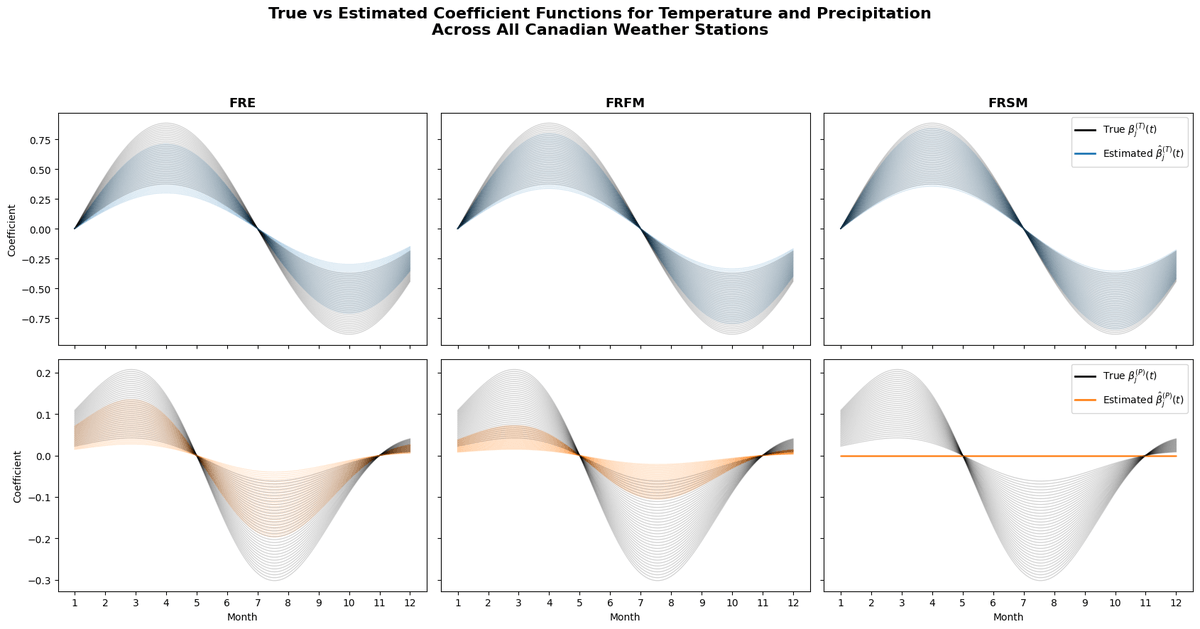
The empirical application models Montreal's annual mean temperature from temperature and precipitation trajectories at 34 other Canadian stations, using 35 years of data. Pairwise correlations between temperature predictors exceed 0.97, which is exactly the pathology the framework is designed for. FRFM automatically identifies temperature as the dominant block and precipitation as nuisance, applies weak shrinkage to the former, and comes out with the lowest mean IMSE for both variables (0.0023 for temperature, 0.0008 for precipitation), well below FRE (0.0191, 0.0036) and FRSM (0.0491, 0.0082).
When to reach for which estimator
The paper is a theoretical and simulation contribution and does not ship a code release, so anyone wanting to use these estimators will need to reimplement them on top of an existing P-spline library. That said, the recipe is straightforward: cubic B-splines, second-order difference penalty, GCV on a log grid from 10^-4 to 10^4, and the iterative reweighting scheme for adaptive partition discovery. The practical takeaway is a simple decision rule:
- Small sample or severe multicollinearity where variance control dominates: use FRSM.
- Moderate to large samples with heterogeneous predictor relevance: use FRFM.
- Uniform-signal problems where partitioning offers no leverage: FRE remains a stable baseline.
The core limitation is that FRFM depends on reliable partition recovery. When the sample is very small and correlations are extreme, it can misclassify nuisance predictors as relevant and inflate variance, which is exactly when FRSM's more aggressive approach wins. The framework does not do explicit variable selection, so sparse-interpretation use cases where you need a hard yes/no on each predictor are outside its scope.