
LSS Framework Pushes Multi-Agent AI Past the Complexity Ceiling
A new engineering framework treats multi-agent LLM systems as software that rewrites itself at runtime, with three layers to keep the chaos governable.
 Pro
Takeaways
- Paper introduces Loosely-Structured Software, a paradigm for multi-agent LLM systems that self-organize at runtime.
- Three-layer framework tames context entropy, self-organization entropy, and evolution entropy separately.
- Design patterns include Semantic Lens, Router, Mediator, Inheritance Generator, Evolver, and Sandbox Mode.
- On RepoBench-R, Lens plus Index raised Hit@5 from 0.70 to 0.84 versus a single worker.
- Framework reinterprets OOP concepts like classes and inheritance in a semantic, runtime-generated space.
- No code release: this is a design vocabulary, validated through one benchmark and a self-hosted research workflow.
Anyone who has tried to scale an LLM multi-agent system past a handful of agents has felt the same wall: adding more agents adds more failures, not more capability. A new paper argues that the fix is not smarter prompts or bigger models, but a fundamentally different way of thinking about the software itself. The authors introduce Loosely-Structured Software (LSS), a framework for engineering agentic systems where structure, bindings, and even the code are generated at runtime.
Why multi-agent systems keep hitting a ceiling
The core observation is that capability does not scale linearly with the number of agents. In practice, larger teams amplify errors and coordination overhead, and prototypes that dazzle in demos hit a complexity ceiling in production. The paper reframes this as an engineering problem rather than an intelligence problem, arguing that agentic software has a core property traditional software does not: runtime generation and evolution under uncertainty.
To make that concrete, the authors identify three coupled forces that break classical software assumptions:
- View-Constructed Programming: an agent's effective program is a step-specific slice of prompts, skills, tools, and memories projected into its context window at runtime, not code encapsulated at build time.
- Runtime Semantic Binding: component connections form dynamically through natural-language interpretation rather than fixed function signatures.
- Endogenous Evolution: the files that determine behavior (skills, plans, routing rules) are themselves rewritable by the system while it runs.

Three layers of entropy to tame
The heart of the paper is a three-layer framework that reframes engineering as managing three kinds of runtime entropy. Each layer targets a specific failure mode that emerges as agent counts grow.
- View/Context Engineering governs what information lands in an agent's context window each step. The failure mode is two-sided: too much information causes attention dilution, while too little causes reasoning breaks.
- Structure Engineering governs how agents and artifacts bind to each other at runtime. Failures here look like binding to the wrong tool, missing a suitable capability, or over-binding to too many candidates and drowning in metadata.
- Evolution Engineering governs the lifecycle of self-rewriting artifacts. The tricky part is that a patch that helps the current task can quietly degrade the whole system, causing what the authors call knowledge rot and long-term drift.
Design patterns for fluid systems
Borrowing vocabulary from object-oriented programming but reinterpreting it in a semantic space, the paper defines a catalog of patterns. A Semantic Lens retrieves and assembles a compact view from a large artifact pool. A Semantic Router forwards a message to the most suitable agent. A Mediator concentrates messy negotiation in its own context, then hands two clean child agents an explicit contract to execute against.
An Inheritance Generator forks a child agent with only the minimal trajectory it needs, keeping the parent's context uncontaminated. And an Evolver continuously monitors traces and proposes reviewable patches to the artifact set, gated through sandboxed A/B replays before anything is promoted to persistent state. There's also a striking reframing of file systems as generated structures: rather than handing an agent a fixed hierarchy, the system produces a task-specific index.md that the agent navigates by semantic intent.

Does the framework actually help?
The authors validate two of the patterns, Semantic Lens and Index Generator, on RepoBench-R, a code retrieval benchmark. Three configurations were compared against the same DeepSeek model with a top-5 candidate budget:
| Configuration | Hit@5 | Top-1 Accuracy |
|---|---|---|
| Worker-only | 0.70 | 0.10 to 0.12 |
| Lens + Worker | 0.78 | 0.10 to 0.12 |
| Lens + Index + Worker | 0.84 | 0.10 to 0.12 |
Adding the Semantic Lens raised Hit@5 from 0.70 to 0.78, and adding the Index Generator pushed it to 0.84. The Worker's average input dropped from 1543 to around 1400 tokens because it no longer ingests the full candidate pool. The trade-off is honest: total token cost increases because selection is externalized into additional agent calls, though the indexing cost is amortizable if index packages are persisted and reused.
Top-1 accuracy stayed flat around 0.10 to 0.12 across variants, so the mechanisms broaden coverage of the correct evidence but do not solve the harder ranking problem.
Where this is useful, and where it isn't
LSS is a design language, not a runnable framework, and the authors are upfront about this. It is complementary to existing stacks like LangChain, AutoGen, and MetaGPT rather than a replacement. The framework earns its keep when you are building systems with dozens of agents, thousands of skills, or long-horizon workflows that need to keep improving across sessions.
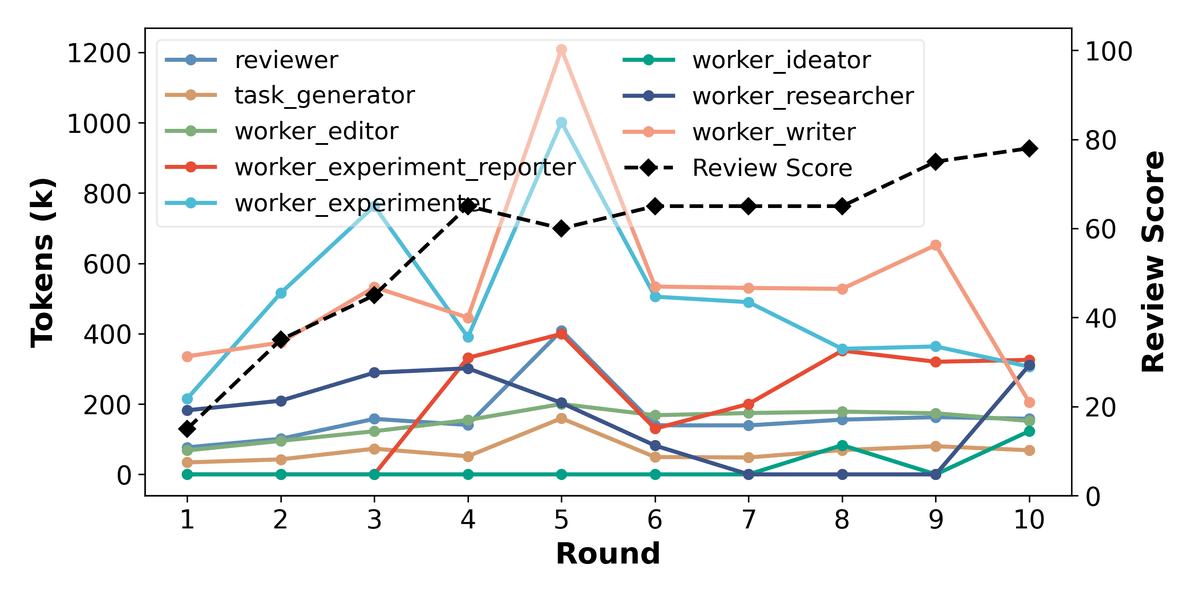
It is less relevant if you are wiring up a deterministic three-step pipeline where prompt tuning and a stable orchestrator do the job. And no code repository is released with the paper: this is a vocabulary and set of principles, backed by one benchmark experiment and one self-hosted research environment where the authors had their LSS workflow attempt to reproduce the paper itself in a fully automated loop over 10 rounds.
The deeper bet in this work is that the line between using a system and developing it is dissolving. If most executable behavior is synthesized at runtime, engineering shifts from writing the program to designing the conditions under which the program continually rewrites itself.