
LR-AVSE Trains Speech AI Using Language Model Critiques, Wins 96.7% Human Preference
A new framework replaces scalar training losses with natural language speech quality feedback from an audio LLM, then converts it into a reinforcement learning reward.
 Pro
Takeaways
- LR-AVSE uses an audio LLM's natural language quality description as a PPO reward for speech enhancement.
- SALMONN generates the description; a BERT sentiment model converts it to a 1-5 score.
- The reward is the score difference between the RL policy and the frozen AVSEC-4 baseline.
- On AVSEC-4 test data, PESQ rises to 1.57 versus 1.45 for the supervised baseline.
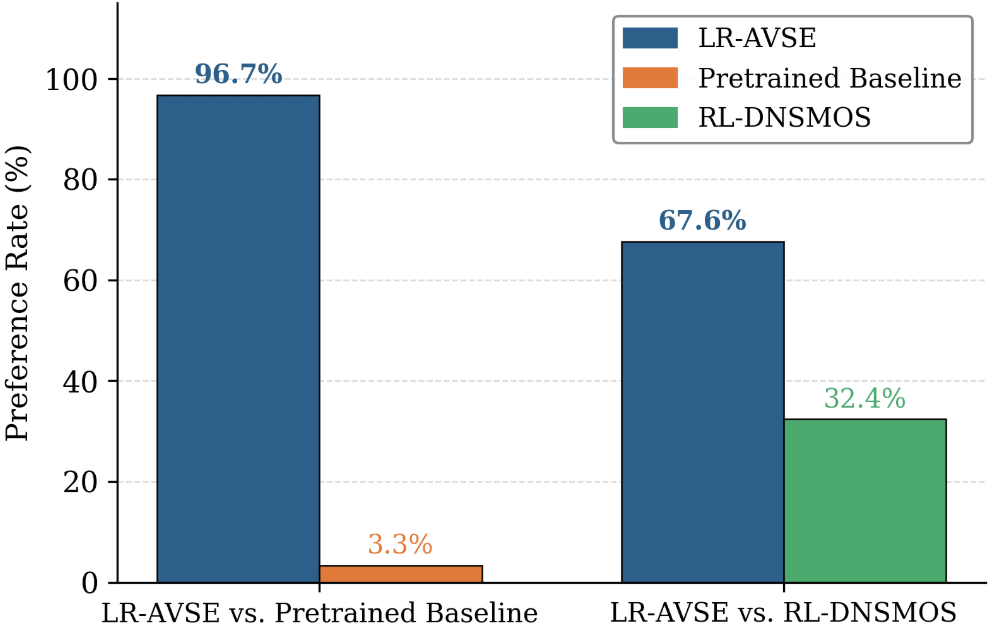
- Human A/B tests preferred LR-AVSE 96.7% over the baseline and 67.6% over an RL-DNSMOS variant.
- Main limitation: SALMONN's repetitive vocabulary limits how finely the reward can rank similar samples.
Training a speech enhancement model to produce audio that sounds good to humans has always been an awkward proxy problem. Researchers optimize signal-to-noise ratios and hope the numbers translate to something listeners actually enjoy. A team from National Taiwan University, Academia Sinica, and UC Irvine is proposing a different path: let an audio-capable large language model describe how the speech sounds, then use that description as the training reward.
Their framework, called LR-AVSE, is described in a new paper and is, to the authors' knowledge, the first attempt to convert LLM-generated natural language quality assessments into a reinforcement learning signal for audio-visual speech enhancement.
The mismatch between loss functions and ears
In existing Audio-Visual Speech Enhancement (AVSE) methods, objectives such as Scale-Invariant Signal-to-Noise Ratio (SI-SNR) and Mean Squared Error (MSE) are widely used; however, they often correlate poorly with perceptual quality and provide limited interpretability for optimization. A model can push SI-SNR higher while still introducing artifacts or unnatural distortions that a human immediately notices.
Prior workarounds like MetricGAN tried to approximate metrics such as PESQ directly inside a GAN discriminator, but those metrics themselves are imperfect stand-ins for perception. Reinforcement learning approaches using predicted MOS scores from models like DNSMOS or NISQA are closer to human ratings, but they collapse everything into a single opaque number.
Turning a speech critique into a reward
LR-AVSE starts from the pretrained backbone provided by the 4th COG-MHEAR AVSE Challenge (AVSEC-4), an encoder-separator-decoder network that fuses noisy audio with visual features from the speaker's face. Instead of continuing to train it against SI-SNR alone, the authors wrap it in a PPO loop with a two-stage reward model.

The reward pipeline works like this:
- The enhanced speech is fed to SALMONN, an audio LLM prompted with "Give me an assessment of the quality of this speech sample".
- SALMONN returns a natural language description such as "clear and easy to understand" or "distorted and muffled with a lot of background noise."
- A multilingual BERT sentiment classifier maps that text to a score from 1 to 5.
- The reward passed to PPO is the difference between the score for the RL policy's output and the score for the frozen base policy's output on the same input.
Because the mask predicted by the enhancement network is deterministic, the authors inject Gaussian noise into it to give PPO the stochasticity it needs to explore. They also keep the original SI-SNR loss alongside the RL objective and add a KL penalty against the base policy to prevent the model from wandering too far during fine-tuning.
What the numbers show
Evaluation on the AVSEC-4 test set, which uses real recorded room impulse responses from conference rooms rather than the simulated ones seen in training, compares LR-AVSE against the supervised pretrained baseline and against the same RL pipeline using DNSMOS as the reward.
| Method | PESQ | STOI | NISQA | VQscore | S-BERT |
|---|---|---|---|---|---|
| Noisy input | 1.31 | 0.55 | 0.97 | 0.58 | 0.55 |
| Supervised baseline | 1.45 | 0.48 | 0.99 | 0.61 | 0.54 |
| RL-DNSMOS | 1.54 | 0.57 | 1.15 | 0.62 | 0.56 |
| LR-AVSE | 1.57 | 0.58 | 1.29 | 0.62 | 0.57 |
The subjective test is more striking. In an A/B preference test with 21 participants, LR-AVSE achieved a 96.7% preference rate over the pretrained baseline and 67.6% over RL-DNSMOS. The paper also shows that when SALMONN's textual reward improves by +1.79 on a sample, PESQ moves by +0.38 and STOI by +0.02, suggesting the language-based signal tracks the objective metrics rather than diverging from them.

The real breakthrough and where it falls short
The genuinely new idea here is not "RL for speech enhancement", it is treating a language model's prose as a differentiable-enough training target. Because the reward comes with a written explanation, engineers debugging a model can read why one sample scored higher than another rather than staring at a scalar MOS estimate.
The limitations are honest and specific. SALMONN produces repetitive phrasing, cycling through variants of "the audio is distorted and muffled" or "the quality of this speech sample is good." That vocabulary ceiling caps how finely the reward can distinguish between similar-quality outputs. The authors suggest stronger LLMs and structured prompts asking about clarity, noise level, timbral naturalness, and loudness stability as the next step.
For teams working on hearing aids, video conferencing, or any downstream task where perceived quality matters more than raw distortion metrics, the recipe is portable: swap in any audio LLM, any sentiment or scoring head, and reuse the PPO-with-relative-reward setup on an existing enhancement backbone. No code repository was released alongside the paper, but the AVSEC-4 baseline weights the authors fine-tune from are publicly available through the challenge organizers.