
Loyola Study Finds Scientists Fine-Tune AI Models 72% of the Time
An automated LLM pipeline scanned 17,718 open-access papers to reveal how scientists actually reuse pre-trained deep learning models in their research.
 Pro
Takeaways
- First empirical study of pre-trained model reuse across 17,718 natural science papers from four mega-journals.
- 1,837 papers reused PTMs; adaptation dominates at 72%, deployment 17%, conceptual just 3%.
- Biochemistry, Genetics and Molecular Biology leads all fields with 1,529 PTM-reusing papers.
- Over 61% of PTM usage sits in the Test stage of the scientific workflow.
- Automated pipeline used gpt-5.4-nano to classify papers against a four-tier reuse hierarchy.
- Early-stage uses like hypothesis generation and observation barely register, signaling untapped opportunity.
Training a serious deep learning model from scratch is out of reach for most working scientists. The GPUs, the labeled data, the engineering time. So natural scientists have been quietly doing what software engineers have done for years: grabbing something pre-trained off the shelf and bending it to their problem. A new study from Loyola University Chicago and Purdue is the first to actually measure that behavior at scale, and the results give a surprisingly clear picture of where pre-trained models (PTMs) are landing in science, and where they are not.
The team built an automated pipeline that pulled 17,718 peer-reviewed open-access papers from four mega-journals (BMJ, F1000, FrontiersIn, and PLOS) between 2000 and 2025, then used a large language model to classify each one along a four-tier hierarchy: does it use deep learning, does it reuse a PTM, which model, and which reuse pattern.
Three ways scientists reuse a model
The paper leans on a taxonomy from prior software engineering work that splits PTM reuse into three patterns:
- Conceptual reuse: taking an architecture from a paper and reimplementing it from scratch.
- Adaptation reuse: taking an existing pre-trained model and fine-tuning or adapting it to a new task.
- Deployment reuse: taking a PTM and running it in a new environment or framework, without changing the weights.
Of the 6,956 candidate natural science papers that made it through filtering, 4,662 (66.96%) were classified as utilizing deep learning methods, and of those, 1,837 (39.40%) were identified as reusing PTMs.

Adaptation is eating everything else
The distribution across the three patterns is not close. Of the 1,837 papers reusing PTMs, 1,329 leveraged adaptation, 50 leveraged conceptual, and 318 leveraged deployment reuse. That is roughly 72% adaptation, 17% deployment, 3% conceptual. In other words, when a biologist or chemist reaches for a PTM, they are almost always fine-tuning something that already exists rather than reimplementing an architecture from a paper.
The authors argue this makes sense as a cost story. Scientists leverage adaptation to realize the benefits of DL methodologies without incurring the prohibitive financial and computational costs of training models from scratch, effectively treating Hugging Face and similar registries as reusable scientific infrastructure.
Biology is way ahead
Broken down by field, the fields with the most PTM reuse are Biochemistry, Genetics and Molecular Biology (1,529 papers), Neuroscience (624 papers), and Agricultural and Biological Sciences (600 papers). Biochemistry is not only the largest cumulative user, it also shows the steepest annual growth curve. Physics, chemistry, and environmental science are all rising, but they are years behind the biology cohort.
PTMs live in the results section
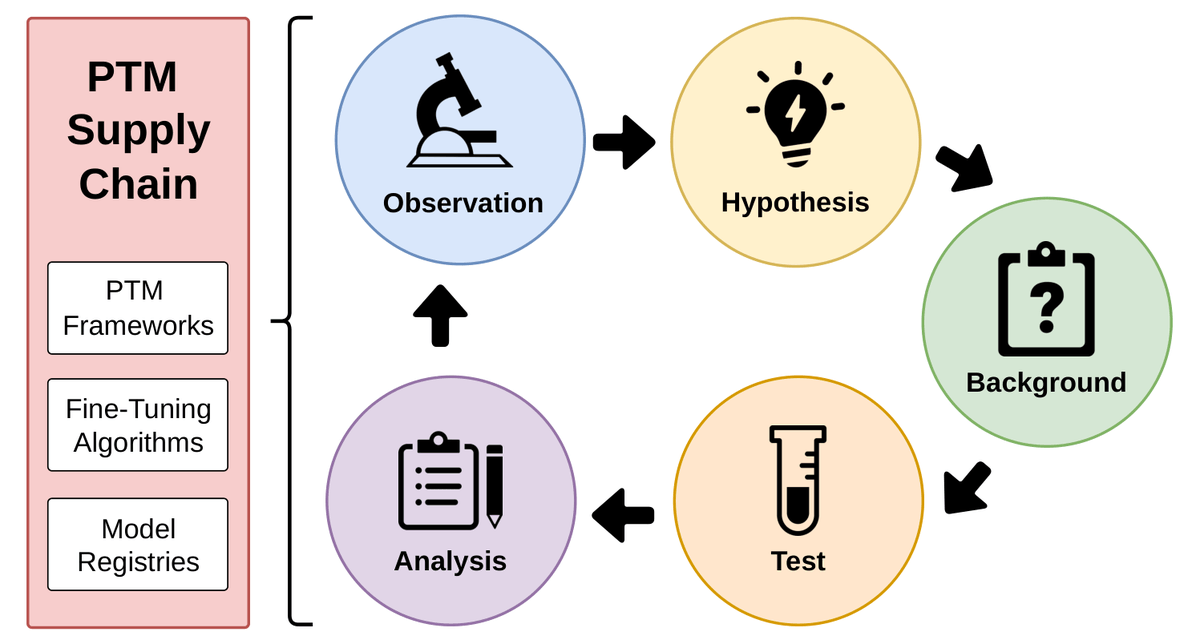
The second research question is more interesting: where in the actual scientific process do these models get used? The authors mapped paper sections onto the hypothetico-deductive framework (observation, hypothesis, background, test, analysis) and let the LLM classify each PTM mention.
The answer is skewed. Of the 1,837 papers reusing PTMs, 265 (14.42%) leveraged PTMs in the Analysis stage, 115 (6.26%) in Background, 5 (0.27%) in Observation, 55 (2.99%) in Hypothesis, and 1,123 (61.13%) in the Test stage. Over 60% of PTM usage is concentrated in testing, which the paper argues suggests PTMs are currently utilized as evaluative or benchmarking instruments rather than as foundational components of early stage experimental design.
What is actually new here
The headline finding is less about a specific number and more about the shape of PTM adoption in science. Model reuse is real, it is dominated by fine-tuning existing weights, and it is concentrated at the tail end of the pipeline where scientists are already sitting on experimental data and need an inference engine. Early-stage uses like hypothesis generation and experimental design barely register.
Methodology caveats worth knowing
A few things temper the results:
- The LLM classifier itself is a source of error. The authors note that they specifically used gpt-5.4-nano which has limited reasoning capacity compared to top-tier frontier models, and prompts were tuned until agreement with manual labels hit 90%.
- The corpus is restricted to four open-access mega-journals, which skews the sample toward biology and away from communities that publish elsewhere.
- Reporting bias is a real threat: scientists using an LLM to help design a study rarely write that down in the methods section.
Still, this is the first attempt to put actual numbers on a trend that everyone has felt anecdotally. The dataset mapping literature to reuse patterns is being released alongside the paper, which should make it easier for follow-up work to look at agentic reuse, code-level integration, and the fields the mega-journals miss.