
Los Alamos Cuts Subsurface Pressure Prediction Errors by 64% Wiring Physics Into AI
A neural network learns to invert underground permeability from pressure readings by backpropagating through a differentiable Darcy flow simulator, cutting pressure errors in half.
Takeaways
- Physics-informed ML method embeds a differentiable Darcy flow simulator into neural network training for permeability inversion.
- Cuts pressure inference errors by 33-64% across eight data scenarios compared to purely data-driven baseline.
- Permeability accuracy is comparable between methods; the win comes from physics-consistent pressure predictions.
- Particularly strong on rare, high-consequence events sampled via large-deviation-theory importance sampling.
- Fast inference at deployment (single MLP pass); simulator only used during offline training.
- Code available at Extreme-Reservoir-Characterization; limited to 2D single-phase steady-state flow.
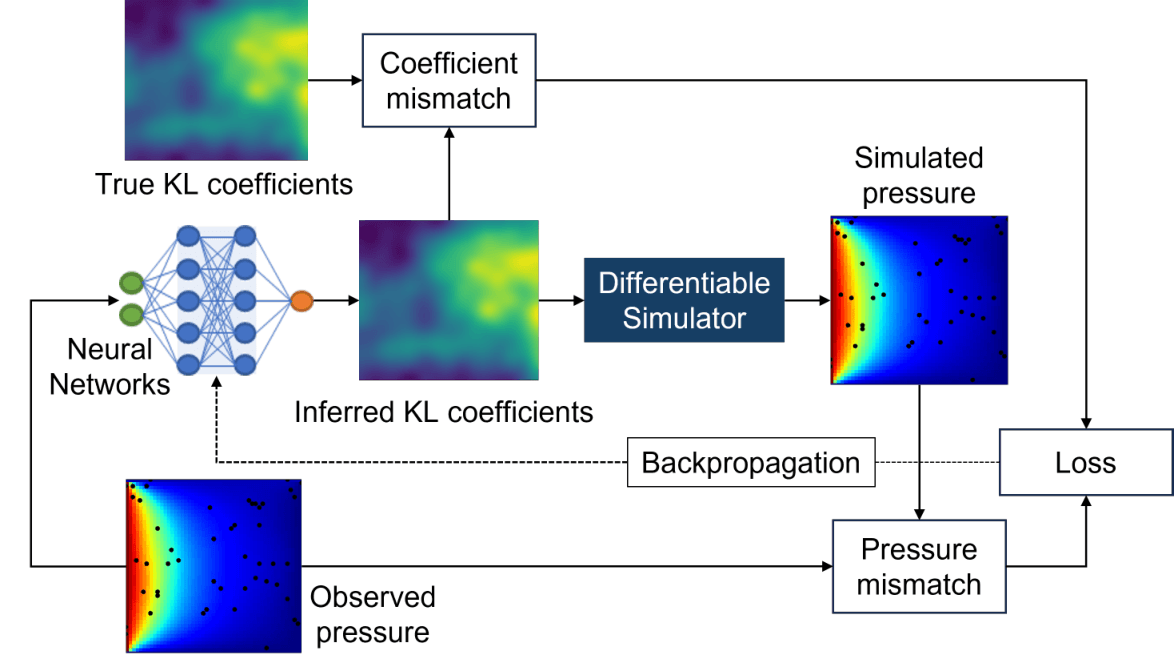
Figuring out what rock actually looks like a kilometer below the surface is one of the harder inverse problems in engineering, and it matters more every year as operators inject CO2, hydrogen, and wastewater into formations they can only observe through a handful of pressure sensors. A new study from Los Alamos and NYU wires a physics simulator directly into a neural network's training loop, so gradients flow back through Darcy's equation itself.
The resulting surrogate model infers heterogeneous permeability fields from sparse pressure observations while remaining consistent with fluid-flow physics. The paper reports that pressure inference errors drop by 33% to 64% across eight data scenarios compared to a purely data-driven baseline, with the biggest gains coming exactly where classical methods struggle most: rare, high-consequence pressure events.
Why permeability inversion is a nightmare
Reservoir characterization estimates subsurface properties like porosity, permeability, and fluid saturation from indirect measurements. The authors point out that this matters for pressure management, geothermal extraction, and gas storage, but it is fundamentally hard because subsurface formations are highly heterogeneous, uncertain, and governed by multiscale physics, while observations come from a few exploratory wells.
The traditional playbook has two moves, and both are expensive:
- History matching, where physics simulators are calibrated to reproduce observed pressures. Accurate, but computationally intensive and impractical for uncertainty quantification.
- Bayesian inversion with MCMC sampling, which handles uncertainty properly but needs thousands of forward simulations to converge.
Pure ML surrogates are fast at inference time but tend to learn statistical interpolation rules that break outside the training distribution and can violate the governing PDEs. Physics-informed neural networks (PINNs) try to fix this by adding a PDE residual term to the loss, though they run into trouble on strongly heterogeneous fields with sharp spatial gradients, which is exactly the setting that matters here.