
LMU Munich's GDR-Learners Give AI Full Treatment Outcome Distributions With Statistical Guarantees
GDR-learners bring doubly-robust, asymptotically optimal training to generative models for causal potential outcome distributions, outperforming all existing baselines.
 Pro
Takeaways
- New framework: GDR-learners are the first generative models for potential outcome distributions with provable Neyman-orthogonality (double robustness + quasi-oracle efficiency).
- Model-agnostic: Works with normalizing flows, GANs, VAEs, and diffusion models -- any generative model with a log-likelihood or ELBO objective.
- Two-stage training: Stage 1 estimates nuisance functions (propensity score + outcome distribution); Stage 2 trains the target model with the doubly-robust GDR loss.
- Key guarantee: Nuisance estimation errors only appear as a second-order product term, so a slow propensity model is compensated by a good outcome model and vice versa.
- Empirical wins: GDR-CDMs achieve best Wasserstein-2 on synthetic data; GDR-CNFs outperform IPTW baselines in 61% of ACIC 2016 runs under model restriction.
- Open source: Full code and hyperparameter configs at github.com/Valentyn1997/gdr-learners.
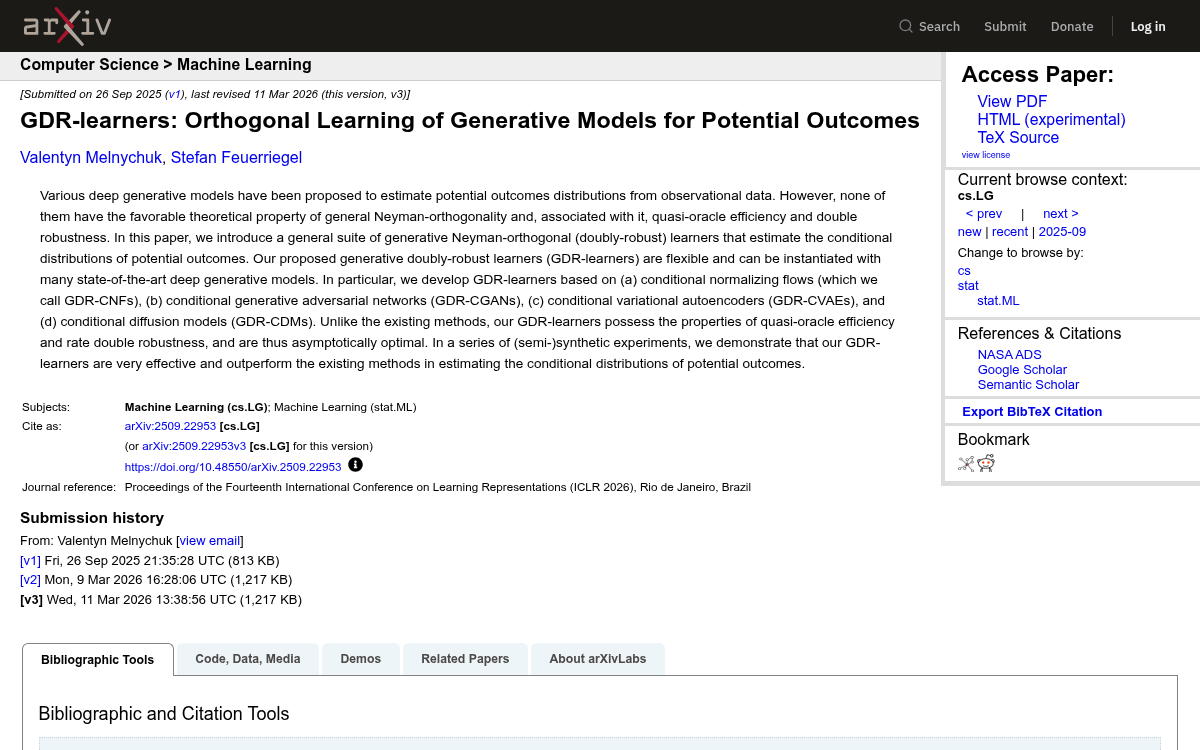
Causal machine learning has long been able to predict the average outcome of a treatment. But averages hide a lot. A cancer drug might shrink tumors in 70% of patients and cause severe side effects in 30%. A clinician who only sees the mean effect is flying blind. The real target is the full conditional distribution of potential outcomes (CDPOs) -- the entire probability distribution of what would happen to a specific patient under each treatment option. Researchers at LMU Munich have now published GDR-learners, a framework that, for the first time, brings the gold-standard statistical property of Neyman-orthogonality to generative models trained on this harder target.
Why the average is not enough
When you train a model to predict potential outcomes from observational data (hospital records, clinical trials, economic datasets), you face a fundamental problem: you never observe both outcomes for the same individual. A patient either received the drug or they did not. This missing-data structure means your model must rely on two imperfect "nuisance" estimates: the propensity score (how likely was this patient to receive treatment, given their covariates?) and the conditional outcome distribution (what is the distribution of outcomes for treated patients with these characteristics?). If either estimate is wrong, the error bleeds directly into your final model.
Most existing generative approaches -- including GANITE, NOFLITE, and DiffPO -- use either plug-in losses or inverse-propensity-weighted (IPTW) losses. None of them have the favorable theoretical property of general Neyman-orthogonality and, associated with it, quasi-oracle efficiency and double robustness. This is a significant gap, because Neyman-orthogonality is the property that makes an estimator's training objective first-order insensitive to errors in those nuisance estimates.
To understand why this matters: Neyman orthogonality ensures that small errors in the estimation of nuisance components do not significantly bias the final estimate. Specifically, the estimation procedure is first-order insensitive to small perturbations in the nuisance parameters. Without it, a slow or slightly wrong propensity score model can corrupt the entire downstream generative model, no matter how expressive it is.
The GDR-learner framework
The core idea is to construct a training loss for any generative model such that errors in the nuisance functions only appear at second order -- their product -- rather than at first order. This is achieved via a one-step bias correction of the regression-adjusted (RA) learner using the efficient influence function of the target risk. The resulting loss is the GDR (Generative Doubly-Robust) objective.
Training proceeds in two stages:
- Stage 1 (Nuisance estimation): Train a conditional generative model to estimate the conditional outcome distribution
ξ_a(y|x), and separately train a classifier to estimate the propensity scoreπ_a(x). - Stage 2 (Target model training): Freeze the nuisance models and use their outputs to optimize the GDR loss for the target generative model. The nuisance model weights are updated with exponential moving average (EMA, λ=0.995) to stabilize training.
The GDR loss combines an IPTW-weighted term (using the propensity score) with a regression-adjusted term (using the conditional outcome distribution), so that if one nuisance estimate is poor, the other compensates. This is the essence of double robustness: consistency holds as long as at least one of the two nuisance models converges at a reasonable rate.

Four flavors, one framework
The GDR-learners are flexible and can be instantiated with many state-of-the-art deep generative models. In particular, the authors develop GDR-learners based on conditional normalizing flows (GDR-CNFs), conditional generative adversarial networks (GDR-CGANs), conditional variational autoencoders (GDR-CVAEs), and conditional diffusion models (GDR-CDMs). The framework is model-agnostic by design: any generative model that can be trained with a log-likelihood or ELBO objective can be plugged in.
Here is a minimal sketch of how the GDR loss is computed for a normalizing flow:
# Pseudocode for GDR-CNF second stage
for x, a, y in dataloader:
    # Nuisance outputs (frozen from stage 1)
    pi_hat = propensity_model(x)          # P(A=a | X=x)
    xi_hat_samples = outcome_model.sample(x, a, n=1)  # samples from P(Y | X=x, A=a)
    # IPTW term: observed treated/untreated
    iptw_weight = (a == treatment) / pi_hat
    log_prob_obs = flow.log_prob(y, context=x)
    # RA correction term: integrate over nuisance outcome distribution
    log_prob_cf = flow.log_prob(xi_hat_samples, context=x)
    # GDR loss (Eq. 8 from paper)
    gdr_loss = iptw_weight * log_prob_obs + (1 - iptw_weight) * log_prob_cf
    loss = -gdr_loss.mean()
    loss.backward()
The theoretical guarantees
The paper proves two key theorems. First, the GDR loss satisfies Neyman-orthogonality: its cross-derivative with respect to the nuisance functions and the target model is exactly zero at the optimum. Second, this implies two practical properties:
- Quasi-oracle efficiency: Even if the nuisance models converge slowly (at rate
o(n^{-1/4})), the target generative model converges as if the true nuisance functions were known. The nuisance errors only appear as a higher-order (squared) term. - Rate double robustness: Rate double robustness compensates for a slow convergence speed of one of the nuisance functions with a fast convergence of another. Formally, the error bound is proportional to the product of the two nuisance errors, not their sum.
This is a strict improvement over all prior work. Double robustness means consistency is attainable if either outcome regressions or propensity scores are consistently estimated, as error propagation is at worst second order in the product of errors. Previous generative methods for CDPOs had no such guarantee.
What the experiments show
The authors evaluate across four benchmarks, comparing 16 model variants (four generative architectures times four meta-learner types: plug-in, IPTW, RA, and GDR).
- Synthetic data (noisy moons, d_y=2): GDR-learners achieve the best Wasserstein-2 distance as dataset size grows, with GDR-CDMs performing best at n=2000 and n=4000. The asymptotic advantage is clear.
- ACIC 2016 (77 semi-synthetic datasets, d_y=82, d_x=82): In the restricted model setting (where GDR-orthogonality is most relevant), GDR-CNFs outperform plug-in learners in over 51% of runs and IPTW learners in over 61% of runs.
- HC-MNIST (n=70,000, d_x=784+1): GDR-learners consistently outperform other learners for the majority of generative models and treatment arms in a high-dimensional confounding setting.
- Colored MNIST (image outcomes, d_y=300): GDR-learners better preserve digit shapes in generated counterfactual images, demonstrating scalability to high-dimensional structured outputs.
One important nuance: on the IHDP100 dataset, which has severe overlap violations (some patients have near-zero probability of receiving one treatment), the RA-learner actually outperforms GDR. This is expected -- IPTW-based methods are theoretically sensitive to poor overlap, and GDR inherits this weakness. The paper is transparent about this limitation.
When should you use this?
GDR-learners are the right tool when:
- You need the full distribution of potential outcomes, not just the mean -- for example, to quantify tail risks or multi-modal treatment responses.
- You are working with observational data where treatment assignment is confounded by measured covariates.
- You want theoretical guarantees on asymptotic optimality, especially when your nuisance models (propensity score or outcome model) may not be perfectly specified.
- You need to impose fairness or interpretability constraints on the target model class -- GDR-learners maintain Neyman-orthogonality even when the target model is restricted, whereas IPTW-learners lose it.
They are less suitable when overlap is severely violated (propensity scores near 0 or 1), or when you only need the conditional average treatment effect (CATE) rather than the full distribution. In those cases, simpler meta-learners like the DR-learner or R-learner may be more stable.
What is now possible
Before this work, there was no principled way to train a generative model for CDPOs with the same statistical guarantees that the causal inference community has long enjoyed for scalar treatment effect estimators. These techniques yield robust and efficient performance, maintaining accuracy when representation constraints, model misspecification, or low overlap would otherwise undermine causal inference. The GDR framework closes this gap and is explicitly designed to be extended -- the authors note it provides a foundation for future work on Neyman-orthogonal generative learners in time-varying treatment settings.
Code for all four GDR-learner variants is available at github.com/Valentyn1997/gdr-learners, with YAML files for reproducing all reported hyperparameters. The implementation uses PyTorch and Pyro, and runtime overhead versus single-stage methods is roughly 2x -- a reasonable price for asymptotic optimality.