
LMU Munich's EffCre Brings Uncertainty Estimates to Frozen CLIP and TabPFN
A new post-hoc method applies credal uncertainty sets to frozen foundation models like CLIP and TabPFN, cutting training costs by orders of magnitude
 Pro
Takeaways
- New method: EffCre builds credal uncertainty sets (ranges of plausible probability distributions) from a single frozen model using logit perturbation -- no retraining needed.
- Key unlock: First credal prediction method applicable to foundation models like CLIP, SigLIP, and TabPFN, where ensemble retraining is infeasible.
- Speed: Training time drops from ~21,000 seconds (ensemble baselines) to ~2,136 seconds -- a 10x reduction, using only 1 model vs. 20.
- How it works: Shifts class logits within a relative-likelihood budget (alpha), solving 2K small convex optimization problems to find probability interval bounds per class.
- Trade-off: Slightly lower OOD detection AUROC than ensemble methods (~0.885 vs ~0.957 on SVHN), but competitive on coverage-efficiency Pareto fronts.
- Code released: Open-source implementation works on any model exposing logits; includes new credal spider plot visualization for multi-class uncertainty.
Every time a machine learning model makes a prediction, it returns a single probability distribution -- a confident-sounding answer even when it probably shouldn't be. The field has long known this is a problem in high-stakes settings like healthcare or autonomous systems, but the solutions have always been expensive: train an ensemble of 10 or 20 models, run Bayesian inference, or use specialized architectures. A new paper from LMU Munich flips that approach on its head, delivering richer uncertainty estimates from a single frozen model with no retraining required.
The technique, called Efficient Credal Prediction through Decalibration, targets a specific and powerful form of uncertainty representation called credal sets. Instead of outputting one probability distribution, a credal predictor outputs a set of plausible distributions -- essentially saying "the true answer lies somewhere in this range" rather than committing to a single number. The width of that range encodes how much the model doesn't know (epistemic uncertainty), separate from the inherent randomness in the data itself (aleatoric uncertainty).
Why Standard Uncertainty Methods Fall Short
To understand the problem, it helps to know the two types of uncertainty that matter in ML. Aleatoric uncertainty is irreducible noise -- a blurry image is inherently ambiguous no matter how much data you have. Epistemic uncertainty is the model's ignorance -- it doesn't know because it hasn't seen enough examples. Standard probabilistic classifiers capture the first type but completely ignore the second. A model trained on cats and dogs will output a confident probability even when shown a photo of a wolf it has never encountered.
The accurate representation of epistemic uncertainty is a challenging yet essential task in machine learning, and credal sets -- convex sets of probabilistic predictors -- have emerged as a widely used representation for this purpose. The appeal is clear: instead of pretending you know the answer, you return the full range of answers that are consistent with your training data.
The catch is cost. One popular way of constructing credal sets is via ensembling or specialized supervised learning methods, where epistemic uncertainty can be quantified through measures such as the set size or the disagreement among members. Training 20 models to get one uncertainty estimate is already painful for a ResNet. For a foundation model like CLIP or TabPFN, it is simply not feasible.

The Decalibration Trick
The core insight of the paper is that you don't need to train many models to explore the space of plausible predictions. You just need to systematically perturb the one model you already have. The authors call this decalibration -- the deliberate inverse of probability calibration. Where calibration adjusts a model's outputs to be more accurate, decalibration asks: how far can we push those outputs and still remain statistically consistent with the training data?
The method is grounded in relative likelihood -- a classical statistics concept. A model is considered "plausible" if its likelihood on the training data is at least some fraction alpha (α) of the maximum-likelihood model's likelihood. This defines a budget: you can explore any prediction that doesn't cost you more than a chosen fraction of your training evidence. The resulting set of reachable predictions forms the credal set.
Mechanically, the procedure works by adding a small scalar offset to each class's logit (the raw pre-softmax score) and solving a convex optimization problem to find the extremes of what's reachable. For each class k, this yields a lower and upper probability bound. Together, these bounds define a box-shaped credal set in probability space. The key properties that make this tractable:
- The feasibility region (all logit shifts within the likelihood budget) is a convex set, proven by the authors.
- Finding the upper bound per class reduces to a single convex program -- solvable reliably with standard optimizers.
- Restricting to one-dimensional, class-specific shifts makes the lower bound tractable too, since probability varies monotonically with the shift.
- The method needs only the model's logits -- no gradients, no architecture access, no retraining.
In practice, for K classes, the method solves 2K small convex optimization problems (one for each bound of each class interval) using SciPy's minimize function. The resulting constants are then applied at inference time to any test input.
What This Unlocks
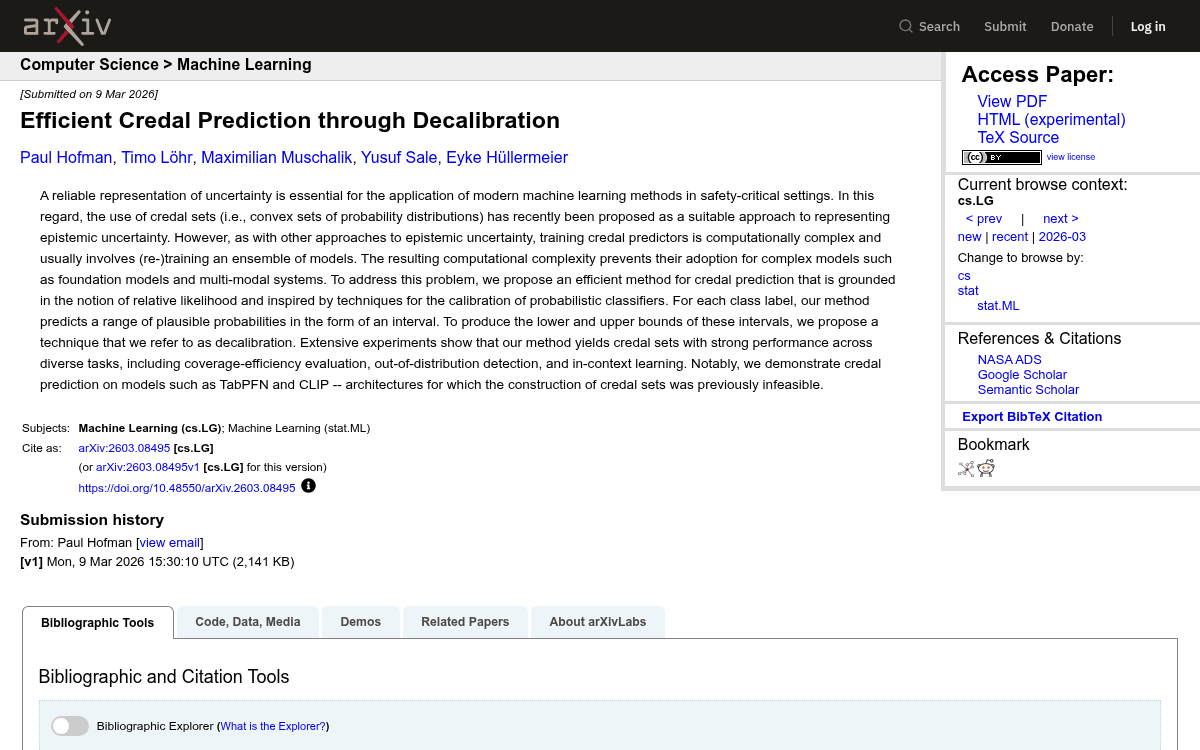
The headline result is not a benchmark score -- it's access. The method enables credal prediction on models such as TabPFN and CLIP -- architectures for which the construction of credal sets was previously infeasible.
The released code demonstrates this on four major model families:
- TabPFN: A transformer foundation model for tabular data that uses in-context learning and never updates its weights. Ensemble-based credal methods can't touch it -- they need to retrain. EffCre applies directly to its logits.
- CLIP, SigLIP, SigLIP-2: Vision-language models used as zero-shot classifiers. The method turns cosine similarity scores into logits and builds credal sets on top, with no access to the original 400M-image training set.
- BiomedCLIP: A biomedical CLIP variant, demonstrating the method works in specialized domains.
- Standard classifiers (ResNet18, MLP): Where direct comparison to baselines is possible.

The Numbers
On standard benchmarks, the method (called EffCre) holds its own against ensemble-based competitors while being dramatically cheaper. The training time comparison on CIFAR-10 is stark:
| Method | Training Time (s) | Inference Time (s) | Models Required |
|---|---|---|---|
| EffCre | 2,136 ± 1.7 | 1.50 ± 0.02 | 1 |
| CreRL | 12,676 ± 413 | 11.46 ± 0.12 | 20 |
| CreWra | 21,363 ± 34 | 11.44 ± 0.19 | 20 |
| CreBNN | 29,797 ± 13 | 12.74 ± 1.1 | 20 |
On coverage-efficiency trade-offs (the primary quality metric for credal sets -- how often the true distribution falls inside the predicted set, versus how tight the set is), EffCre consistently advances the Pareto front over baselines on CIFAR-10 and CHAOSNLI. On out-of-distribution detection, ensemble methods score slightly higher AUROC, but they require 5-20x more training time and are inapplicable to frozen models.
A particularly compelling qualitative result involves CLIP on ambiguous CIFAR-10 images. When shown a ship photographed in a dry dock (an unusual context), the MLE confidently misclassifies it. EffCre's credal set correctly spreads probability mass across ship, truck, and automobile -- reflecting genuine epistemic uncertainty. For an image where human annotators themselves split nearly evenly between cat and dog, the credal set captures that ambiguity even though the MLE picks one answer.
Where It Struggles
The method has real limitations worth knowing. The one-dimensional logit shift (perturbing one class at a time) is a simplification. The fully coupled case -- shifting all class logits jointly -- would produce tighter, more accurate credal sets, but the lower bound optimization becomes non-convex and hard to solve reliably. The authors leave this as an open problem.
On OOD detection, ensemble baselines still win by a meaningful margin when you can afford them. EffCre at α=0.95 scores around 0.885 AUROC on SVHN versus 0.957 for CreWra -- a gap that matters in production systems where OOD detection is safety-critical. The method also requires a calibration dataset to compute relative likelihoods; when the original training data is unavailable (as with CLIP), a proxy dataset is used instead, which introduces some approximation.
Practical Takeaways
This work is most immediately useful if you are working with frozen or API-gated models and need principled uncertainty estimates. The key question to ask is whether you can afford to retrain an ensemble. If you can, existing methods may still outperform EffCre on specific tasks. If you cannot -- because the model is a foundation model, the training data is proprietary, or compute is constrained -- this is currently the only credal prediction method that applies at all.
The active learning experiment with TabPFN is a concrete example of downstream value: by using EffCre's epistemic uncertainty to select which examples to label next, the model converges to full-data performance faster than random sampling across multiple TabArena benchmark datasets. That's a direct workflow improvement for anyone using in-context learning with limited labeled data.
The open-source implementation wraps SciPy's optimizer and works on any model that exposes logits -- which in practice means almost everything. The authors also introduce credal spider plots, a new visualization for credal sets with more than three classes, where each axis represents a class and bars show the probability interval. It is a small contribution but a genuinely useful one for anyone trying to communicate uncertainty to stakeholders beyond a single confidence score.