
LMU Munich's DRQ-Learner Brings Causal Guarantees to Cancer Treatment Sequencing
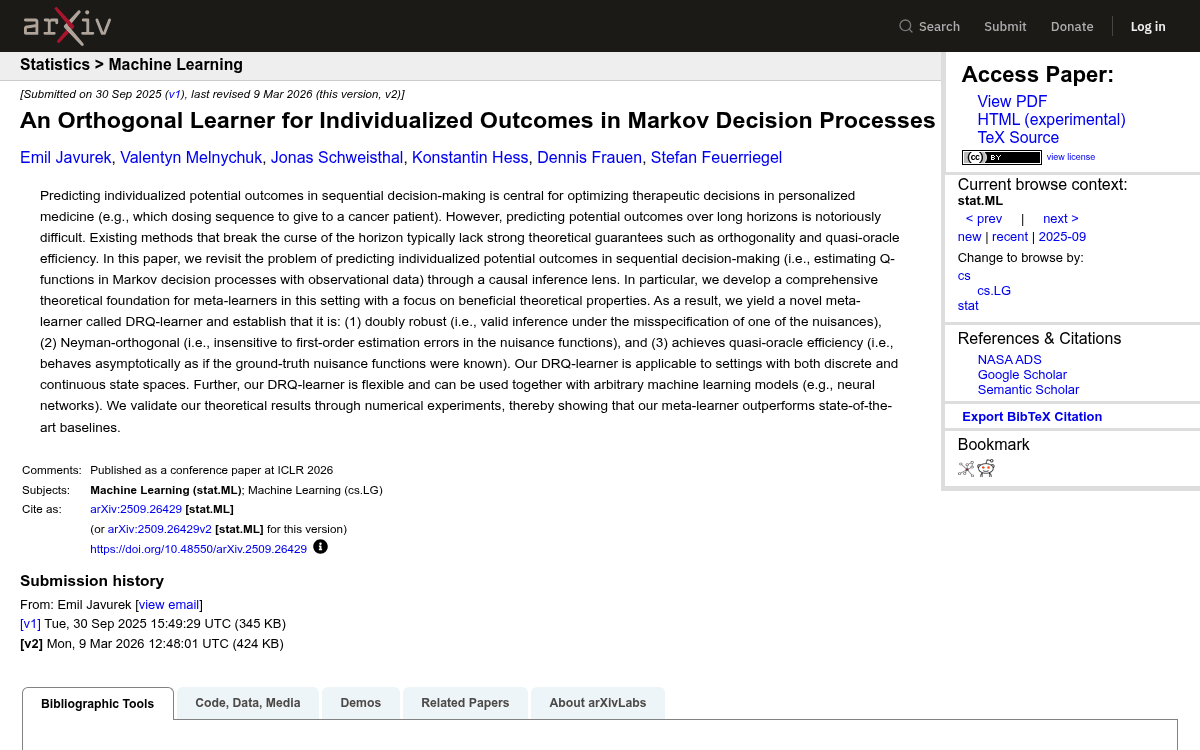
The DRQ-learner is the first meta-learner to simultaneously achieve double robustness, Neyman-orthogonality, and quasi-oracle efficiency for Q-function estimation from observational data in MDPs.
 Pro
Takeaways
- New meta-learner: The DRQ-learner is the first method to simultaneously achieve double robustness, Neyman-orthogonality, and quasi-oracle efficiency for Q-function estimation from observational data.
- Core problem solved: Existing methods for predicting individualized outcomes over long sequential horizons either suffer from the curse of the horizon (IPW-based) or have no theoretical guarantees (FQE).
- How it works: A two-stage procedure -- estimate nuisance functions first, then minimize a debiased Neyman-orthogonal loss -- that cancels first-order bias from imperfect nuisance estimation.
- Model-agnostic: Works with any ML model (neural networks, linear models) and supports constrained model classes for interpretability or fairness.
- Best use case: Observational sequential data with low policy overlap and long horizons -- the exact conditions where existing methods fail most.
- Open source: Code available at github.com/EmilJavurek/Orthogonal-Q-in-MDPs; accepted at ICLR 2026.
Personalizing treatment for a cancer patient is not a single decision -- it is a sequence of them. Which drug, at what dose, for how long, and then what next? The challenge of predicting how a specific patient will respond to an entire sequence of treatments is one of the hardest open problems at the intersection of machine learning and medicine. A team from LMU Munich has now published a paper introducing the DRQ-learner, a new meta-learner that brings rigorous causal inference guarantees to this sequential prediction problem for the first time.
The problem with long horizons
Predicting individualized potential outcomes in sequential decision-making is central for optimizing therapeutic decisions in personalized medicine, but predicting potential outcomes over long horizons is notoriously difficult. The core difficulty has a name: the curse of the horizon. When you want to estimate what would have happened to a patient under a different treatment policy than the one they actually received, you need to reweight the observed data to account for the policy mismatch. The standard tool for this is inverse propensity weighting (IPW) -- essentially dividing by the probability of each observed action.
In sequential settings, IPW suffers from exponentially decaying overlap between trajectories from the observed and evaluation policies, leading to instability from division by near-zero probabilities and making consistent estimation of potential outcomes impossible. The longer the horizon, the worse the problem gets. Existing methods that sidestep this issue -- like Fitted Q-Evaluation (FQE) -- do so at the cost of theoretical guarantees, and are known to have unpredictable failure modes.
What existing methods get wrong
The paper's first contribution is a taxonomy of existing approaches through a causal inference lens. The authors show that the two dominant baselines -- Q-regression and FQE -- are both plug-in learners: they estimate auxiliary (nuisance) functions and plug them directly into the target estimator. This sounds reasonable, but it has a well-known flaw.
Several of the existing baselines correspond to naive plug-in learners, which are known to be biased. Specifically, errors in the nuisance estimates propagate directly into the final Q-function estimate. If your model of the behavioral policy is slightly off, your Q-function estimate is systematically wrong -- and there is no correction mechanism. The paper formalizes this as plug-in bias.
- Q-regression: Uses cumulative importance weights across the full trajectory. Theoretically grounded but suffers from the curse of the horizon.
- FQE (Fitted Q-Evaluation): Recursively fits Q-functions step by step, avoiding the horizon problem. But it has no robustness guarantees and can diverge (the so-called "deadly triad" in RL).
- Minimax Q-learning (MQL): Addresses some limitations but still lacks the full suite of statistical guarantees.
The DRQ-learner: causal inference meets RL
The paper revisits the problem of predicting individualized potential outcomes in sequential decision-making through a causal inference lens, developing a comprehensive theoretical foundation for meta-learners with a focus on beneficial theoretical properties. The result is the DRQ-learner (Doubly Robust Q-learner).
A meta-learner in the causal inference sense is a model-agnostic recipe: it specifies a two-stage training procedure that can be applied on top of any base ML model (a neural network, a random forest, a linear model). The DRQ-learner is the first such recipe for Q-function estimation that simultaneously achieves three properties:
- Double robustness: The estimator remains consistent even if one of the nuisance models is misspecified. You need either your behavioral policy model or your stationary density ratio to be correct -- not both.
- Neyman-orthogonality: The final Q-function estimate is insensitive to small errors in the nuisance functions. Formally, the gradient of the loss with respect to the target is zero at first order in nuisance error. This means imperfect nuisance estimation only affects the result through second-order (much smaller) terms.
- Quasi-oracle efficiency: Asymptotically, the estimator converges at the same rate as if you had access to the true nuisance functions from the start. You pay no statistical price for having to estimate them.
How it works, step by step
The DRQ-learner follows a two-stage procedure. The key insight is that instead of plugging nuisance estimates directly into the identification formula, you use them to construct a debiased loss function -- one whose gradient is insensitive to nuisance errors.
The authors derive the efficient influence function (EIF) of the training loss and use it to construct a debiased second-stage loss that is Neyman-orthogonal. The EIF -- a concept from semiparametric statistics -- captures the first-order sensitivity of a functional to perturbations in the data distribution. By adding the EIF back into the loss, you cancel out the leading-order bias from nuisance estimation.
Concretely, the algorithm runs as follows:
- Stage 1 (nuisance estimation): Estimate three auxiliary quantities from the observational data:
- The behavioral policy
π_b(a|s)-- the probability of each action under the observed policy - The stationary density ratio
w_{e/b}(s'|s,a)-- how likely a state is under the evaluation policy vs. the behavioral policy - A first-pass Q-function estimate
Q̂¹(using any existing method, e.g., FQE)
- The behavioral policy
- Stage 2 (DR adjustment): Minimize the Neyman-orthogonal loss over a model class
G, using the stage-1 estimates as inputs. This refines the first-pass Q estimate by correcting for its bias.
The pseudo-outcomes in the second-stage loss have an intuitive structure: they combine the first-pass Q-function with a temporal difference error term (the Bellman residual R + γ·V(S') - Q(S,A)) scaled by importance-sampling density ratios. This is the same debiasing pattern seen in DR-learners for average and conditional treatment effects -- the paper extends it to the sequential MDP setting.
# Sketch of DRQ-learner usage
# Stage 1: fit nuisances on held-out split
pi_b_hat = fit_behavioral_policy(D_train)
w_hat = fit_stationary_density_ratio(D_train)
Q1_hat = fit_fqe(D_train, pi_e)  # any off-policy Q estimator
# Stage 2: minimize debiased loss on second split
# pseudo_outcome_1 = 2 * (I(A=a)/pi_b) * TD_error + Q1_hat(S, a)
# pseudo_outcome_2 = 2 * (pi_e/pi_b) * w_hat * TD_error + Q1_hat(s, a)
# minimize MSE between g(S, a) and pseudo-outcomes over model class G
Q_DR = fit_second_stage(D_val, pi_b_hat, w_hat, Q1_hat, model_class=G)
A key practical note: the second stage can use any model class G, including restricted ones like linear models. This lets practitioners enforce interpretability or fairness constraints on the final Q-function without sacrificing the theoretical guarantees of the training procedure.
Benchmarks and results
The experiments use the Taxi and Frozen Lake environments from OpenAI Gym, with behavioral and evaluation policies constructed as epsilon-greedy variants of the optimal policy. The authors vary three axes:
- Dataset size: 2,000 to 6,000 trajectories
- Effective horizon: 3 to 20 steps (discount factor γ from 0.66 to 0.95)
- Policy overlap: how similar the behavioral and evaluation policies are
The DRQ-learner is evaluated against Q-regression, FQE, and Minimax Q-learning (MQL) using relative mean squared error (rMSE). The results confirm the theoretical predictions: the DRQ-learner consistently outperforms all baselines, with the largest gains in the two regimes where theory predicts it should shine -- long horizons and low overlap between policies. The advantage holds for both unrestricted model classes and restricted (linear) ones.
The real breakthrough
The DRQ-learner is motivated by central challenges in personalized medicine and reinforcement learning -- namely, the accurate estimation of Q-functions over long horizons, while maintaining strong theoretical guarantees: double robustness, Neyman orthogonality, and quasi-oracle efficiency. What makes this genuinely new is not any single one of these properties -- prior work had achieved some of them in isolation -- but their simultaneous combination in the MDP setting.
The paper also unlocks something that was previously impossible: applying the full machinery of semiparametric efficiency theory to Q-function estimation. This means the DRQ-learner is not just robust in practice -- it is provably optimal in an asymptotic sense. For high-stakes applications like oncology dosing or ICU treatment scheduling, that kind of guarantee matters.
When to use it (and when not to)
Its theoretical properties make it a robust choice for sequential individualized outcome modeling and policy evaluation in both tabular and high-dimensional environments, particularly personalized medicine scenarios requiring robust, individualized counterfactual reasoning. Concretely, the DRQ-learner is most valuable when:
- You have observational (non-experimental) trajectory data and want to evaluate a policy different from the one that generated it
- The evaluation and behavioral policies have low overlap (the setting where IPW-based methods break down)
- The horizon is long (many treatment steps)
- You need interpretable or constrained Q-functions (the model class
Gcan be restricted) - You need statistical guarantees for deployment in regulated settings
The main cost is complexity: the first stage requires estimating the stationary density ratio, which is a non-trivial quantity. The authors acknowledge this, noting that the nuisances are only as complex as the underlying problem demands -- and that simpler-looking methods like FQE hide their complexity in unpredictable failure modes rather than explicit nuisance estimation. The method also requires sample splitting between stages, which reduces effective sample size in small-data regimes.
Code is available at github.com/EmilJavurek/Orthogonal-Q-in-MDPs, and the paper was accepted at ICLR 2026.