
LMU Munich Catches TabPFN Quietly Lying About Treatment Effect Uncertainty
A calibration procedure fixes broken uncertainty estimates when tabular foundation models like TabPFN and CausalPFN are used for treatment effect estimation.
 Pro
Takeaways
- PFN-based Bayesian ATE estimators like TabPFN and CausalPFN suffer from prior-induced confounding bias in their uncertainty estimates
- The implicit prior from synthetic training data shrinks observed confounding toward zero, biasing posteriors even asymptotically
- Proposed MP-OSPC calibration adds a one-step correction using efficient influence functions on top of martingale posteriors
- Proves a semi-parametric Bernstein-von Mises theorem: calibrated posteriors match A-IPTW frequentist intervals asymptotically
- Wins on 77 ACIC 2016 datasets when the base PFN is miscalibrated, and does nothing harmful when it is already calibrated
- Code available at anonymous.4open.science/r/frequentist-pfns, plugs into existing PFN checkpoints without retraining
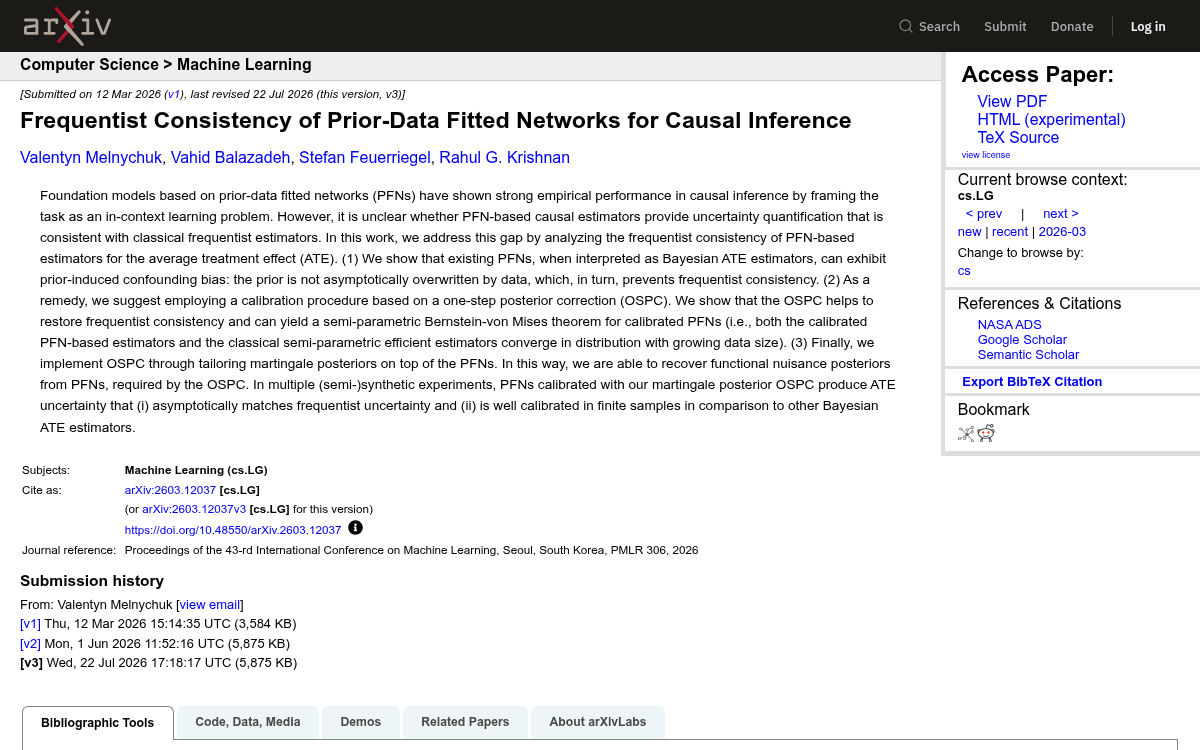
Tabular foundation models like TabPFN have become a popular way to do Bayesian inference in a single forward pass, and several variants such as CausalPFN and CausalFM have been trained specifically to estimate treatment effects. A new paper from researchers at LMU Munich and the University of Toronto shows that the uncertainty these models report is systematically off when used as Bayesian estimators of the average treatment effect (ATE), and proposes a lightweight fix that restores agreement with classical statistical estimators.
The core issue is subtle. Prior-data fitted networks (PFNs) are foundation models that amortize Bayesian inference by pretraining on synthetic datasets sampled from a user-specified prior over data-generating processes. That prior is implicit in the synthetic training data, and it turns out to bias downstream causal estimates in a way more data cannot wash out.
The bias hiding in the training prior
The authors call it prior-induced confounding bias. The PFN's implicit prior (which is learned from synthetic training distributions) can systematically shrink the degree of observed confounding toward zero. As a result, the PFN's posterior is concentrated on nearly unconfounded data-generating processes, so the ATE estimates can be biased even as the sample size grows, which thus prevents the frequentist consistency.
In plain terms: the synthetic datasets used to train models like TabPFN rarely contain the kind of strong confounding that shows up in real observational data. So when you hand these models a confounded dataset and ask for a posterior over the treatment effect, the answer is pulled toward the "no confounding" region of the prior, and the credible intervals lie.
There is a second, more mechanical problem. PFNs only output pointwise posterior predictive densities, one query point at a time. Reconstructing a coherent posterior over the full nuisance function (the outcome model or propensity score) from those pointwise predictions is not unique.

The fix: MP-OSPC
The proposed method, MP-OSPC, combines two existing ideas. First, a one-step posterior correction (OSPC) adds a bias-correction term based on the efficient influence function, the same object that makes the frequentist augmented inverse probability weighting (A-IPTW) estimator asymptotically optimal. Second, a martingale posterior built on top of the PFN, combined with a copula-based smoothing step, recovers coherent posteriors over the full nuisance functions that the correction needs.
The authors prove a semi-parametric Bernstein-von Mises theorem for the corrected posterior. In practice this means:
- Asymptotically, the Bayesian credible intervals converge to the same normal distribution as the classical A-IPTW confidence intervals.
- The correction is a Bayesian version of double robustness: consistency holds even when nuisance functions converge slower than the parametric rate.
- If the underlying PFN was already well calibrated, the correction term is close to zero and does not degrade the estimate.
What the experiments show
On synthetic data with strong confounding (delta around -3.4), MP-OSPC on top of TabPFN aligns with the A-IPTW estimator far better than naive plug-ins from TabPFN or CausalPFN. On 77 semi-synthetic ACIC 2016 datasets, MP-OSPC wins on both asymptotic alignment and finite-sample calibration for most runs when the underlying PFN is TabPFN. On CausalPFN, which was trained with access to counterfactual data, the correction changes little, matching the theory that OSPC is a no-op on already-calibrated models.
One clear limitation: the method degrades on very large training sets (n greater than about 5000), because TabPFN itself struggles to recover propensity scores near 0 or 1 in that regime. It also inherits the overlap requirements of any A-IPTW-style estimator, which makes datasets like IHDP unstable regardless of the fix.
When it is worth using
If you are using a tabular PFN as a black box to estimate a treatment effect and quoting its posterior as a confidence interval, this paper is a warning. The naive credible intervals from CausalPFN in the reported experiments almost never matched the frequentist reference distribution. If you need uncertainty you can defend, MP-OSPC gives you a way to get it without retraining the foundation model, at the cost of running about 100 martingale posterior update steps and 100 posterior draws per estimate.
Code is available at an anonymous repository linked in the paper, and the method plugs on top of existing PFN checkpoints without additional training.