
Liverpool Teaches Robot Chemists to Read Human Intent Using LLaVA
Researchers at Liverpool give lab robots the ability to read human intent, cutting idle time in shared autonomous chemistry labs
 Pro
Takeaways
- The problem: Mobile robot chemists in self-driving labs use only LiDAR, so they freeze whenever a human is nearby, wasting time in time-critical workflows.
- The solution: A two-stage system combining YOLO object detection with fine-tuned LLaVA-1.5-7b to classify whether a human is actively using equipment or just passing by.
- Key results: Fine-tuning alone boosted accuracy from ~30% baseline to 88-94% across three real lab scenarios with 3,270 collected frames.
- Surprising finding: Adding depth/distance data to prompts hurt performance in 2 of 3 scenarios by overcomplicating the model's reasoning.
- Limitation: No code or weights released; data was collected using the paper's own authors, not independent lab workers.
- Next steps: RAG-based context injection, adversarial training, and real user studies planned for future work.
Inside a self-driving laboratory, a mobile robot chemist is mid-task, rolling toward a fume hood to collect a sample. A human researcher is already there, setting up an experiment. Under today's systems, the robot simply stops and waits -- indefinitely -- until its LiDAR sensor stops detecting an obstruction. It has no idea whether the person is about to leave in ten seconds or settle in for an hour. A team at the University of Liverpool wants to fix that.
Their paper, presented at the ACM/IEEE International Conference on Human-Robot Interaction, introduces a two-stage AI perception framework that gives mobile robot chemists (MRCs) the ability to infer what a nearby human is actually doing -- and respond proactively instead of just freezing in place.
The bottleneck nobody talks about
Self-driving laboratories (SDLs) are rapidly transforming research in chemistry and materials science to accelerate new discoveries. The robots at their core, MRCs, are not stationary arms bolted to a bench. They autonomously navigate the lab to transport samples, effectively connecting synthesis, analysis, and characterisation equipment. Think of them as the circulatory system of an automated lab -- constantly moving reagents and samples between instruments.
A synthesis laboratory can be integrated into an autonomous laboratory by using mobile robots that operate equipment and make decisions in a human-like way, combining mobile robots, an automated synthesis platform, a liquid chromatography-mass spectrometer and a benchtop nuclear magnetic resonance spectrometer. These labs are genuinely impressive. But they share a quiet flaw: the instruments within an SDL are typically designed or retrofitted to be accessed by both human and robotic chemists, and in many scenarios, both may need to use the same equipment simultaneously.
The current solution is embarrassingly blunt. MRCs rely on simple LiDAR-based obstruction detection, which forces the robot to passively wait if a human is present. LiDAR (Light Detection and Ranging -- a sensor that bounces laser pulses off nearby objects to measure distance) can tell the robot something is in the way. It cannot tell the robot whether that something is a person who is actively using the equipment or just walking past. The result is unnecessary idle time in workflows where every minute counts.
A two-stage brain for reading the room
The proposed system layers two modules on top of each other. The first is a multimodal perception module; the second is a vision-language reasoning engine. Together, they let the robot move from "something is blocking me" to "a human chemist is actively using the fume hood and I should ask if they need more time."

Here is how it works step by step:
- Perception stage: As the robot navigates, an Intel RealSense D435i RGB-D camera (mounted on the robot base) continuously captures color and depth frames. A YOLO object detector identifies and localizes relevant entities -- human chemists, lab instruments, fume hoods -- and assigns them 3D coordinates in the robot's reference frame.
- Distance calculation: The system computes pairwise Euclidean distances between all detected objects. This tells the model not just that a human is present, but how close they are to the target instrument versus the robot itself.
- Vision-language reasoning: The image, detected class labels, and computed distances are packaged into a structured prompt and fed to LLaVA-1.5-7b -- a multimodal model that can reason over both images and text. The model returns two binary answers: Is the human obstructing the robot's path? Is the human actively interacting with the equipment?
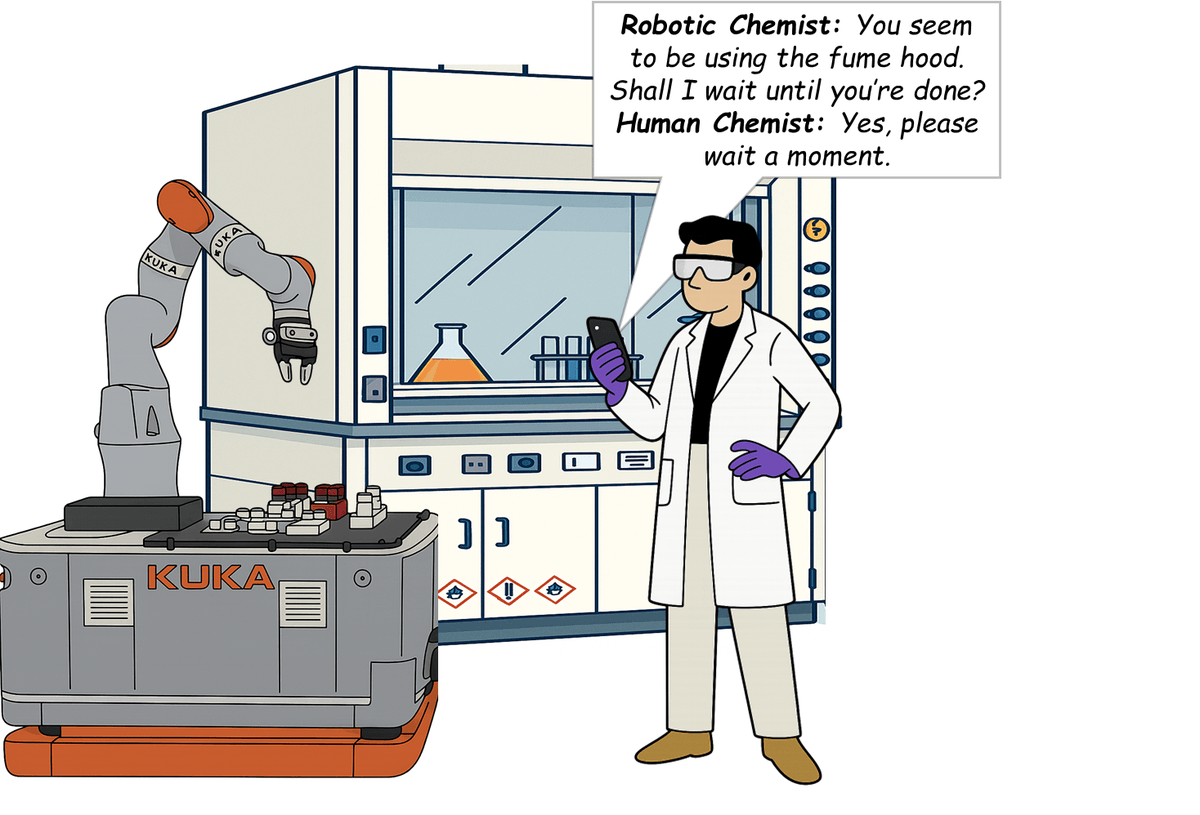
- Proactive interaction: Based on those two answers, the robot decides whether to wait silently, approach and ask a question, or proceed. If the human is both blocking and interacting, the robot generates a natural-language message: "You seem to be using the fumehood. Shall I wait until you are done?"
The key distinction the system learns to make is between preparatory actions (a person walking toward equipment, about to leave) and transient interactions (a person actively engaged with the instrument). That difference is invisible to LiDAR but readable from posture, proximity, and scene context.
What the numbers actually show
The team collected 3,270 paired RGB and depth frames across three real-world scenarios in an operational autonomous chemistry lab, using a KUKA KMR-iiwa robot. The three scenarios were:
- S1: A human chemist blocking the robot's access to its destination equipment
- S2: A human obstructing the robot's path near a fume hood
- S3: Multiple humans present, doing various lab activities
They tested three model configurations: the base LLaVA-1.5-7b with no fine-tuning, the fine-tuned version, and the fine-tuned version augmented with YOLO-derived labels and distance rules. The results after fine-tuning alone were striking -- fine-tuning alone improves performance over the baseline by 59%, 74%, and 47% across the three scenarios, respectively, reaching accuracies of 88%, 94%, and 90%.
The accuracy metric is strict: a prediction counts as correct only when both the obstruction label and the interaction label are simultaneously correct. That makes those numbers more meaningful than they might first appear.
Where it still struggles
Adding depth-based distance measurements to the prompt -- which seems like it should help -- actually hurt performance in two of the three scenarios, dropping accuracy by 18% and 8% respectively. The reason is instructive: incorporating additional information into the prompt increases its complexity, frequently confusing or misleading the model, rather than improving its reasoning across all cases. The model either ignores the distance data or over-relies on it, abandoning visual reasoning that was working correctly.
There are two other recurring failure modes worth noting:
- The model sometimes misreads body posture and orientation, producing wrong interaction labels
- It assumes the robot's target is always directly ahead (center of frame), causing false positives when equipment is off-center and false negatives when a human stands beside -- rather than directly in front of -- the target
The team's proposed fix for the distance-injection problem is retrieval-augmented generation (RAG) -- a technique where relevant context (distance thresholds, lab topology) is retrieved and inserted into the model's context window in a more structured, reliable way, rather than being dumped raw into a prompt.
Why this matters beyond the lab
The real breakthrough here is not the accuracy numbers -- 88-94% is solid for a preliminary study, but not yet production-ready. The more important contribution is the framing of the problem: that robot chemists need a semantic model of human intent, not just a collision-avoidance sensor. Enabling mobile robotic chemists to interpret contextual cues and human intentions supports proactive, socially-aware navigation -- a capability that existing social navigation frameworks, designed for open spaces like hallways, cannot provide in the tight, equipment-dense environment of a chemistry lab.
This methodology is expected to improve operational efficiency by minimising idle time, enabling robotic chemists to dynamically reallocate their attention to other productive tasks. In a lab running closed-loop experiments 24/7, even small reductions in idle time compound into significant throughput gains.
No code or pre-trained model weights have been released alongside this paper. The authors describe this as an initial study, with future work targeting adversarial training for robustness, RAG-based context injection, and comprehensive user studies with real chemists rather than the paper's own authors serving as data collection participants.