
LiveMoments Fixes the Blurry Frames Hiding Inside Every Live Photo
A team from vivo BlueImage Lab and Nankai University proposes a diffusion framework that rescues low-quality alternate frames picked from Live Photos.
Takeaways
- ICLR 2026 paper from vivo BlueImage Lab and Nankai University tackles reselected Live Photo frame quality.
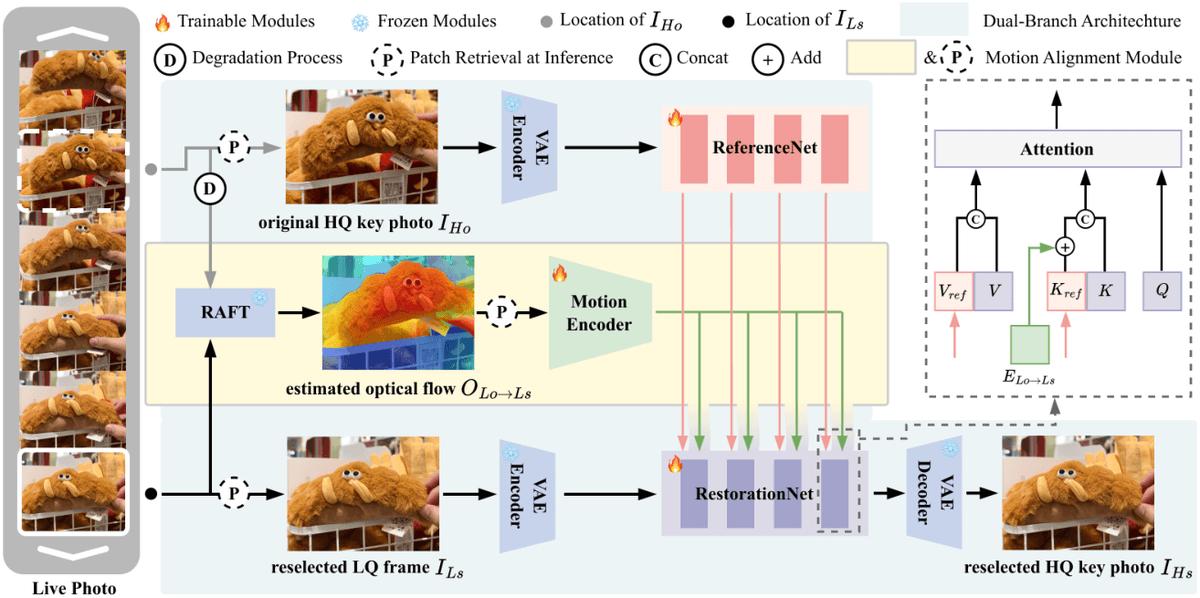
- Dual-branch SD3 architecture with cross-attention transfers detail from the original key photo to the low-quality frame.
- Motion Alignment module uses RAFT optical flow at latent and image levels to handle subject and camera movement.
- Custom flow matching schedule runs inference in 6 steps, 1.89s per 1024x1024 patch on H20 GPU.
- Beats 15 baselines on three new benchmarks (SynLive260, vivoLive144, iPhoneLive90) with 69.62% user study approval.
- Code and benchmarks released Apache-2.0 at github.com/OpenVeraTeam/LiveMoments.
When you tap a Live Photo and swap the still image for a different moment, that new frame almost always looks noticeably worse than the original. A group of researchers led by Clara Xue and Zizheng Yan, working out of vivo BlueImage Lab and Nankai University, dug into why that happens and built a diffusion-based fix for it. Their paper, LiveMoments, is scheduled to appear at ICLR 2026, with code released under Apache-2.0.
The quality cliff hiding inside every Live Photo
A Live Photo bundles two components together: a high-quality key photo captured at the shutter moment, and a low-quality video clip of roughly 3 seconds spanning the surrounding time. LiveMoments is a diffusion-based framework targeting the case where a user reselects a different frame from that clip as the new key photo.
The two components go through completely different processing pipelines. The original key photo runs through the full ISP with advanced enhancements, while the alternative frames come from a compressed, low-latency preview stream and pick up motion blur and sensor noise along the way. Pick a better smile from the video timeline and you inherit all of those artifacts.

Existing reference-based super-resolution work does not cleanly apply. Conventional reference-based image SR restores a low-quality image using a high-quality reference pulled from external databases, whereas this task leverages an in-sequence reference that guarantees content consistency. Reference-based video SR methods, meanwhile, were built around triple-camera smartphone rigs and struggle at 4K. The novelty is treating restoration as a single-frame problem where you happen to have one perfectly-processed sibling frame from the same shutter click.