
Linköping University Proves Smaller LLMs Actively Prefer Broken, Unnatural Translations
A new Swedish benchmark reveals that LLMs reliably prefer stilted, source-language-tainted translations over natural ones — even when they know better.
 Pro
Takeaways
- New benchmark: First freely available English-to-Swedish dataset (600 sentences) contrasting translationese with idiomatic human alternatives, available on HuggingFace.
- Key finding: All tested LLMs (Gemma, EuroLLM, LLaMA variants) prefer stilted, literal translations over natural Swedish phrasing in the majority of cases.
- Source sentence effect: Showing the English source sentence to a model makes translationese bias significantly worse, even with up to 10 sentences of context.
- GPT-5 is better but not a fix: GPT-5 translations are more idiomatic than OPUS-MT, but larger models increasingly prefer GPT-5 output, making the benchmark harder to beat.
- Error taxonomy: Dataset includes fine-grained tags (idiom, slang, grammar, semantic shift, direct translation) to diagnose root causes of translationese.
- Broader implication: If bias is this strong for high-resource Swedish, lower-resource languages are likely worse — a systemic problem for multilingual product teams.
When a language model translates "Poor little thing" into Swedish, it might produce stackars lilla sak , a phrase that literally calls a person an "item," which in Swedish is reserved for objects, not people. The correct, idiomatic phrase would be din stackare. This kind of error has a name: translationese. And according to a new paper from Linköping University, smaller LLMs don't just produce it , they actively prefer it.
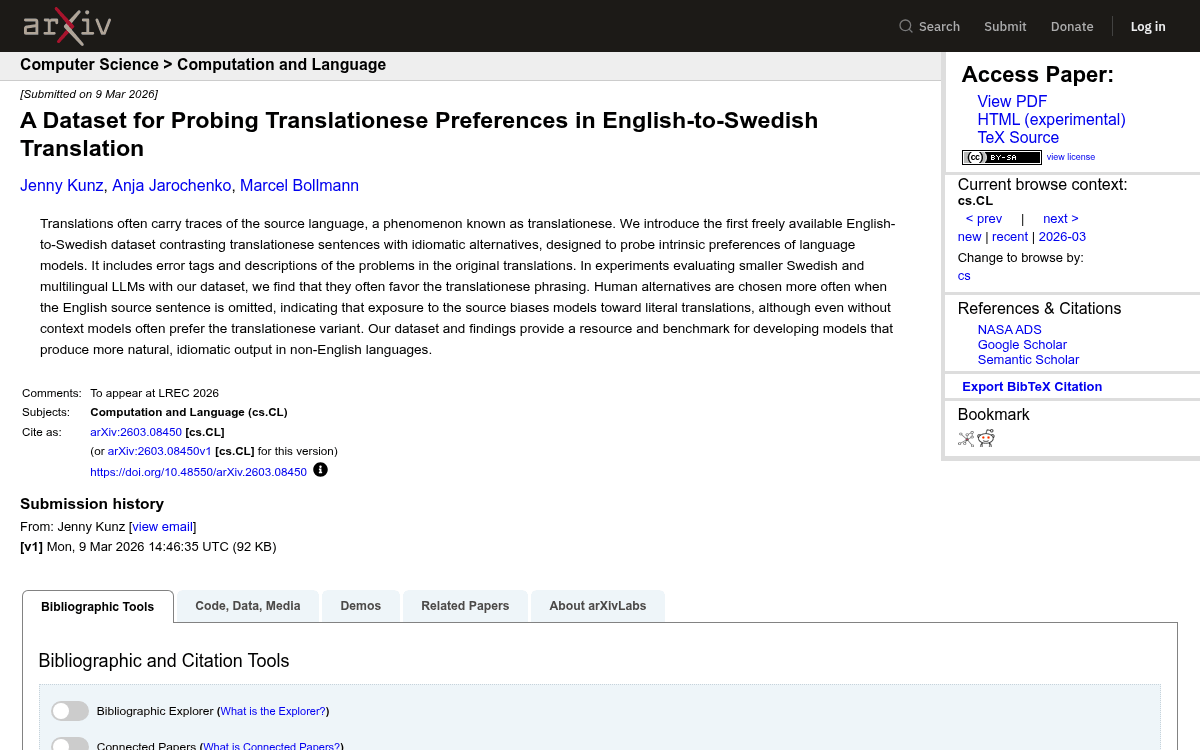
Researchers Jenny Kunz, Anja Jarochenko, and Marcel Bollmann introduce the first freely available English-to-Swedish dataset that explicitly contrasts translationese sentences with idiomatic human alternatives, designed to probe the intrinsic preferences of language models. The dataset and code are available on HuggingFace and GitHub.
The ghost in the machine translation
Translationese is what happens when translated text carries the fingerprints of its source language. Translated texts have long been known to differ in style and features from texts originally written in the target language, and this effect is particularly strong in machine translation, leading to simplified and less varied language marked by reduced lexical and morphological richness. Think of it as the difference between a native speaker saying something and a foreigner who learned the language from textbooks , technically correct, but somehow off.
For many languages, it is common to use translated datasets for LLM evaluation and instruction tuning, as there is often no practical alternative. Large portions of modern web-crawled corpora that constitute the training data of LLMs are also translations. This creates a feedback loop: models trained on translationese data learn to prefer translationese output. Research suggests that supervised fine-tuning introduces biases by prioritizing faithfulness , literal semantic mapping , over fluency.
A subtler effect of this bias is cross-linguistic interference, whereby a language (generally English) influences outputs in other languages. Studies suggest that LLMs may rely on English as a pivot language, and in one experimental setup, 16% of linguistic errors in French and Dutch texts generated by GPT-4 and two smaller LLMs showed clear English influence.
Building the benchmark
The dataset consists of 600 sentences from the English part of OpenSubtitles , a corpus of predominantly spoken dialogue , translated to Swedish with OPUS-MT as a neural (but not LLM-based) translation system, and GPT-5 as a recent LLM. For each sentence, the team provides:
- The original English source sentence with preceding context
- An OPUS-MT machine translation (the translationese variant)
- A GPT-5 translation
- A human-written idiomatic alternative
- Fine-grained error tags explaining what went wrong and why
Each phrase is annotated with up to three tags capturing the type of issue in the OPUS translation. The team introduces tags for major errors , grammar (GR), missing parts (SAK), incorrect word choice (LF), and loss of meaning (BET) , as well as minor issues like semantic shift (SEM) and lexical preference (PR). Descriptive tags like idiom (ID), slang (SL), and direct translation (DIR) mark the root causes of errors.
The choice of subtitles as a domain is deliberate. Spoken dialogue is notoriously hard to translate: it's packed with idioms, slang, and emotional nuance that resist literal rendering. An English phrase like "It's got good bones" (about a house's structure) becomes Den har bra ben in OPUS , literally "it has good legs" , losing the idiomatic meaning entirely.
What the experiments revealed
The core experiment is a minimal pairs probe , a technique where a model is shown two versions of the same sentence and its preference is measured by which one it assigns a higher probability to. The researchers use length-normalized mean log probability to compare the translationese variant against the human alternative, measuring both how often the model prefers the human variant (accuracy) and by how much (delta log probability).
The results are stark. All models evaluated show a bias toward the machine-translated sentences, even for OPUS variants where the translationese wording is obvious. The best-performing model, Gemma-12B-it, only chose the human alternative over the OPUS translation 58.3% of the time , barely above chance , when no translation context was provided.
The team tested seven models across multiple families and sizes:
- AI Sweden LLaMA-3 8B , a Swedish-adapted LLaMA-3 8B
- LLaMA-3 8B , the original, as a baseline
- EuroLLM 1.7B and 9B , open multilingual models covering Swedish
- Gemma-3 270M, 1B, 4B, and 12B , multilingual models across a wide size range
Both base models and instruction-tuned variants were evaluated. Scores increase with model size for both the Gemma and EuroLLM families, and the Swedish-adapted AI Sweden LLaMA scores higher than the base LLaMA-3 8B.
The source sentence trap
One of the most striking findings is what happens when you remove the English source sentence from the prompt. Models favor the translationese phrasing, but human alternatives are chosen more often when the English source sentence is omitted , indicating that exposure to the source biases models toward literal translations, although even without context models often prefer the translationese variant.
Adding more context helps, but only partially. Adding more preceding sentences often leads to a clear improvement in accuracy, suggesting that context helps the model better interpret the intended meaning. Five sentences of context is often the best overall setup. But the bias never fully disappears , even with 10 sentences of context, most models still prefer the machine-translated phrasing in the majority of cases.
The error tag analysis adds another layer. Direct translations (DIR) stand out as strongly overrepresented when translation context is provided , with 54–71% OPUS preference , a sharp increase from the no-context setting, suggesting that context may lead models to translate too literally. Slang (SL) also leads to many errors, particularly with context.
GPT-5 is better, but not immune
The GPT-5 translations consistently have fewer problems than the OPUS translations, with the largest error reductions observed for lexical preference (PR) and missing parts (SAK), indicating that GPT-5 is much better at generating more idiomatic words or phrasings, and less likely to omit words entirely. Annotators judged the GPT-5 translation equally acceptable in about 40% of cases, and even better than the human translation in 6% of cases.
But here's the twist: when models are evaluated against GPT-5 translations instead of OPUS, larger models generally perform worse , as models become more capable, their preference for the GPT-produced translations tends to increase. In other words, bigger models recognize that GPT-5 translations are better, which makes the benchmark harder to beat.
Why this matters beyond Swedish
Swedish is a high-resource language with substantial NLP tooling. If translationese bias is this pronounced for Swedish, the problem is almost certainly worse for lower-resource languages where translated training data is even more dominant. Over 34% of fine-tuning training data examined in related research exhibited translationese, reinforcing unnatural patterns in model outputs.
The practical implications are real. Any team building multilingual products , localization pipelines, customer support bots, content generation tools for non-English markets , is likely shipping translationese to users without knowing it. The dataset provides a concrete way to measure and track this problem.
The dataset is freely available on HuggingFace under a permissive license, with the full annotation code on GitHub. The paper is on arXiv. The current limitations are worth noting: the dataset is limited to 600 sentences from a single domain (subtitles), covers only English-to-Swedish, and focuses on smaller open models rather than frontier systems. Expanding to other language pairs and domains is flagged as the natural next step.