
LimAgents Beats Zero-Shot AI Reviewers by 15 Points on Research Flaws
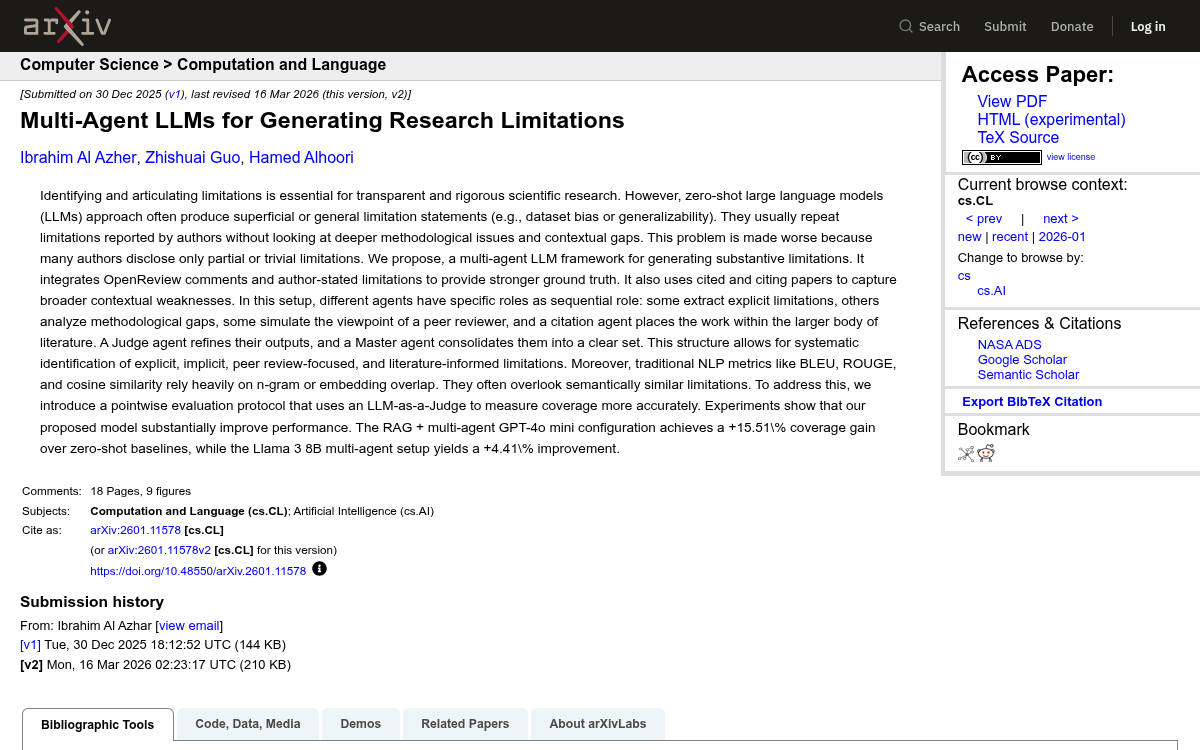
A multi-agent LLM pipeline extracts, infers, and cross-checks scientific paper limitations, boosting ground-truth coverage by up to 15.51 percent over zero-shot prompting.
 Pro
Takeaways
- LimAgents introduces a multi-agent LLM framework for generating substantive research paper limitations beyond generic critiques.
- Agents split work into Extractor, Analyzer, Reviewer, Citation, Judge, Self-Feedback, and Master roles with provenance tags.
- Citation Agent uses hybrid BM25+FAISS retrieval and LLM reranking over cited and citing papers.
- Ground truth merges author-stated limitations with OpenReview reviewer comments across 2,700 NeurIPS papers.
- GPT-4o mini four-agent setup gains +15.51 coverage points, Llama 3 8B three-agent setup gains +4.41 over zero-shot.
- Code and dataset are open on GitHub and Hugging Face.
Ask a chatbot to critique a research paper and you will usually get the same tired list: dataset bias, limited generalizability, needs more experiments. A new framework called LimAgents argues that scientific limitation detection deserves better, and it shows what a small team of coordinated LLM agents can pull out of a manuscript when they work together instead of stuffing everything into one prompt.
Why zero-shot critiques fall flat
The core problem is that authors themselves often bury the important flaws. Ioannidis famously showed that only 17% of top-tier articles mention limitations in the main text and a mere 1% in abstracts or dedicated sections, and in biomedical research, 27% of papers omit any discussion of limitations altogether. When a language model is asked to fill the gap in a single pass, it tends to fall back on vague and generic critiques, such as dataset bias or generalization issues, or simply reproduce author-stated limitations.
That matters more than usual right now because peer review is under strain. ICLR submissions increased by 47% in 2024 and 61% in 2025, and top venues like ICLR and AAAI have started piloting LLM assistance in the review loop. Earlier evaluations of those pilots found LLM reviewers hallucinating details, favoring verbose papers, and even giving positive feedback to empty submissions.
A pipeline of specialists
The authors of LimAgents decompose the task across role-specialized agents that each get their own prompt and their own slice of context:
- Extractor Agent pulls verbatim author-stated limitations from anywhere in the paper, following a chain-of-thought style scan for cue phrases.
- Analyzer Agent acts as a methodological auditor, inferring implicit weaknesses like unaddressed confounders, poor statistical power, or missing corrections for multiple comparisons.
- Reviewer Agent takes an external peer-review stance and probes reproducibility, transparency, and ethical disclosure.
- Citation Agent uses a RAG pipeline over cited and citing papers to surface contextual weaknesses the authors would not admit themselves.
- Judge Agent scores each output on depth, originality, actionability, and topic coverage, and can send weak outputs back for regeneration through a Self-Feedback loop.
- Master Agent merges everything into a deduplicated list with provenance tags like Author-stated, Inferred, Peer-review-derived, or Cited.
The Citation Agent is the interesting part. It uses ScienceParse and the OpenAlex API to gather referenced and citing papers, then builds a per-paper vector store where a hybrid retrieval approach combines sparse (BM25) and dense (FAISS) methods with equal weighting to rank all chunks and select the top 20 candidates. An LLM reranker keeps only chunks scoring 8 or higher for relevance before feeding them to the generator.
Better ground truth, better metric
Two evaluation innovations sit alongside the agents. First, ground truth is not just what authors admit; the team scraped OpenReview and merged reviewer critiques with author-stated limitations across 2,700 NeurIPS papers from 2022 and 2023, ending up with roughly 51,300 limitations. Second, instead of relying on BLEU, ROUGE, or cosine similarity, they introduce a pointwise LLM-as-a-Judge coverage metric that asks, for every ground-truth limitation, whether any generated limitation matches it semantically. A validation study against two human annotators reported agreement scores of 0.98 and 0.95.
What the numbers show
The optimal configuration depends on model size. For GPT-4o mini, the full four-agent setup with the Citation Agent yields the largest jump, and for Llama 3 8B, a leaner three-agent version wins because the smaller model struggles to digest cited-paper context.
| Configuration | Coverage | Gain vs zero-shot |
|---|---|---|
| Llama 3 8B zero-shot | 62.04% | baseline |
| Llama 3 8B, 3 agents | 66.45% | +4.41 |
| GPT-4o mini zero-shot | 49.43% | baseline |
| GPT-4o mini, 4 agents + RAG | 64.94% | +15.51 |
Two subtler findings are worth flagging. Feedback loops are a double-edged sword: on Llama 3 8B, one round of self-feedback improved coverage of the model's own prior points by 8.18 but dropped ground-truth coverage by 12.62, because refinement narrows the model's exploration. And piling on more agents backfires. Pushing the architecture further to nine agents proved counterproductive, causing a significant performance drop of -12.23 points, suggesting there is a sweet spot beyond which agent coordination becomes noise.
What it is good and bad for
The framework is a solid drop-in for anyone building review-assist tooling, journal desk-check systems, or automated critique for internal research documents. It runs without fine-tuning and works with off-the-shelf APIs. Both the code and the dataset are open.
The caveats are real, though. Evaluation is limited to NeurIPS papers and two models, long inputs get truncated for Llama's 8k window, and reasoning-oriented models like DeepSeek R1 Distill Qwen 7B fell over on the long structured prompts. The Gemini 1.5 Flash Extractor also unreliably identified relevant passages, dragging down the whole pipeline. In practice, treat LimAgents as a scaffolding pattern rather than a finished product: the agent roles and pointwise coverage metric transfer cleanly, but you will need to tune prompts and retrieval to whichever model and domain you actually deploy against.