
LEYA's Four-Modality AI Detects Human Hesitation on Camera at 83% Accuracy
A four-modality fusion system with prototype-augmented Transformers pushes ambivalence detection in videos to 71.43% Macro F1 on the ABAW10 private test.
 Pro
Takeaways
- Team LEYA's four-modality system reaches 71.43% Macro F1 on the ABAW10 A/H private test via ensemble.
- Fine-tuned EmotionDistilRoBERTa is the strongest single modality at 70.02% Macro F1.
- Scene + text is the best two-modality pair (80.39%), beating face + text combinations.
- Prototype head with 16 learnable class centroids serves as an auxiliary loss to regularize the fused space.
- Full source code is available on GitHub for reproduction and extension.
- Trained on the BAH corpus: 1,427 videos, 300 participants, 10.6 hours.
Detecting when someone is genuinely uncertain, torn, or hedging on camera is one of the hardest problems in affective computing. Unlike a smile or a frown, ambivalence rarely lives inside a single channel. It leaks out in the mismatch between what a person says, how their voice cracks, and how their face flickers. A new competition submission from team LEYA at the 10th ABAW Workshop takes that observation seriously and builds a four-modality pipeline around it.
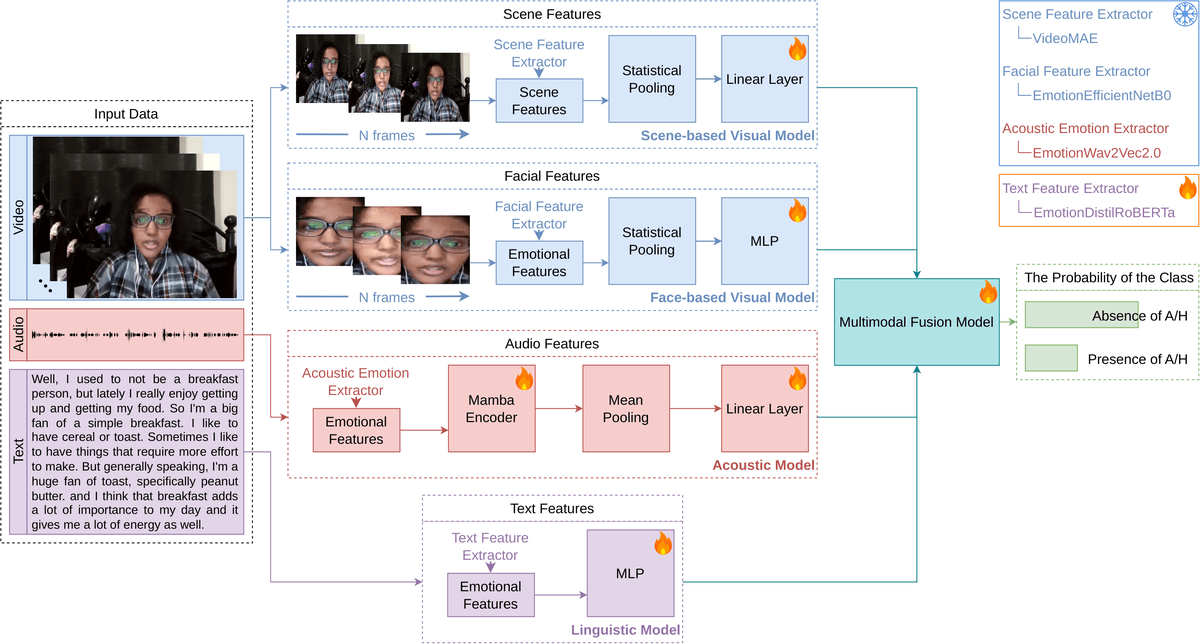
The system, described in a new arXiv paper, fuses scene, face, audio, and text streams through a prototype-augmented Transformer. The best unimodal configuration achieved an average MF1 of 70.02%, whereas the best multimodal fusion model reached 83.25% on the development and public test splits. On the harder private test, an ensemble of five prototype-augmented fusion models topped out at 71.43%.
Why ambivalence is a nasty ML problem
The task lives inside the Ambivalence/Hesitancy (A/H) Video Recognition Challenge. The challenge aims to predict Ambivalence/Hesitancy at the video level, formulating it as a binary classification task where each video is labeled as either containing A/H (1) or not (0). That sounds simple until you look at what triggers those labels. Ambivalence/hesitancy recognition in unconstrained videos is a challenging problem due to the subtle, multimodal, and context-dependent nature of this behavioral state.
The clinical motivation matters. These signals are strongly linked to decision uncertainty, resistance, and fluctuating motivation during behavior change, which is why digital health platforms want to detect them automatically to spot users who are wavering or about to disengage.
The BAH corpus in numbers
Everything is trained and evaluated on the BAH (Behavioural Ambivalence/Hesitancy) dataset. The full corpus contains 1,427 videos from 300 participants, totaling 10.60 hours of recordings. It includes video-level and frame-level expert annotations, timestamps of A/H segments, cropped and aligned faces, speech transcripts with timestamps, and participant metadata. Participants answered a predefined set of questions designed to elicit neutral, positive, negative, willing, resistant, ambivalent, and hesitant responses. The data were collected through an online platform with an avatar-guided interaction setup in order to mimic real-world personalized behavioral interventions.
Evaluation uses Macro F1 at the video level, and the corpus is partitioned participant-wise so no subject appears in both training and test.
Four encoders, one shared latent space
Each modality gets its own specialist model before anything is fused:
- Scene: A VideoMAE-based model processes 16 uniformly sampled frames at 224x224 as spatio-temporal tubelets, capturing overall behavioral dynamics rather than just the face.
- Face: A YOLO face detector crops the largest face per frame, then an EfficientNetB0 fine-tuned on AffectNet+ produces per-frame emotion embeddings. These are collapsed into a single video-level vector via statistical pooling (mean and standard deviation concatenated), which is a compact way to preserve how much the face fluctuates over time.
- Audio: Speech is resampled to 16 kHz and passed through an EmotionWav2Vec2.0 encoder fine-tuned on MSP-Podcast. The resulting sequence is then run through a Mamba selective state-space encoder, which is a linear-time alternative to a Transformer that handles long audio clips more cheaply, followed by mean pooling.
- Text: Provided transcripts feed a fine-tuned EmotionDistilRoBERTa with an MLP head. The team also tested classic TF-IDF with LightGBM and CatBoost as sanity checks.
Each embedding is projected into a shared 128-dimensional latent space and turned into a modality token, with a learnable modality-type embedding added on top. A 6-layer Transformer with 4 attention heads then operates over just four tokens and mixes them via self-attention. Missing modalities are handled via a binary mask so the system degrades gracefully.
The prototype trick
The interesting piece is the prototype head. On top of the fused representation, the model learns 16 vectors per class (present vs. absent) and compares the L2-normalized fused embedding to each of them via a temperature-scaled dot product. Rather than replacing the classifier, this becomes an auxiliary loss term (weight 0.2) that pulls fused representations toward class-specific centroids during training. The idea is to regularize the shared latent space so that ambivalent videos cluster together even when different modalities carry the signal.
What the numbers actually say
The unimodal ranking is a good sanity check on what carries A/H signal:
| Modality | Model | Avg MF1 (dev + public test) |
|---|---|---|
| Text | Fine-tuned EmotionDistilRoBERTa | 70.02% |
| Text | Fine-tuned EmotionTextClassifier | 70.00% |
| Audio | EmotionWav2Vec2.0 + Mamba | 69.03% |
| Text | TF-IDF + CatBoost | 68.79% |
| Face | EmotionEfficientNetB0 + stats pooling | 62.67% |
| Scene | VideoMAE | 61.96% |
Text wins alone, but the ablation reveals a surprise: the strongest two-modality result was obtained by combining scene and text features, with an average MF1 of 80.39%. Scene beats face as a partner to text, presumably because posture and gaze shifts carry hesitancy signals that a face crop misses.
Full four-modality prototype fusion hits 83.25% on the combined dev/public test average. But there is a real gap on the private set: the single best fusion model drops to 65.21% there, while ensembling five prototype-augmented models across different seeds recovers to 71.43%. In other words, this task punishes overfitting, and averaging across seeds is doing a lot of the heavy lifting on generalization.
What is useful and what is not
The gap between 83% average and 71% final test is the honest headline. On unseen participants, the model is much less confident than on the public split, and no single model held up without ensembling. Anyone deploying this in a real behavior-change app should expect similar variance across users, and should budget for ensembles or heavy calibration.
Where the approach is genuinely useful:
- Digital mental health and coaching platforms that want to flag users who are wavering during structured Q&A sessions.
- Interview and survey tooling that needs a lightweight second opinion on whether a spoken answer is confident or hedged.
- Research pipelines studying decision uncertainty, where the modality-masked Transformer makes it easy to add or drop channels without retraining the whole stack.
The full pipeline, including the prototype-augmented fusion head and per-modality encoders, is available on GitHub under the LEYA-HSE organization. Given that competing submissions at the same challenge, such as a divergence-based fusion approach that explicitly measures cross-modal conflict, are converging on similar architectures, the direction feels settled: fuse modality tokens with a Transformer, but bring a regularizer that keeps the shared space honest.