
Leiden University Maps Every Zero-Shot RL Algorithm Into One Unified Framework
A new paper from Leiden University builds the first formal taxonomy for zero-shot RL, giving researchers a shared language to compare methods that were previously incomparable
 Pro
Takeaways
- First unified framework for zero-shot RL: Leiden University paper introduces a formal taxonomy covering all major zero-shot RL methods under one structure.
- Two-axis taxonomy: methods are classified by representation (direct vs. compositional) and learning paradigm (reward-free vs. pseudo reward-free).
- Unified error decomposition: total error splits into three terms -- inference, reward, and approximation -- enabling principled comparisons across methods.
- 15 algorithms mapped: includes SF+GPI, Forward-Backward, USF, PSM, FRE, HILP, and more in a single feature matrix.
- Key insight: all reward-free methods must be compositional -- a mathematical necessity, not a design choice.
- No code released: the contribution is purely theoretical; the paper calls for new dedicated benchmarks to properly evaluate zero-shot methods. [Paper]
Reinforcement learning has a fragmentation problem. Over the last few years, a wave of algorithms has emerged under the banner of "zero-shot RL" -- the idea that an agent should be able to handle any new task immediately after training, without any fine-tuning or planning. But these algorithms have been developed in parallel, using different notation, different assumptions, and different theoretical lenses. Comparing them rigorously has been nearly impossible. A new paper from Leiden University sets out to fix that.
The dream: a foundation model for behavior
Zero-shot RL pushes the unsupervised RL paradigm to its limit: agents must generalize to tasks immediately after pre-training, without any task-specific fine-tuning, planning, or substantial computation. The appeal is obvious. Instead of training a new policy every time you define a new reward, you train once and deploy everywhere. This paradigm has emerged as a possible candidate to train the analogue of foundation models in RL, so-called behavioral foundation models -- an area where RL has historically lagged behind.
Unsupervised zero-shot RL has emerged as a powerful paradigm for pretraining behavioral foundation models (BFMs), enabling agents to solve a wide range of downstream tasks specified via reward functions in a zero-shot fashion, without additional test-time learning or planning. Recent work has even applied this to humanoid robots: researchers trained Meta Motivo, the first humanoid behavioral foundation model that can be prompted to solve a variety of whole-body tasks, including motion tracking, goal reaching, and reward optimization.
A field speaking in different dialects
In recent years, zero-shot RL has received increasing attention, resulting in a diverse set of proposed algorithms. Yet the field remains fragmented: while prior works have offered partial unifying views, some approaches lie outside their scope. The core challenge is that different methods make fundamentally different architectural bets -- some decompose the value function, some don't; some train without any reward signal, some use random rewards as a proxy -- and there has been no principled way to put them side by side.
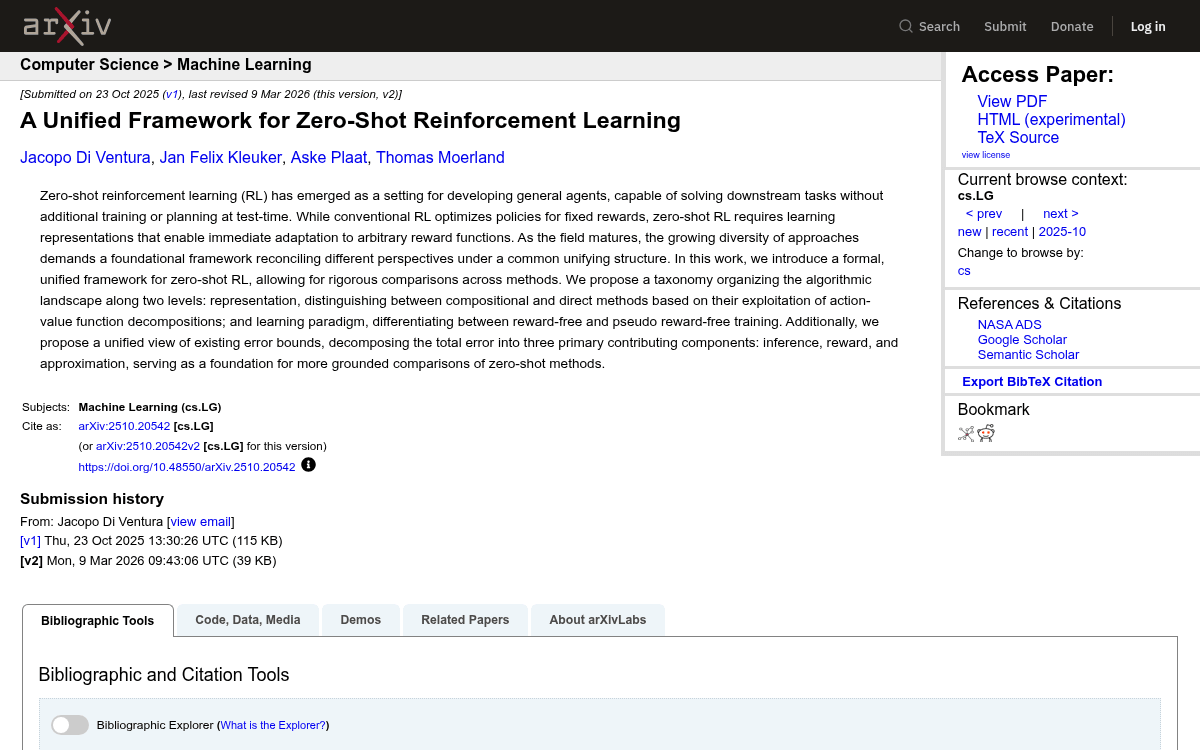
While conventional RL optimizes policies for fixed rewards, zero-shot RL requires learning representations that enable immediate adaptation to arbitrary reward functions. As the field matures, the growing diversity of approaches demands a foundational framework reconciling different perspectives under a common unifying structure.
Two axes that explain everything
The paper's central contribution is a two-level taxonomy that slots every existing zero-shot RL method into one of four quadrants. The first axis is representation; the second is learning paradigm.
On the representation axis, methods are either direct or compositional. Direct methods learn a reward-conditioned value function Q(s, a | r) -- they map states, actions, and reward descriptions straight to values, with no intermediate structure. Compositional methods instead learn a building block μ(s, a) that can be recombined at inference time for any reward, exploiting the mathematical structure of value functions.
The key insight behind compositional methods is the successor representation (SR) -- a concept from neuroscience that tracks how often an agent expects to visit future states. The SR lets you separate the dynamics of an environment from its rewards, so that a single learned representation can be reused across arbitrary reward functions. The paper traces how modern methods like Successor Features, Forward-Backward representations, and Proto Successor Measures all build on this idea in different ways.
On the learning paradigm axis, methods are either reward-free or pseudo reward-free:
- Reward-free: training objectives contain no reward signal at all. The agent learns purely from environment dynamics. Only compositional methods can be reward-free.
- Pseudo reward-free: the agent trains on randomly sampled reward functions that are uninformative of downstream tasks -- a form of self-supervised RL. The hope is that by covering enough of reward space during training, the learned representation generalizes to anything at test time.
The methods, mapped
The paper reviews 15 concrete algorithms and places each one in the taxonomy. Here is a condensed view of the major families:
| Method | Representation | Paradigm | Policy Extraction | Linear Reward Constraint |
|---|---|---|---|---|
| SF+GPI (Barreto et al.) | Compositional | Reward-free | GPI search | Yes |
| USF (Borsa et al.) | Compositional | Pseudo | Forward pass | Yes |
| FB (Touati & Ollivier) | Compositional | Pseudo | Forward pass | Yes |
| PSM (Agarwal et al.) | Compositional | Reward-free | Constrained LP | No |
| FRE (Frans et al.) | Direct | Pseudo | Forward pass | No |
| HILP (Park et al.) | Direct | Pseudo | Forward pass | Yes |
A key observation: all reward-free methods are compositional. This is not a coincidence -- it falls directly out of the math. If you have no reward signal during training, you cannot optimize a value function directly; you can only learn structural building blocks of value functions.
Three sources of error, unified
Beyond the taxonomy, the paper's second major contribution is a unified error decomposition. Every zero-shot method incurs error from three distinct sources, and the paper formalizes all of them under a single framework:
- Inference error: the cost of not being able to perfectly evaluate the decomposition operator at test time. For example, SF+GPI can only search over a finite set of trained policies, so it may miss the optimal one for a new reward.
- Reward error: the mismatch between the true reward and its latent representation. Methods that compress rewards into a fixed-size embedding (like HILP or FRE) pay this cost when the embedding is lossy.
- Approximation error: the gap between the true representation and the learned one, due to finite data and model capacity. Every method pays this.
Formally, for an extracted policy π̃, the error bound takes the shape:
‖Q*_r - Q^π̃_r‖ ≤ C₁ · ε_inference + C₂ · ε_reward + C₃ · ε_approxThis decomposition reveals real trade-offs. Successor Features + GPI eliminate reward error (if rewards are linear in features) but pay inference error because GPI must search over a discrete set of policies. Forward-Backward representations eliminate explicit reward error by not assuming linearity, but pay inference error through the structural assumption that the successor measure factors into two low-rank matrices. Direct methods skip inference error entirely but can pay heavily in reward error when their embedding compresses the reward space.
What this actually unlocks
The practical value here is diagnostic. If you are building a zero-shot RL system and it underperforms, this framework tells you which error term to blame and which architectural choices address it. Some concrete use cases where this matters:
- Robotics: training a single robot policy that can be re-tasked at inference time by specifying a new reward -- no retraining required.
- Multi-task control: pre-training on an offline dataset and deploying across many downstream tasks, as in the Forward-Backward representation line of work.
- Exploration: using zero-shot representations to guide exploration in new environments, since the representation already encodes environment structure.
- Humanoid control: behavioral foundation models for whole-body humanoid tasks are a direct application of the pseudo reward-free compositional paradigm the paper formalizes.
Where it falls short
The paper is a theoretical framework, not an empirical study. It does not run new experiments or introduce a new algorithm. The feature matrix covers 15 methods, but the authors acknowledge it is non-exhaustive. There is also a deeper conceptual issue the paper surfaces but does not resolve: the framework reveals an ambiguity in the definition of zero-shot RL itself. The unified framework for unsupervised RL proposed by Agarwal et al. is most closely related to this work -- they establish a formal equivalence of several unsupervised RL objectives via the successor measure. This framework, by contrast, focuses on structuring the landscape of zero-shot methods by analyzing the implications of various design choices.
Existing benchmarks are also a concern. The paper notes that standard benchmarks like URLB and ExoRL may obscure representation-specific limitations of zero-shot methods, and calls for dedicated benchmarks. Despite promising results, zero-shot policies are often suboptimal due to errors induced by the unsupervised training process, the embedding, and the inference procedure -- exactly the three error terms this framework names, but measuring them cleanly in practice remains an open problem.
The real contribution
What the paper actually delivers is a shared vocabulary. Zero-shot RL has been a field where researchers talk past each other because the same algorithmic idea gets described in five different ways depending on which paper you read. The taxonomy and error decomposition in this work give the community a common coordinate system. That is less flashy than a new state-of-the-art result, but it is often what a maturing field needs most. No code or model is released -- the contribution is entirely conceptual and mathematical.