
Lehigh's RadAgents Beats GPT-4o on Chest X-Rays With an 8B Open Model
Researchers from Lehigh University and Oracle Health AI unveil a multi-agent system that decomposes chest X-ray reading into a radiologist-style workflow, letting an 8B open model beat GPT-4o.
Takeaways
- Researchers from Lehigh University and Oracle Health AI introduce RadAgents for chest X-ray interpretation.
- Seven specialized agents mirror the ABCDE radiology review scheme with an Orchestrator and Synthesizer.
- Visual Retrieval-Augmented Generation (V-RAG) resolves conflicts by retrieving clinically similar X-rays via Rad-DINO embeddings.
- Qwen3-VL 8B backbone hits 74.6% on CheXbench, beating GPT-4o (63.5%) and CheXagent (64.7%).
- Multi-agent design costs 2-3x more compute; latency around 41 seconds per complex query with parallel execution.
- Paper accepted at MIDL 2026; full trajectory logging enables step-level auditing of every diagnosis.
Chest X-rays are the most common imaging exam on the planet, and among the most tedious to interpret. A team from Lehigh University and Oracle Health AI has proposed RadAgents, a multi-agent framework that tries to fix what current AI radiology systems get wrong: opaque reasoning, conflicting tool outputs, and rationales that never actually look back at the image. The paper has been accepted for publication at MIDL 2026.
Instead of asking one big vision language model to stare at a chest X-ray and produce an answer, RadAgents breaks interpretation into seven specialized agents that mirror how radiologists are trained to read films, log every intermediate step, and cross-check each other before committing to a diagnosis.
Why one big model falls short
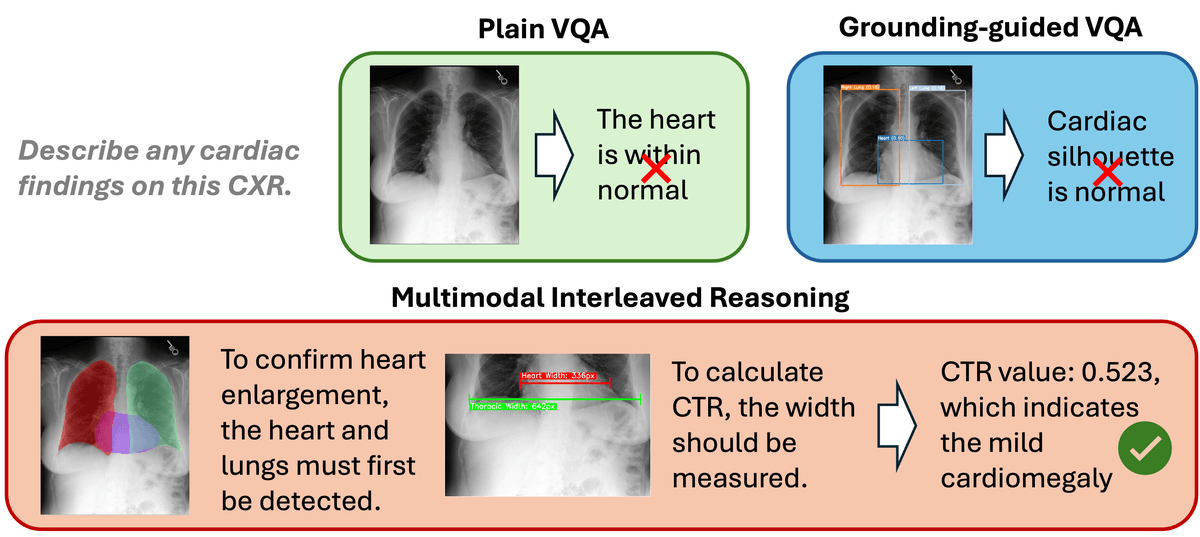
Current agentic systems for chest X-ray (CXR) reading tend to fail in three specific ways. Reasoning is frequently neither clinically interpretable nor aligned with guidelines, multimodal evidence is insufficiently fused (yielding text-only rationales that are not visually grounded), and systems rarely detect or resolve cross-tool inconsistencies. In practice, the model encodes the image once and then reasons entirely in text, which works for simple yes/no questions but breaks down on tasks that require re-inspecting the image, taking measurements, or comparing across time points.
Radiologists reason through structured, domain-specific workflows, moving back and forth between image inspection, measurements, and textual synthesis, refining hypotheses as new evidence arrives. RadAgents encodes that loop explicitly rather than hoping a large model picks it up implicitly.