
Lehigh's DiffShortcut Breaks Every AI Photo Protection Tool 10x Faster
A new red-teaming framework exposes why image protection tools like Glaze and MetaCloak fail, using shortcut learning analysis and one-shot restoration.
 Pro
Takeaways
- New paper diagnoses why protective perturbations like Glaze and MetaCloak succeed: they trigger shortcut learning in fine-tuning.
- Perturbations shift image embeddings out of the "person" region in CLIP latent space, misaligning them with text prompts.
- Proposed framework DiffShortcut combines CodeFormer plus super-resolution purification with Contrastive Decoupling Learning.
- Beats all baselines across seven protection methods on VGGFace2, recovering above clean-training identity and quality scores.
- Runs at 51 seconds per sample with 0.271 LPIPS, roughly 10x faster than prior state of the art IMPRESS.
- Full paper on arXiv with code, configs, and adaptive attack analysis on a single 24GB GPU setup.
Tools that add invisible perturbations to photos, promising to stop AI models from learning your face or art style, have become a small industry. Glaze, PhotoGuard, MetaCloak, and Anti-DreamBooth all claim to poison images so that anyone fine-tuning Stable Diffusion on them gets garbage output. A new paper from Lehigh University argues these protections are more brittle than they look, and the reason is a mechanism nobody had properly diagnosed: shortcut learning.
The work, titled Rethinking and Red-Teaming Protective Perturbation in Personalized Diffusion Models, digs into what actually happens when you fine-tune a personalized diffusion model on protected images, then proposes a purification pipeline that beats every existing baseline while running roughly 10x faster.
The shortcut hiding inside protected images
Personalized diffusion models like DreamBooth work by binding a rare identifier token (something like sks) to a specific subject through a handful of reference images. Protective perturbations exploit this process by adding adversarial noise crafted to maximize the denoising loss during fine-tuning.
The authors' key finding is that these perturbations don't just add noise. They push the image embedding away from its matching text prompt in CLIP's joint latent space. When they visualize clean versus perturbed images with t-SNE, Truncated-SVD, and UMAP, the perturbed portraits drift out of the "person" region entirely and get classified as "noise" by a zero-shot CLIP classifier.

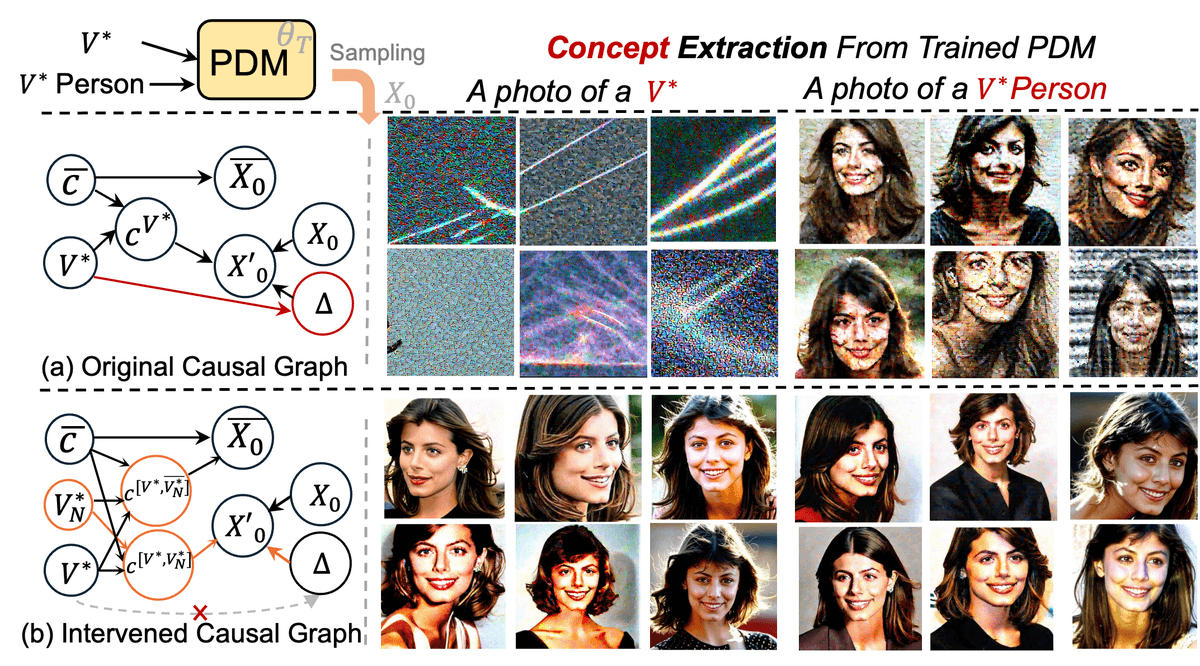
This mismatch creates a fork during training. The model can either link the identifier token to the actual person, which is hard, or to the high-frequency noise pattern, which is easy. Loss minimization takes the easy path. The identifier ends up meaning "noise" rather than "this specific face," which is why generations from protected data look distorted.
Two interventions instead of one
The proposed framework, called DiffShortcut, treats this as a causal problem and intervenes at two points:
- CodeSR purification: A one-shot pipeline that runs CodeFormer (a face restoration transformer) followed by a Stable Diffusion x4 upscaler at 128x128 intermediate resolution. This realigns images with their original semantic content in latent space without the iterative optimization that makes prior methods slow.
- Contrastive Decoupling Learning (CDL): During fine-tuning, the instance prompt gets a suffix like "with t@j noisy pattern," while class-prior prompts get "without t@j noisy pattern." This gives the model a dedicated token to absorb noise, so the identifier is free to learn the actual person.
At inference time, sampling uses classifier-free guidance with a negative prompt ("noisy, abstract, pattern, low quality") to further steer generations away from any residual noise concept.
The numbers
Evaluated on VGGFace2 against seven protection methods (FSMG, ASPL, EASPL, MetaCloak, AdvDM, PhotoGuard, and Glaze), DiffShortcut is the only approach that recovers identity matching similarity and image quality above the clean training baseline in every setting. On efficiency and faithfulness, the gap is stark:
| Method | LPIPS (lower better) | Time per sample |
|---|---|---|
| IMPRESS | 0.451 | 675.0s |
| GrIDPure | 0.429 | 92.8s |
| DDSPure | 0.384 | 122.5s |
| LatentDiffPure | 0.453 | 63.8s |
| DiffShortcut | 0.271 | 51.0s |
Ablations show CDL is the single most important component. Turning it off drops average performance more than removing either the CodeFormer or SR module. The combination of all three is complementary, with CodeFormer handling faces and the super-resolution model covering the rest of the image.

What this means for protection tools
The paper is explicitly framed as red-teaming, and the results should worry anyone relying on current perturbation-based protections. Even MetaCloak, the most robust protection tested, gets bypassed. The authors also test adaptive attacks that target their own pipeline and find the CDL module holds up better than the image restoration components, suggesting future protections need to attack the training process itself, not just the image.
Practical caveats: the evaluation focuses on facial portraits from VGGFace2 and CelebA, with only qualitative demonstrations on WikiArt-style artwork. CodeFormer is face-specific, so applying this exact pipeline to protecting artistic style would require swapping in a different restoration backbone. The full training and inference process fits on a single 24GB GPU, which makes reproduction accessible.
Code is available at github.com/liuyixin-louis/DiffShortcut, along with configuration details for the CodeSR pipeline and the exact noise tokens that worked best in ablations.