
LeCun and Malik Say AI Learns Nothing After Deployment and Propose a Fix
A conceptual blueprint from Dupoux, LeCun, and Malik argues today's models can't truly learn on their own, and proposes a three-system cognitive architecture to fix it.
 Pro
Takeaways
- Dupoux, LeCun, and Malik argue that today's AI models don't actually learn once deployed, with all real learning outsourced to human engineers running MLOps pipelines.
- They propose an A/B/M architecture: System A learns from observation, System B learns from action, System M orchestrates when each engages.
- System M reads epistemic, somatic, and species-specific signals to gate learning, essentially internalizing the human engineer's role.
- The architecture is optimized in two nested loops: an outer evolutionary search over meta-parameters, an inner developmental loop for a single agent's lifetime.
- The paper diagnoses a data wall and "language-centrism" as reasons scaling text-based LLMs alone won't reach autonomous learning.
- No code or model is released; the contribution is a conceptual blueprint plus a call for new simulators and capability-based evaluation.
Modern foundation models look impressive on benchmarks, but they share an awkward secret: once deployed, they barely learn anything. Every improvement comes from a human somewhere aggregating data, tuning losses, and re-running training. A new position paper from Emmanuel Dupoux, Yann LeCun, and Jitendra Malik argues that this is the field's central bottleneck, and it lays out a cognitive-science-inspired architecture for building agents that can genuinely learn on their own.
The learning is happening outside the model
The authors' diagnosis is blunt. Current AI systems "learn essentially nothing" once deployed and their learning "is outsourced to human experts instead of being an intrinsic capability". Everything we call "training" is really a human-run pipeline of data curation, pretraining, fine-tuning, and evaluation, wrapped around an otherwise passive network.
That matters because the industry is running into hard walls. There is a "data wall," where the supply of high-quality human-generated text is becoming exhausted, and a fundamental lack of environmental interaction. Unlike biological organisms, most current AI systems are passive; they process static datasets rather than learning through active engagement with a physical or social world. The authors also call out "language-centrism," which prioritizes linguistic patterns over the spatial, embodied, and grounded reasoning required for real-world interaction. An LLM that has read the internet still fumbles when a robot arm meets a new kitchen.

Three systems that talk to each other
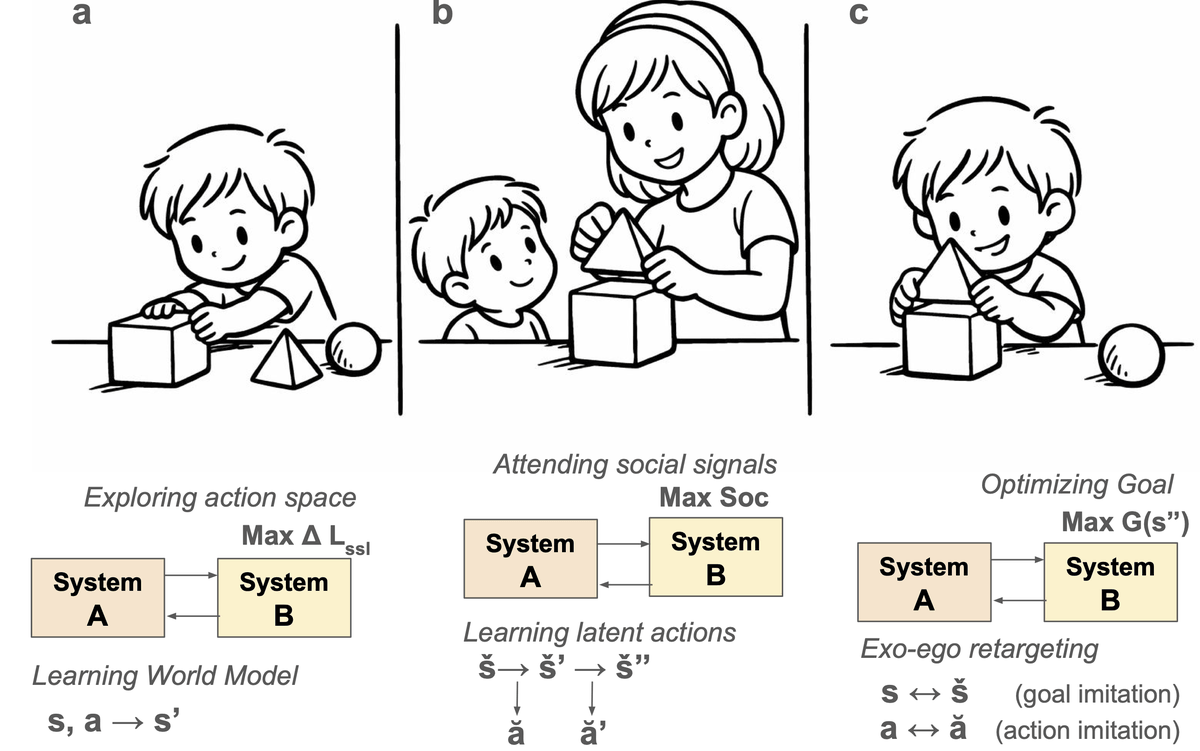
The proposal is a tripartite architecture, deliberately mapped onto how animals learn across evolutionary and developmental time. The authors formalize an architecture comprising System A (learning from observation), System B (learning from action), and a hardwired System M (meta-control orchestrator), all optimized through a bilevel evolutionary-developmental (Evo/Devo) framework.
- System A is the passive learner. It maps onto self-supervised learning: the organism passively accumulates sensory input and learns by building a statistical or predictive model of its input data. The set of learning mechanisms that fall in this bucket is called System A.
- System B is the agent. It maps onto reinforcement learning and control. System B interacts with the environment to drive learning through goal-directed behavior.
- System M is the meta-controller. It doesn't act on the world; it decides when System A should learn, when System B should explore, and how signals should be routed between them.
The interesting part is not any single system, all of which exist in the literature. It's the wiring.
Why observation and action need each other
Both paradigms have shown impressive independent progress, but each hits a ceiling alone. Passive self-supervised learning finds correlations without ever testing them; pure reinforcement learning wanders through high-dimensional pixel spaces trying to bootstrap a policy from scratch.

The paper spells out the two-way street between them. System A helps System B by compressing raw sensory streams into abstract representations, by providing a learned world model the agent can plan inside, and by generating intrinsic rewards from prediction error or novelty when no external reward is available. Going the other way, System B, through active behavior, can help collect better data and provide grounding for learned representations. Acting on the world is how correlations get promoted to causal knowledge: if you want to know whether the switch turns on the light, you have to flip it.
System M: putting MLOps inside the agent
System M is the most distinctive piece. It is the paper's attempt to internalize what human engineers currently do by hand. It reads low-dimensional telemetry from the rest of the system, which the authors group into three families:
- Epistemic signals such as prediction error, uncertainty, or learning progress.
- Somatic signals such as simulated energy levels or "pain" penalties for hardware damage.
- Species-specific signals, hardwired priors like an innate tendency to track faces or looming objects.
Based on those signals, System M issues meta-actions: not motor commands, but internal switches. It might flip the agent from active exploration into a sleep-like consolidation mode, reweight objectives, or route a particular stream of data into System A for focused learning. Concretely, the authors describe System M as a fixed policy that can connect or disconnect A and B on the fly, producing behaviors like imagination (running the world model without acting) or social learning (attending to a reliable teacher).
A concurrent paper trying to instantiate this at LLM scale describes the loop compactly: System A is the autonomous, internal-world-model component, a network that maintains a predictive model of its own next state and uses prediction error as a learning signal. System M is the meta-control component, a process that senses the network's current state, predicts what it should do, and gates training-time updates accordingly.

Evolution on the outside, development on the inside
There's a chicken-and-egg problem here. System A needs curated data to learn good representations, but that curation is supposed to come from System B and System M, which themselves need decent representations to work. The authors' answer is a bilevel optimization inspired by biology:
- Inner loop (development): a single agent's lifetime. Parameters of A and B update from environmental interaction, while M stays fixed as a hardwired guide.
- Outer loop (evolution): across many agent lifetimes, meta-parameters defining the initial architecture and System M's logic are optimized against a fitness function over diverse environments.
The upshot is that the innate biases, curiosity drives, and routing policies inside M aren't hand-designed. They're the product of an outer search, letting individual agents inherit inductive biases that make in-lifetime learning fast and stable.
What this is and isn't useful for
This is a position paper and blueprint, not a released model. There is no repo, no checkpoint, no benchmark table. What you get is a vocabulary and an architecture diagram for thinking about agents that need to keep learning after deployment: robots facing new kitchens, embodied assistants adapting to a specific user, or any system where the deployment distribution isn't the training distribution.
The authors are honest about the roadblocks. Realistic multimodal simulators are needed to feed the evolutionary outer loop. Evaluation has to move from static accuracy benchmarks toward capability "unit tests" like learning a new tool from a few shots. And there is a fresh alignment concern: an agent that sets its own intrinsic rewards can also game them, which is why the paper calls for explicit auditing of System M.
A recent critique picks up on exactly that tension, noting that the proposal argues current AI lacks autonomous learning because current learning remains externalized through human-managed pipelines, and it responds by proposing lessons from cognitive science, namely an A/B/M architecture intended to integrate observation, action, and meta-control. Whether the field builds systems that match the blueprint, or borrows only the useful pieces, the framing is likely to stick.