
LEAD Catches AI Vision Models Hallucinating at Their Most Uncertain Moments
A new plug-and-play decoding trick tackles hallucinations in multimodal reasoning models by mixing token embeddings during high-uncertainty steps.
 Pro
Takeaways
- LEAD is a training-free decoding strategy that mitigates hallucinations in multimodal reasoning models. Paper
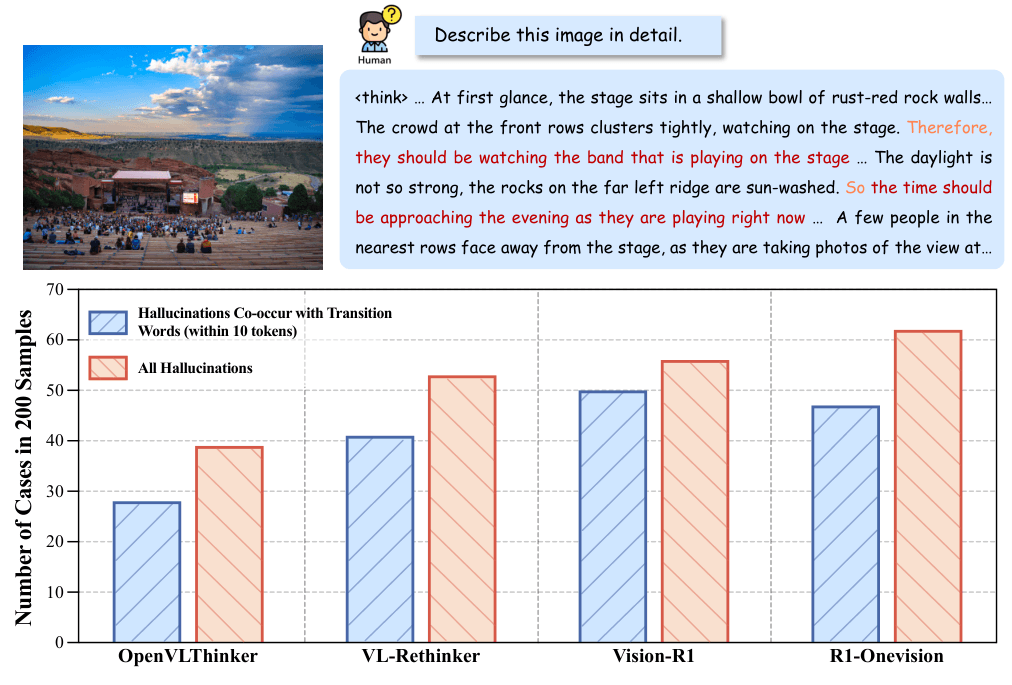
- Transition words like "because" and "however" show high entropy and precede most hallucinations.
- Under high entropy, LEAD swaps one-hot token embeddings for probability-weighted mixtures of all candidates.
- It re-injects visual anchor embeddings during uncertain steps to keep the model grounded in the image.
- Boosts MMHalu by +4.7% and Bingo by +3.8% on R1-Onevision, with gains across five open MLRMs.
- Reduces reasoning length while improving Pass@k sample efficiency versus VCD, MemVR, and SID. Project page
Multimodal reasoning models have gotten impressively good at chaining together visual perception and step-by-step logic, but they still make things up, often at the worst possible moment. A new arXiv preprint titled Thinking in Uncertainty pinpoints where those hallucinations sneak in and proposes a lightweight decoding fix called LEAD (Latent Entropy-Aware Decoding) that plugs into existing models without retraining.
The finding that anchors the paper is oddly specific: the researchers observe that MLRMs employ causal, contrastive, and reflective transition words (like "because," "however," "wait") at significantly higher frequencies during generation, and the content that follows such transition words often exhibits hallucinatory descriptions. In other words, the moments where the model pivots its reasoning are also the moments it is most likely to invent things.
Why transition words are dangerous
Looking at this through the lens of token-level entropy, the pattern becomes clearer. Entropy here just means how spread out the model's next-token probabilities are: a low-entropy step is one where the model is confident about a single token, and a high-entropy step is one where several candidates are competing. Transition words consistently exhibit higher entropy, indicating high-uncertainty stages within the reasoning chain.

To confirm these tokens actually matter, the team ran masking ablations. Masking high-entropy tokens leads to a significant drop in reasoning performance, whereas masking low-entropy tokens causes only minor degradation, indicating that high-entropy tokens serve as critical informational nodes in the reasoning process. Even more telling, token masking applied early in the reasoning chain results in the most severe performance degradation, meaning early high-entropy tokens exert stronger directional influence on the overall reasoning trajectory. A wrong turn at step three can poison every downstream token.
There is also a visual side effect. High-entropy tokens associated with hallucinations typically exhibit lower visual attention, suggesting a reduced reliance on visual information under high-uncertainty conditions. The model literally stops looking at the image when it gets confused.
Swapping one-hot tokens for a probability soup
LEAD's core idea is that when the model is uncertain, it shouldn't be forced to commit. Standard autoregressive decoding samples one token, embeds it, and feeds it back as if it were the only possibility. That collapses the full distribution into a single choice at exactly the wrong moment.
Instead, under high entropy, LEAD replaces the collapsed one-hot token vector with a probability-weighted combination of all token embeddings, implicitly preserving multiple reasoning hypotheses. As entropy decreases, the model naturally reverts to discrete token embeddings. Think of it as letting the model carry a superposition of "maybe because, maybe however, maybe wait" forward for a few steps until it figures out which branch it actually wants, then snapping back to normal token-by-token generation.

Concretely, the mechanism has a few moving parts:
- Entropy threshold: A reference entropy value that is initialized and updated at each mode transition, so the switch is adaptive rather than fixed.
- Persistence window: A discrete-to-latent transition is permitted only after the model has remained in the discrete mode for at least a set number of steps, ensuring the model stays in discrete reasoning long enough to consolidate a coherent reasoning trajectory before returning to latent exploration.
- Switch count cap: A global switch counter with an upper bound limits the total number of allowed mode transitions to prevent overthinking; once exceeded, the model halts further reasoning and proceeds to the final answer. The default cap is five.
- Visual anchor injection: When the model detects an entropy rise above the threshold and enters the first latent step in that phase, a visual anchor derived from pretrained visual special tokens is injected into the weighted embedding to pull attention back to the image.
The numbers
LEAD was tested as a drop-in plugin on five open multimodal reasoning models: R1-Onevision-7B, Vision-R1-7B, VL-Rethinker-7B, VL-Cogito-7B, and OpenVLThinker-7B. Benchmarks span general understanding (MMEval-Pro, MMVP, RealWorldQA, VStar), hallucination assessment (Bingo, MMHalu, POPE), and domain-specific reasoning (MathVision, MathVista, MathVerse, Geometry3K, plus physics, chemistry, and biology subsets of MMK12).
Integrating LEAD as a plugin into R1-onevision resulted in an average improvement of +3.6% in the general reasoning and understanding tasks, with MMHalu and Bingo scores increasing by +4.7% and +3.8%, respectively. On structured tasks, LEAD improved average accuracy by +2.0% on mathematics benchmarks and +3.2% on scientific benchmarks.
There is also an efficiency angle. LEAD generates shorter reasoning length than the baselines while maintaining the highest accuracy, an efficiency gain attributed to the latent reasoning phase, which allows the model to retain multiple reasoning hypotheses at each step and reach the solutions with fewer generated tokens. On Pass@k, LEAD reaches its peak accuracy at smaller k values than the baselines, indicating higher sample efficiency.
Where it fits and what to watch
Ablations reveal the tradeoffs. Performance improves as visual anchor injection strength increases, reaching its peak at 0.4 across all datasets, but when injection strength is too high, visual embedding begins to dominate the representation, diminishing the influence of linguistic context and leading to a slight performance drop. Similarly, the persistence window is sensitive: too small and the model oscillates, too large and it collapses back to standard chain-of-thought behavior, negating the benefit.
LEAD is training-free and applied at inference, which makes it easy to try on any autoregressive multimodal reasoning model that exposes logits. It is most useful for tasks where hallucination hurts more than raw fluency, like visual QA, scientific reasoning over diagrams, and math word problems with figures. It is less obviously useful for pure text reasoning or for models that already run under strict greedy decoding with low entropy across the board.
Code and additional visualizations are indicated on the project page, and the full technical write-up is available on arXiv. The bigger takeaway beyond the specific numbers is a shift in how to think about hallucination mitigation: rather than penalizing bad tokens after the fact or retraining with more data, LEAD treats entropy itself as a control signal and gives the model room to hedge exactly when hedging is warranted.