
Lawrence Livermore's mLaSDI Cuts Physics Simulation Error by 10x Faster
Researchers at Lawrence Livermore fix a core tension in data-driven PDE surrogates by stacking decoders that fill in residuals stage by stage.
Takeaways
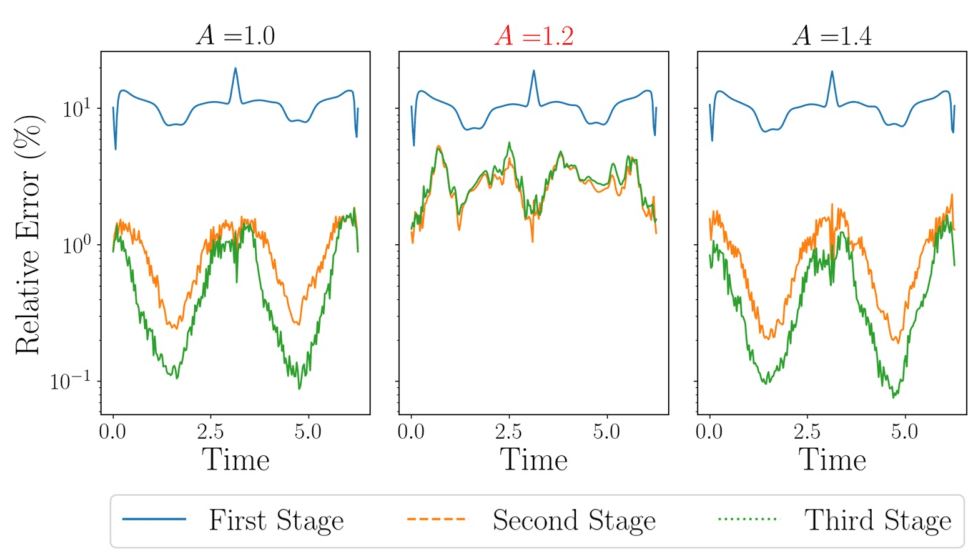
- mLaSDI extends LaSDI reduced-order models with sequential residual-learning decoders sharing the same latent dynamics.
- Standard LaSDI's autoencoder fights two objectives: reconstruct data and satisfy smooth latent ODEs.
- Sine activations in later stages recover high-frequency content that spectral-biased networks miss.
- Achieves order-of-magnitude error reduction on multiscale oscillator, wake flow, and Vlasov benchmarks.
- Provable guarantee: adding stages cannot increase training residual under global minimization.
- Code builds on LLNL's GPLaSDI repository; two stages proved sufficient in all tests.
Reduced-order models let you replace an expensive PDE solver with a lightweight surrogate that predicts new solutions in seconds. One popular data-driven variant, Latent Space Dynamics Identification (LaSDI), compresses simulation snapshots with an autoencoder and then fits a small set of ODEs to the latent trajectory, giving you something interpretable that generalizes to unseen parameters through interpolation. It works well until the physics gets bumpy. A new paper from Lawrence Livermore National Laboratory, mLaSDI, targets that failure mode with a staged residual-learning trick that cuts reconstruction error by an order of magnitude while training faster.
The tension inside every LaSDI model
LaSDI trains an autoencoder and learns interpretable dynamics of the compressed data by applying Sparse Identification of Nonlinear Dynamics (SINDy) in the latent space. Interpolating the learned ODE coefficients then enables rapid predictions for unseen parameter values. SINDy itself is a regression method that picks out the simplest ODE (from a chosen library of terms like linear, quadratic, sinusoidal) that fits observed derivatives.
The catch is that the autoencoder has to do two things at once: faithfully reconstruct the input snapshots and produce latent trajectories that obey a simple ODE. Those goals fight each other. Neural networks already have a well-documented spectral bias toward low frequencies, and forcing latent dynamics to be smooth makes that bias worse. Fine-scale or oscillatory features in the data get smeared out, and pushing accuracy up usually means blowing up the autoencoder size and running long hyperparameter sweeps.