
LASQ Beats GPT-5 on Sentiment Analysis for 400M Underserved Speakers
Researchers built the first target-aspect-opinion-sentiment quadruple dataset for Uzbek and Uyghur, plus a syntax-aware tagging model that beats GPT-5 by seven F1 points.
 Pro
Takeaways
- LASQ is the first target-aspect-opinion-sentiment quadruple dataset for Uzbek and Uyghur, from Google Play reviews. Paper
- Contains 3,064 Uzbek documents (11,728 quads) and 3,028 Uyghur documents (11,543 quads), with 0.85 Cohen's kappa agreement.
- Proposed grid-tagging model injects POS and dependency knowledge via a Syntax Knowledge Embedding Module (SKEM) over GCN.
- Beats best prior baseline by +1.28 F1 (Uzbek) and +1.86 F1 (Uyghur) on quadruple extraction.
- Zero-shot GPT-5 and Qwen3-Max score 7+ F1 points below the small syntax-aware model on both languages.
- Main errors come from aspect identification and dense multi-quadruple documents; parsing relies on Stanford Stanza.
Sentiment analysis research has spent most of its energy on English and Chinese, leaving the roughly 400 million speakers of Turkic languages like Uzbek and Uyghur with almost no fine-grained annotated data to work with. A new benchmark called LASQ tries to close that gap by shipping the first aspect-based sentiment quadruple dataset for these two low-resource languages, along with a grid-tagging model that beats both classical baselines and current frontier LLMs on the task.
Why aspect-level sentiment breaks on agglutinative languages
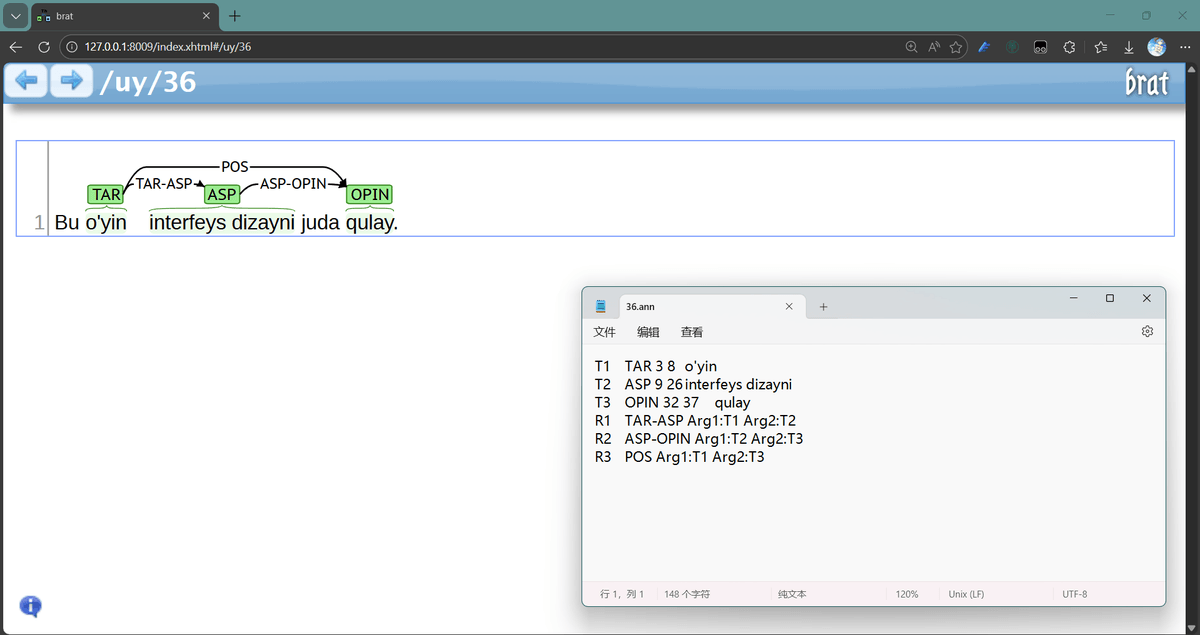
Standard sentiment analysis just labels a whole review positive or negative. Aspect-based sentiment analysis (ABSA) goes further and pulls out structured tuples describing what is being evaluated and how. The most granular version, quadruple extraction, identifies a Target (the entity being evaluated), an Aspect (a specific attribute of the target), an Opinion (the sentiment-bearing expression), and a Sentiment label. From a Gmail review, for instance, you would want to extract that Gmail's synchronization feature is described as slow, with negative polarity.
Uzbek and Uyghur are agglutinative languages in the Altaic family. A single word stem can be followed by a long sequence of derivational and inflectional suffixes that express case, number, tense, and person, which produces high morphological complexity and severe vocabulary sparsity where the same lemma may appear in many surface forms across contexts. That drives up out-of-vocabulary rates and makes it much harder for tokenizers to line up entity boundaries, especially with limited training data.
Prior low-resource ABSA datasets covered Vietnamese, Telugu, Urdu, and Uzbek, but they only focused on aspect-sentiment pair extraction and each contained a single low-resource language. Nothing existed at the target-aspect-opinion-sentiment quadruple level for these languages.