
LAMP Beats Every Economic AI Baseline by Teaching Agents to Read the News
LAMP teaches RL agents to reason in plain language before acting, beating both pure MARL and LLM-only baselines by up to 63% on economic simulations
 Pro
Takeaways
- LAMP is a new framework combining LLM reasoning with multi-agent RL for economic decision-making, beating pure MARL by +63.5% in cumulative return.
- It uses a Think-Speak-Decide pipeline: agents interpret economic news in language, exchange strategic messages, then act via a trained RL policy.
- A FAISS-backed experience pool stores high-reward reasoning trajectories; removing it collapses social welfare by 51% and halves simulation lifespan.
- Tested on TaxAI across stable, slowdown, and crisis scenarios -- LAMP outperforms all 7 baselines including ReAct, CoT, and Reflexion.
- Results are LLM-agnostic: DeepSeek-v3.1, Qwen3-32B, and Gemini-2.5 all yield similar performance as backbones.
- Code is open-source and the paper was accepted at AAAI 2026.
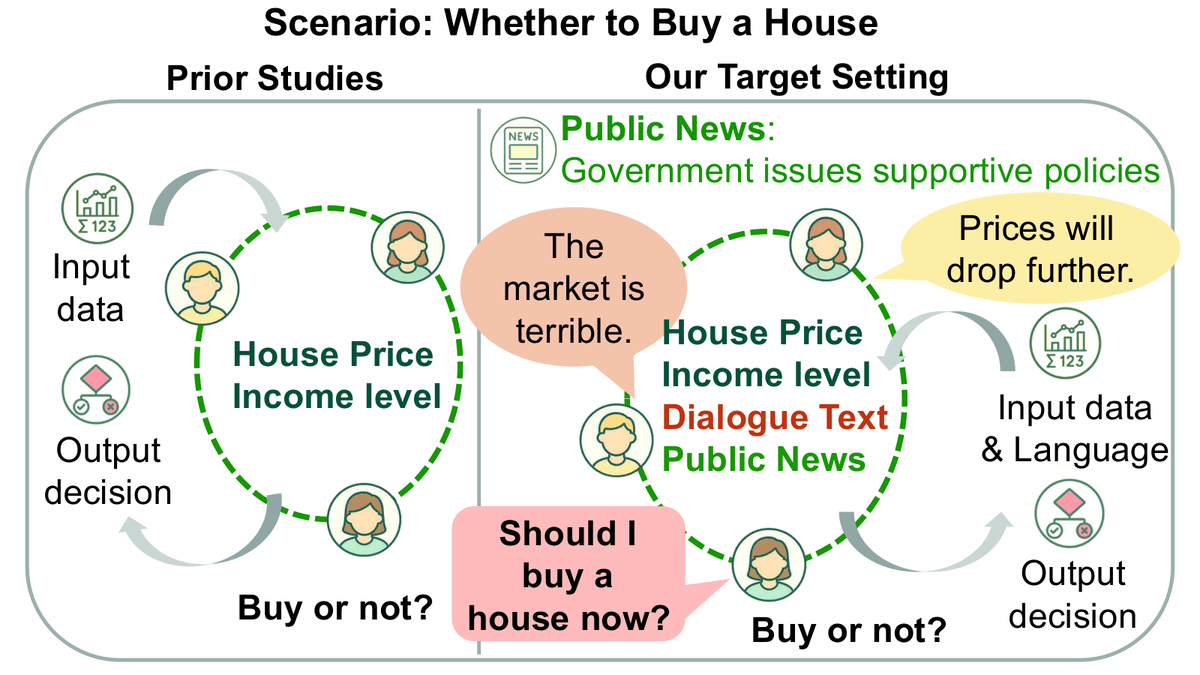
Economic decisions are not made in a vacuum of clean numbers. Households read news headlines, listen to neighbors, and interpret government announcements before deciding how much to save or work. Yet almost every AI system designed to model economic behavior treats language as noise -- stripping the world down to wages, tax rates, and asset values. A new framework called LAMP (Language-Augmented Multi-Agent Policy) argues that this is a fundamental mistake, and backs it up with numbers.
The gap between economic AI and the real world
Multi-agent reinforcement learning (MARL) -- where multiple AI agents learn policies by interacting with each other and an environment -- has become a serious tool for economic modeling. Researchers have used it to design tax policy, model household savings, and simulate market pricing. But while MARL has shown promise in optimizing economic decisions, it struggles with the semantic ambiguity and contextual richness of language. Standard MARL assumes clean, structured communication protocols. Real economies do not.
On the other side, large language models (LLMs) are excellent at reading and reasoning about text -- but they lack the optimization loop that makes RL agents actually improve over time. Most LLM-based economic agents simply generate actions directly from prompts, without any systematic policy learning. The question LAMP asks is: can you get the best of both worlds?
Think, Speak, Decide -- in that order
LAMP follows a Think-Speak-Decide pipeline: (1) Think interprets numerical observations to extract short-term shocks and long-term trends, caching high-value reasoning trajectories; (2) Speak crafts and exchanges strategic messages based on reasoning, updating beliefs by parsing peer communications; and (3) Decide fuses numerical data, reasoning, and reflections into a MARL policy to optimize language-augmented decision-making.
Each stage does something distinct. Here is how they fit together:
- Think: A shared LLM-driven news service watches global economic indicators -- wealth Gini, social welfare, per-capita GDP -- and generates two types of natural-language updates. Long-term news fires at fixed checkpoints, summarizing structural trends like sustained inequality growth. Short-term news fires whenever a key indicator crosses a threshold, flagging sudden shocks. Each agent then privately reasons about what this means for its own situation, producing a short text rationale and an economic status label (good / neutral / bad).
- Speak: Guided by its private reasoning, each agent generates three candidate public statements. A self-attention scorer picks one to broadcast. After all agents exchange messages, each agent runs a reflection step: it estimates each peer's wealth tier (low / mid / high), assigns a trust score from 0 to 10, and writes a brief self-reflection updating its own understanding. This is opponent modeling done in natural language.
- Decide: The private reasoning and reflection texts are encoded by a frozen text encoder, projected down to a compact embedding, and concatenated with the raw numerical observations. This enriched state feeds into a standard MADDPG (Multi-Agent Deep Deterministic Policy Gradient) actor-critic network, trained with centralized training and decentralized execution (CTDE) -- a common MARL paradigm where a shared critic sees all agents' states during training, but each agent acts on its own observations at test time.

One clever detail: LAMP maintains an experience pool with two tiers. A short-term buffer caches each agent's top-k reasoning trajectories from recent steps. A long-term FAISS index (a vector similarity search library) stores the highest-reward trajectories across all agents and all past episodes. Before each long-term reasoning step, an agent retrieves the most similar past situations using k-nearest-neighbor search, and feeds those examples as context into the LLM prompt. This is essentially retrieval-augmented generation (RAG) applied to economic decision-making -- agents can remember and reuse strategies that worked in similar past conditions.
Tested on a real-data economic simulator
All experiments run inside TaxAI, a dynamic economic simulator that models a government agent and multiple heterogeneous household agents. The government sets five policy variables at each step: marginal income tax rate, income tax progressivity, marginal wealth tax rate, wealth tax progressivity, and the public spending-to-GDP ratio. Each household chooses a savings rate and labor supply to maximize lifetime utility from consumption and leisure. The simulator is calibrated with real-world data, making it a demanding testbed.
Three scenarios test different conditions:
- S1 -- Economic Stability: Standard calibrated parameters (6% depreciation, 6.5% consumption tax, 4% interest rate). Training conditions.
- S2 -- Economic Slowdown: Doubled depreciation (12%), lower consumption tax (2%), higher interest rate (8%). Simulates a mild recession.
- S3 -- Crisis Shock: 10% depreciation, 10% consumption tax, 10% interest rate. Severe coupled shocks.
LAMP was compared against seven baselines: Random, Rule-Based, MADDPG (pure numeric MARL), LLM-Only, Chain-of-Thought (CoT), ReAct, and Reflexion. All LLM-based baselines used the same backbone model (Qwen2.5-72B-Instruct-INT4).
The numbers are hard to argue with
Experiments in economic simulation show that LAMP outperforms both MARL and LLM-only baselines in cumulative return (+63.5%, +34.0%), robustness (+18.8%, +59.4%), and interpretability. Against the strongest non-language baseline (Rule-Based), LAMP improves social welfare by +12.3% and average household reward by +12.1%. Against the strongest LLM baseline (ReAct), LAMP achieves +14.8% higher welfare and +14.5% higher reward in the stable scenario -- while also using less labor and consumption, meaning higher welfare comes from efficiency, not brute-force effort.
Under crisis conditions (S3), LAMP maintains its edge: +16.0% reward and +10.4% welfare gains over the best LLM baseline. Stability is also dramatically better -- LAMP sustains simulations for the full 300 simulated years, while ablated versions collapse far earlier.
| Method | Avg. Reward | Social Welfare |
|---|---|---|
| LAMP (Ours) | 8.52 | 2,560 |
| ReAct (best LLM baseline) | 7.44 | 2,230 |
| Rule-Based (best non-LLM) | 7.60 | 2,280 |
| MADDPG (pure MARL) | 5.21 | 1,170 |
| LLM-Only | 6.35 | 1,900 |
What the ablations reveal
The ablation study is where the paper gets interesting. Removing the experience pool is catastrophic: social welfare drops 51%, consumption surges 122%, and the simulation survives only half as many years. Without stored successful trajectories, agents overshoot spending and oscillate. Removing long-term reasoning drops average reward by 38% and cuts stable years from 300 to 219 -- agents become myopic, reacting only to immediate stimuli. Removing short-term reasoning has a smaller effect on final returns (-4%) but causes labor to spike 68%, suggesting agents lose the ability to respond efficiently to shocks.
The Speak module's contribution is subtler but real. Without it, agents compensate for missing coordination by working harder -- labor jumps 71% and consumption 41%. With strategic communication, agents achieve comparable or better welfare with far less input. The LLM outputs show why: after detecting widening inequality, agents revise their stance from "work more" to "moderate labor expansion, increase savings, invest in human capital."
What it is and is not good for
LAMP is well-suited for any multi-agent economic simulation where language signals matter: policy analysis, household behavior modeling, tax design research, and scenarios where agents need to respond to news-like events. The framework is also LLM-agnostic -- the paper tests DeepSeek-v3.1, Qwen3-32B, and Gemini-2.5 as backbones, with average rewards of 8.64, 8.35, and 8.65 respectively, showing the gains are not tied to a specific model.
The limitations are worth noting. LAMP is currently evaluated only in TaxAI, a single simulator. The framework adds significant computational overhead compared to pure MARL -- every step potentially involves LLM calls for reasoning, message generation, and reflection. The paper does not report wall-clock training times or API costs, which matter for practitioners. The agents also operate in a cooperative-competitive setting that may not generalize cleanly to more adversarial environments where deceptive language is strategically optimal.
The real unlock: interpretable economic AI
Beyond the performance numbers, LAMP does something that pure MARL cannot: it produces readable explanations for every decision. Its reasoning traces explain language-guided choices, aiding insight and policy. When an agent decides to reduce labor hours and increase savings, you can read exactly why -- the LLM output shows it detected rising inequality in the top-10% wealth bracket, revised its earlier "work more" stance, and recommended investing in skills for long-term stability while publicly supporting progressive taxation. That kind of auditability is genuinely new for economic simulation AI.
The experience pool adds a second layer of interpretability: it functions as an auditable knowledge base of successful strategies, preserving the reasoning traces that led to high-reward outcomes. Researchers can inspect which past situations an agent is drawing on when it makes a decision -- something impossible with a black-box neural policy.
The code is publicly available on GitHub, and the paper has been accepted at AAAI. The TaxAI environment it builds on is also open-source, making this a reproducible starting point for researchers interested in language-grounded economic AI. Whether LAMP's approach scales to larger populations, more complex market structures, or real financial data remains the open question -- but as a proof of concept that language and RL can be productively fused for economic decision-making, it makes a compelling case.