
Lamarr Institute's CODI Reasons Without Words, Beating Supervised Models on Urdu
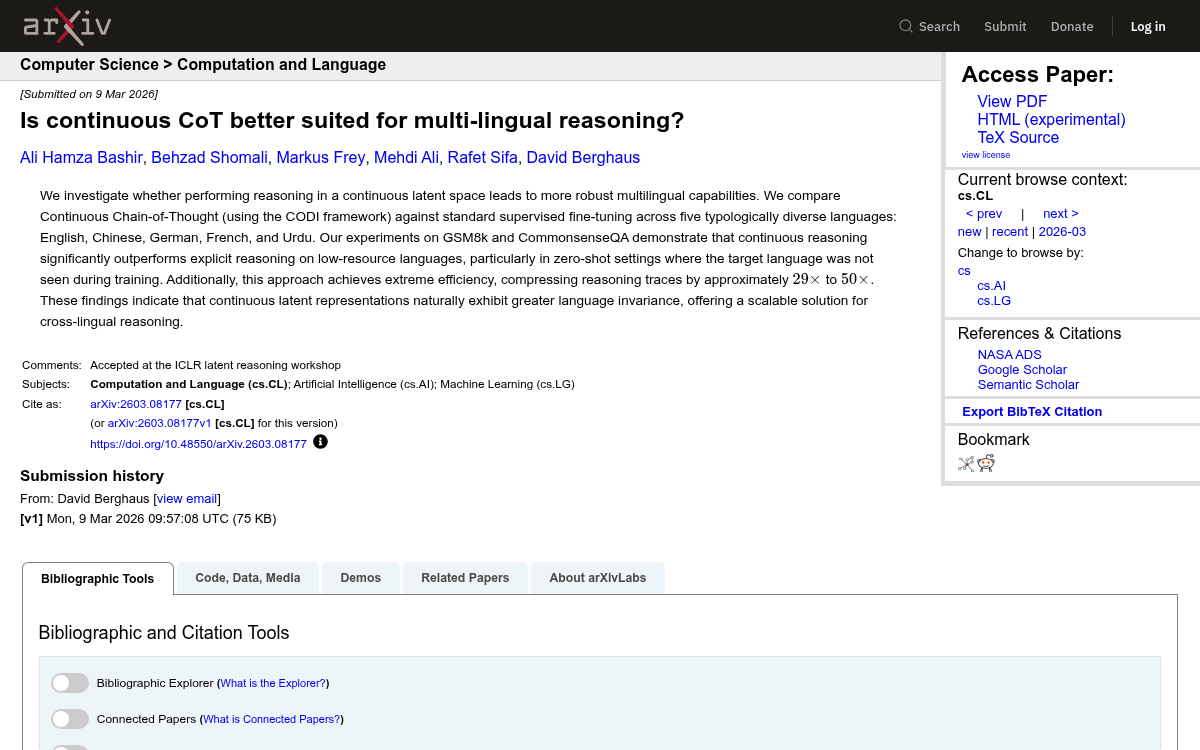
Reasoning in continuous latent space instead of text tokens makes LLMs dramatically better at low-resource languages, with 29x to 50x fewer thinking tokens
 Pro
Takeaways
- Core finding: Reasoning in continuous latent vectors (not text tokens) makes LLMs significantly better at low-resource languages like Urdu, even zero-shot.
- Zero-shot beats supervised: CODI trained without Urdu data scored 35.95% on Urdu CommonsenseQA, outperforming standard CoT fine-tuning that had seen Urdu (34.73%).
- Massive efficiency gains: CODI uses just 6 latent tokens vs ~176-299 text tokens for CoT, achieving 29x to 50x compression.
- Framework used: Built on CODI, which trains a single model as both teacher (explicit CoT) and student (latent reasoning) via self-distillation.
- Tested on: LLaMA 3.2-1B across English, German, French, Chinese, and Urdu on GSM8k and CommonsenseQA benchmarks.
- Limitation: Only tested at 1B scale; CoT-SFT still wins on English math in single-language training; no public model weights released yet.
When a language model reasons through a problem, it typically writes out its thinking in words, step by step. That verbal chain-of-thought is what makes models better at math and logic, but it also bakes in a hard dependency on language. Train your reasoning pipeline in English, and it will struggle badly in Urdu. A new paper from the Lamarr Institute and Fraunhofer IAIS asks a simple but sharp question: what if the model reasoned in a language-free space entirely?
The language gap is a reasoning gap
While LLMs have demonstrated impressive reasoning capabilities, their performance varies dramatically across languages. Low-resource languages in particular suffer from substantially degraded results compared to high-resource languages like English. This is not just a vocabulary problem. Research reveals that even when prompted in other languages, many multilingual models perform internal reasoning in English before translating back to the target language, leading to cultural and contextual misalignments.
The standard fixes all have a catch. One common approach translates multilingual prompts into a high-resource pivot language like English before applying chain-of-thought reasoning, but this creates a bottleneck at the translation step, where subtle linguistic nuances may be lost. Directly fine-tuning LLMs on multilingual CoT data shows improvements for low-resource languages, yet this approach faces scalability issues -- covering hundreds of languages during fine-tuning is impractical -- and risks catastrophic forgetting as more languages are added.
Thinking without words
The paper's bet is that if you strip language out of the reasoning process itself, the model's internal representations might naturally generalize across languages. The intuition comes from a classic NLP finding: rather than verbalizing each reasoning step in natural language tokens, continuous reasoning methods compress reasoning into continuous hidden representations. This approach is motivated by classic findings showing that word embeddings across different languages tend to occupy similar geometric spaces.
To test this, the researchers use CODI (Continuous Chain-of-Thought via Self-Distillation), a framework that trains a model to reason using compact latent vectors instead of text tokens. CODI is a novel training framework that effectively compresses natural language CoT into continuous space. It jointly trains a teacher task (Explicit CoT) and a student task (Implicit CoT), distilling the reasoning ability from language into continuous space by aligning the hidden states of a designated token.
How CODI works under the hood
CODI trains a single model to do two things simultaneously, using a combined loss function that balances three objectives:
- Teacher task: Standard chain-of-thought generation. The model predicts explicit reasoning tokens followed by the final answer using a cross-entropy loss. This keeps the model grounded in language.
- Student task: Continuous thought generation. Instead of writing out reasoning steps, the model autoregressively propagates hidden states between special learnable
<bot>and<eot>tokens. An MLP projects these states between steps to distinguish latent reasoning from token embeddings. The model then predicts the answer directly from these latent vectors. - Knowledge distillation: To prevent the continuous representations from drifting too far from the explicit reasoning trace, CODI aligns the student's hidden activations with the teacher's at the token just before the answer (e.g., ":") using an L1 loss with a stop-gradient. This anchors the latent space to the explicit trace without letting the teacher be influenced by the student.
The total loss is a weighted sum: L = α·L_student + β·L_KD + γ·L_teacher. The key hyperparameter is the number of latent tokens -- in this work, just 6.
The experiment setup
The team built their experiments on LLaMA 3.2-1B-Instruct and tested across five typologically diverse languages: English, German, French, Chinese, and Urdu. The language selection was deliberate -- it spans different language families (Germanic, Romance, Sino-Tibetan, Indo-Iranian), different scripts (Latin, Chinese characters, Arabic script), and different resource levels.
Two benchmarks were used:
- GSM8k-Aug-NL: A grade-school math reasoning dataset, augmented from 7.5k to 385k training samples with natural language CoT traces. The team translated questions into each target language using Llama-3.3-70B for German/French, Qwen2.5-72B for Chinese, and GPT-4o-mini for Urdu, with a native Urdu speaker verifying translations.
- CommonsenseQA-CoT: A multiple-choice commonsense reasoning dataset with ~8.1k training and 1.2k validation examples, with CoT annotations from the original CODI paper.
Three training configurations were compared: English-only training, multilingual training (English + German + French + Chinese, with Urdu held out), and multilingual training including Urdu. The key test was whether CODI could generalize to Urdu zero-shot.
The results: latent space crosses language barriers
The headline finding is striking. CODI performs significantly better on Urdu even if it has not been trained on it during fine-tuning. On CommonsenseQA, CODI trained without any Urdu data scored 35.95% on Urdu -- higher than standard CoT fine-tuning that had seen Urdu during training (34.73%). That is a zero-shot approach beating a supervised one on an unseen language.
The pattern holds more broadly. When trained on a mix of languages:
- On GSM8k, CODI outperforms CoT-SFT on low-resource languages (Chinese: 43.75% vs 35.60%) and matches it on high-resource ones.
- On CommonsenseQA, CODI outperforms CoT-SFT across all five languages, including English (71.42% vs 62.49%).
- In the English-only training zero-shot setting, CODI scores 9.58% on Urdu math vs 5.38% for CoT-SFT -- nearly double, despite both models never seeing Urdu.
The one area where CoT-SFT still has an edge is English math reasoning in the English-only training setup (55.04% vs 46.08%). This is partly a data artifact: CODI preprocessing removes the final sentence from reference CoTs, and 28.3% of GSM8k CoTs are single-sentence, creating empty references that disadvantage CODI specifically on that dataset.
The efficiency story is just as good
Beyond accuracy, the compression numbers are remarkable. Standard latent reasoning achieves compression ratios of roughly 29x and 50x compared to standard CoT. Concretely:
| Dataset | CoT-SFT Avg Tokens | CODI Latent Tokens | Compression |
|---|---|---|---|
| GSM8k-Aug-NL | ~176 | 6 | ~29x |
| CommonsenseQA | ~299 | 6 | ~50x |
Six latent tokens replace hundreds of text tokens. This is not just a curiosity -- it directly translates to faster inference and lower memory pressure at serving time.
Why this matters beyond the numbers
The real insight here is structural. Standard chain-of-thought is fundamentally a language-specific artifact: it forces the model to commit to a particular language's grammar, vocabulary, and token distribution at every reasoning step. When you fine-tune on English CoT and then test in Urdu, the model has to somehow map its Urdu input onto an English reasoning pathway it was trained on -- a mismatch that compounds across every step.
Continuous reasoning sidesteps this entirely. The latent vectors are not tied to any language's token space. Reasoning in a continuous space, unconstrained by rigid linguistic imitation targets, promotes greater robustness and improved generalization. The model appears to learn something closer to a language-neutral "concept space" for reasoning, which then generalizes to new languages without retraining.
This has direct practical implications. If you are building a multilingual assistant or reasoning pipeline and cannot afford to collect CoT training data in every target language, continuous reasoning offers a way to get meaningful zero-shot coverage. The approach is also scalable in a way that multilingual CoT fine-tuning is not -- you do not need to worry about catastrophic forgetting as you add new languages, because the reasoning itself is already language-agnostic.
What it does not solve
A few caveats are worth keeping in mind. The experiments were run on a 1B-parameter model, and it is not yet clear whether the language-invariance property scales to larger models. The authors note this as explicit future work. Additionally, the Urdu dataset is small (only 1.2% of the GSM8k training split, at 4,619 samples), so the zero-shot Urdu results, while impressive, are evaluated on a limited test set. The approach also still lags on English math in the single-language setting, suggesting the compression comes with some accuracy trade-off on the training language when data is limited.
No code or model weights from this specific multilingual study are publicly released yet, though the original CODI framework has code available. The multilingual datasets constructed for this work -- translated versions of GSM8k and CommonsenseQA across five languages -- are a useful contribution in their own right, though their release status is not specified in the paper.