
La Trobe's MM-VAD Beats Every Training-Free Benchmark With Hyperbolic AI Reasoning
MM-VAD swaps flat feature matching for hyperbolic geometry and test-time prompt tuning, setting new training-free records on four VAD benchmarks.
 Pro
Takeaways
- MM-VAD is a training-free video anomaly detection framework using hyperbolic embeddings and adaptive prompt tuning (paper).
- Achieves 90.03% AUC on XD-Violence, 83.24% on UCF-Crime, 96.95% on ShanghaiTech, 98.81% on UCSD Ped2.
- Projects visual and audio captions into Poincaré ball geometry to capture hierarchical scene structure that Euclidean fusion misses.
- Uses an unsupervised entropy plus sparsity loss to tune a learnable prompt at test time; all backbones stay frozen.
- 16.8% faster than LAVAD and needs 26.5 GB VRAM instead of 33.5 GB, running on a single RTX 4080.
- Struggles with slow-developing anomalies and cluttered scenes that produce noisy captions from the vision-language reward model.
Video anomaly detection has quietly become one of the harder open problems in computer vision. Supervised models need mountains of frame-level labels, one-class methods break in messy real-world scenes, and the recent wave of training-free approaches has hit a ceiling because they treat anomaly detection as a shallow similarity lookup. A new paper from La Trobe University and GIFT University proposes MM-VAD, a framework that reframes the problem as adaptive semantic reasoning over hyperbolic embeddings, and it beats the previous training-free state of the art on every benchmark the authors tested.
Why flat embeddings keep failing
Existing training-free systems perform anomaly detection through similarity matching in a flat embedding space, comparing caption embeddings against fixed textual prompts using cosine similarity. That works for simple, single-object anomalies but falls apart when scenes contain hierarchy: a fight in a hallway, a car accident inside a busy intersection, or a riot that overlaps with normal crowd behavior.
The authors point out two specific weaknesses in prior work. Existing methods largely rely on static prompting and geometry-agnostic feature fusion, so anomaly inference is reduced to shallow similarity matching over Euclidean embeddings, leading to unstable predictions and limited interpretability in complex or hierarchically structured scenes. Vision-centric systems like LAVAD also ignore acoustic signatures entirely, and hand-crafted prompts cannot adapt to individual videos.

The core idea: bend the embedding space
MM-VAD replaces Euclidean fusion with hyperbolic geometry, specifically the Poincaré ball model. Hyperbolic space has an important property for this task: hyperbolic embeddings naturally represent hierarchical relationships with exponentially expanding volume, allowing rare or abnormal events to appear as semantic deviations from the dominant normal structure. Think of it as a coordinate system where the volume grows exponentially with radius, giving room for tree-like hierarchies that a flat space compresses together.
On top of that geometric change, the framework rethinks how the LLM is queried. Instead of feeding a frozen prompt like "is there any anomaly?", MM-VAD treats the prompt itself as a small learnable vector that gets tuned at test time for each video, using an unsupervised objective. All backbones stay frozen.
How the pipeline actually runs
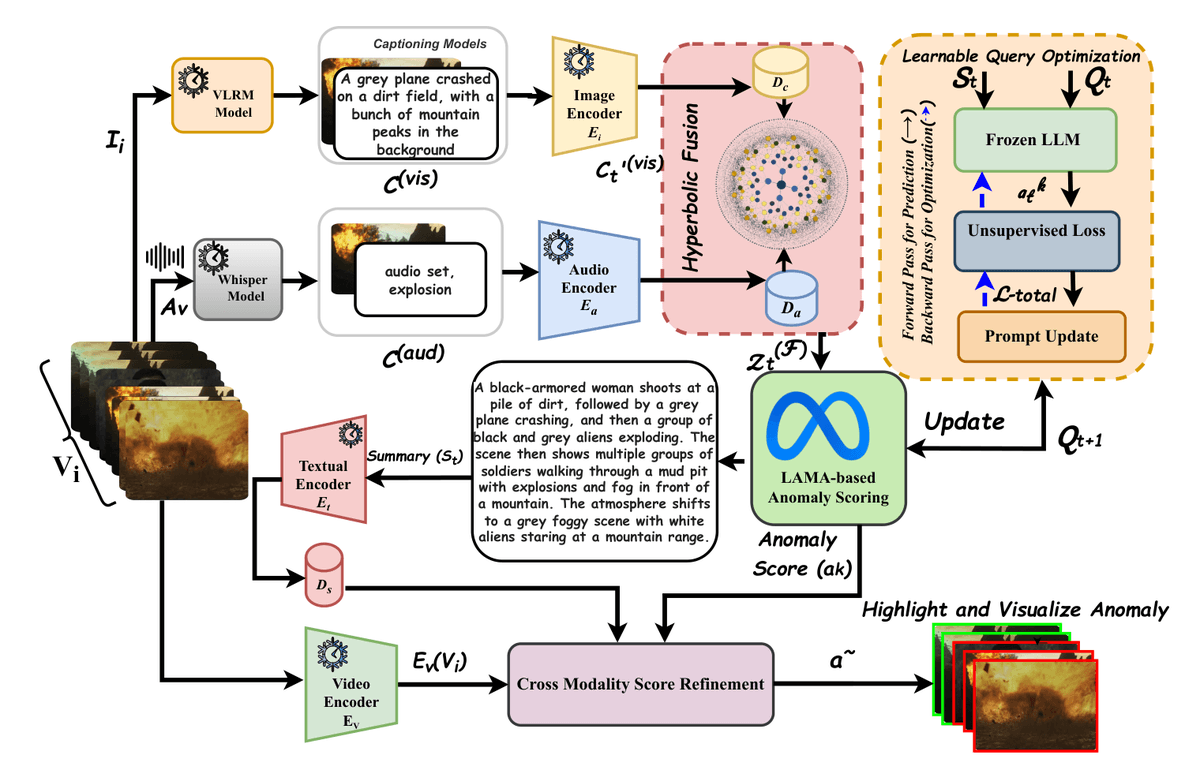
The system chains four components together, all built on frozen foundation models:
- Caption stabilisation. A vision-language reward model generates per-segment visual captions and Whisper transcribes audio. For each video segment, MM-VAD searches for its most semantically consistent caption within the entire set by maximising similarity between the visual embedding and the text embeddings from a frozen ImageBind encoder, denoising raw captions through temporal self-alignment.
- Hyperbolic fusion. Visual and audio caption embeddings are projected onto the Poincaré ball via an exponential map, then combined using a weighted geodesic mean rather than a simple average.
- Adaptive prompt reasoning. A learnable continuous prompt vector
Qis optimized over a handful of iterations using an unsupervised loss: binary entropy over predicted anomaly scores (predictions should be confident) plus a sparsity term (anomalies should be rare). Gradients flow only intoQ; a LLaMA-3B scorer stays frozen. - Mahalanobis refinement. Final scores are re-weighted by Mahalanobis distance between each summary and the video's visual feature distribution, which accounts for feature covariance and suppresses false positives that cosine similarity would miss.
The unsupervised loss for the learnable prompt is worth sitting with, because it is the whole trick that keeps the method training-free:
L_total = sum_t H(a_t) + lambda * | sum_t a_t - mu |
# H is binary entropy: pushes each score toward 0 or 1
# The sparsity term pulls total anomaly mass toward a prior mu
# Only the prompt Q is updated; every backbone stays frozen
Numbers that matter
MM-VAD was evaluated on four standard benchmarks. On the multimodal XD-Violence dataset, MM-VAD attains 90.03% AUC and 65.30% AP, outperforming the previous best training-free method EventVAD by +2.52% AUC and +1.26% AP. On UCF-Crime it reaches 83.24% AUC, beating MCANet's 82.47%. The video-only benchmarks show similar gains: 96.95% on ShanghaiTech and 98.81% on UCSD Ped2, roughly 2 to 3 points above LAVAD.

The t-SNE plots tell a clean story about why hyperbolic geometry helps. Under Euclidean fusion, anomaly categories like Riot and Fighting overlap heavily and normal frames scatter into a diffuse Unknown blob. Under hyperbolic fusion, anomalies form compact clusters and normal frames collapse into a tight central Normal class, which is exactly the inductive bias you want for anomaly detection.
Faster and lighter than the baseline
A common concern with LLM-based VAD is inference cost. MM-VAD is actually cheaper than LAVAD despite adding audio processing. The full pipeline processes a batch of 16 frames in 27.0 seconds versus 32.5 seconds for LAVAD, a 16.8% speed-up, while requiring 26.5 GB VRAM compared with 33.5 GB for LAVAD. Gains come mostly from shorter summary generation and scoring stages.
Backbone ablations show that VLRM plus LLaMA-3B is the strongest combination, but the framework transfers across LLMs. Swapping in DeepSeek, Qwen-4B, Qwen-30B, Mistral-24B, or LLaMA-2-13B all still beat LAVAD when using MM-VAD's reasoning stack, which suggests the improvement is architectural rather than a byproduct of a stronger backbone.
Where it still struggles
The paper is candid about failure modes. Performance is most affected by noisy captions, such as those generated in cluttered scenes or from imperfect audio transcripts, and by anomalies that develop gradually over long durations, which can exceed the capacity of short-window summaries. Slow-burn anomalies (a person loitering, a slowly escalating argument) are hard to catch because the summary window is too short to capture the temporal buildup, and garbage captions in dense urban scenes propagate downstream errors.
Practical takeaways
For anyone building surveillance or content-moderation systems, MM-VAD is interesting for several concrete reasons:
- Zero labels required. No frame-level annotation, no domain-specific fine-tuning, and no gradient updates on any backbone. The only optimization happens on a small prompt vector at test time.
- Modality-agnostic. The audio branch drops out automatically when a dataset lacks sound, and the pipeline still hits 83.24% on UCF-Crime in vision-only mode.
- Explainable outputs. Because scoring goes through an LLM against natural-language summaries, every flagged frame comes with a textual justification, not just a scalar.
- Deployable on a single GPU. The full pipeline runs on an RTX 4080 at roughly 1.69 seconds per frame.
One caveat for practitioners: no code repository has been released alongside the preprint, so reproducing the pipeline requires reassembling VLRM, Whisper, ImageBind, LLaMA-3B, and the hyperbolic fusion and Mahalanobis refinement layers from the paper's equations. Anyone hoping for a plug-and-play checkpoint will need to wait or build it themselves.