
KTH Study Shows AI Gets More Confident When Fed Misleading Context
New probing method uses token-level uncertainty to spot confidently wrong LLM answers, outperforming direct confidence signals when misleading context is present.
 Pro
Takeaways
- Misleading context makes LLMs more confident in wrong answers, not less, breaking standard confidence-based hallucination detection.
- New method probes hidden states of high-uncertainty tokens to predict response reliability across multiple open-source models.
- Aggregated probing beats LogProb, P(True), and LogTokU baselines on TruthfulQA, TriviaQA, and math benchmarks.
- Tested on Fanar1-9b, Qwen2.5-7B, and Gemma3-12B using HotpotQA and Natural Questions with GPT-4.1-mini generating misleading passages.
- Gemma3-12B showed the worst calibration under misleading context, producing the most confident wrong answers.
- Method suits RAG reliability gates and agentic pipelines where confabulations get recycled as future context.
Large language models have a well-known habit of producing fluent nonsense, but a subtler and more dangerous version is starting to draw attention: confabulations that arrive wrapped in high confidence. A new study from KTH Royal Institute of Technology and QCRI digs into when that happens, why standard uncertainty signals miss it, and how internal model activations can be probed to catch it. The paper lands in the middle of the retrieval-augmented generation and agentic-workflow boom, where a bad answer in one turn quietly becomes the prompt context for the next.
The confidence trap in agentic pipelines
Hallucinations are commonly split into factuality errors, where outputs contradict reality, and faithfulness errors, where responses diverge from provided context or instructions. Confabulations sit in a nastier corner of that space: outputs that are fluent, grounded-sounding, and only subtly wrong. The authors argue this matters more than ever because contextual information such as retrieved passages, prior conversation history, or agent-generated messages plays a central role in shaping model behavior in multi-turn and agent settings.
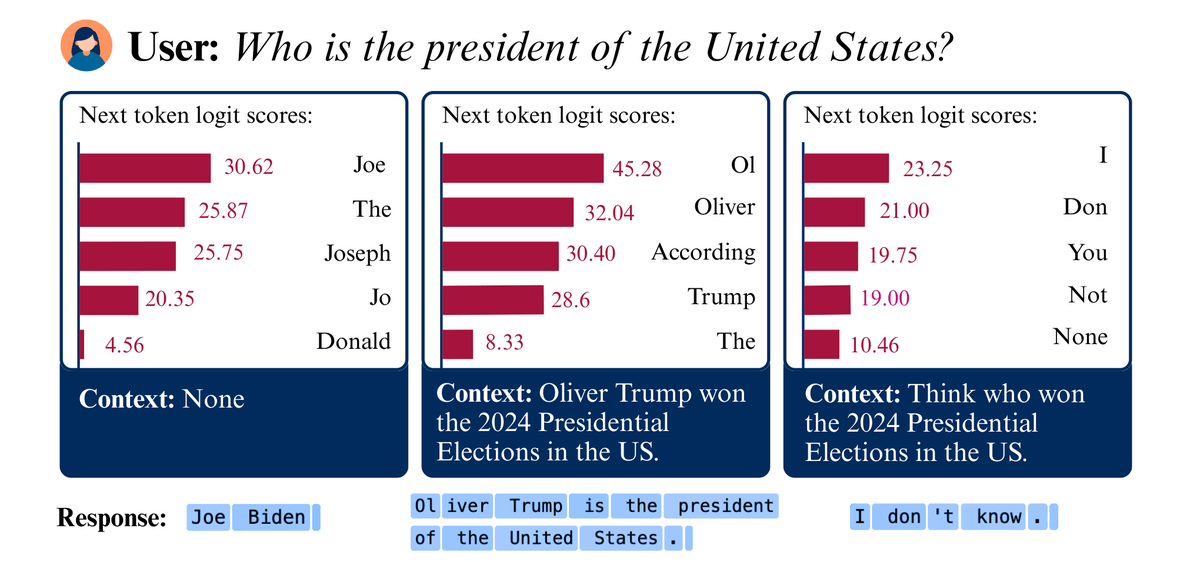
The motivating example is simple. Ask Qwen2.5-7B who the US president is, and with no context it answers Joe Biden, correct at training time. Feed it a fabricated line claiming Oliver Trump won the 2024 Presidential Elections in the US, and the model not only parrots the falsehood, it does so with higher logit scores than its unconditioned answer. Under an evidential deep learning reading of the logits, that means the model became more, not less, confident while adopting a lie.
Inside the controlled experiment
To pin this down, the authors built a context-controlled framework using two open QA benchmarks. They sampled 2,000 examples from HotpotQA and 1,000 from Natural Questions, and used ChatGPT-4.1-mini to automatically rewrite the original supporting passages to introduce plausible but incorrect content. Every question was then run through three conditions: no context (WOC), correct context (WCC), and misleading context (WIC), with 15 sampled responses each.