
KTH's MicroVRide Lets Researchers Test 4 Electric Vehicles on one VR Rig
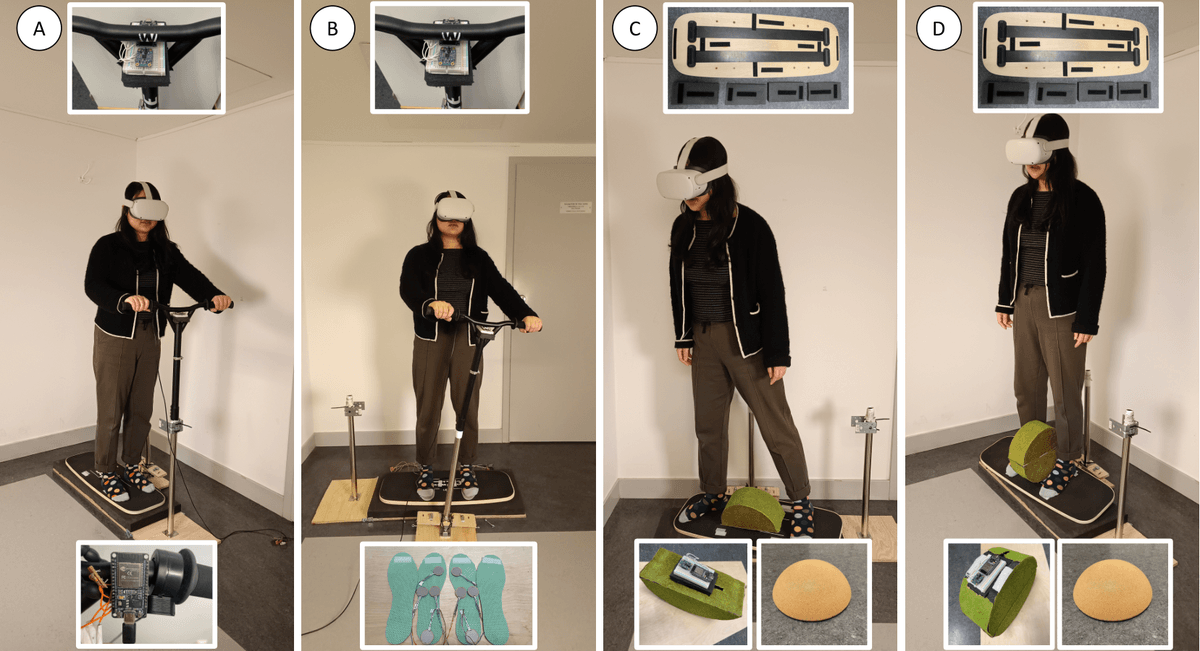
A KTH research team built a single reconfigurable rig that simulates e-scooters, Segways, electric unicycles, and one-wheeled skateboards in VR.
 Pro
Takeaways
- KTH team unveils MicroVRide, a 4-in-1 VR simulator for e-scooter, Segway, unicycle, and one-wheeled skateboard.
- Single reconfigurable rig with motion and force sensors feeds a shared Unity pipeline for cross-vehicle studies.
- Each vehicle keeps its native control metaphor: handlebars, foot-pressure, or body lean and balance.
- User study with 12 participants: e-scooter had lowest workload, unicycle the highest but strongest embodied coupling.
- Segway produced the greatest physical engagement due to its foot-pressure speed control.
- Presented at CHI 2026 as an extended abstract; no public code release yet.
Researchers at KTH Royal Institute of Technology have built something the micromobility research world has been quietly missing: a single VR rig that can impersonate four different personal vehicles without swapping computers, redoing the software, or rebuilding the lab. MicroVRide covers e-scooters, Segways, electric unicycles, and one-wheeled skateboards on shared hardware, and a small user study already reveals how differently each of these vehicles feels to ride.
One rig, four rides
Micromobility is spreading fast on city streets, but studying rider behavior in the wild is either dangerous or logistically impossible. Simulators are the obvious workaround, though most existing ones target a single vehicle type, rely on fixed control mappings, and rarely compare vehicles with different steering mechanisms. Bicycle simulators are relatively mature, and e-scooter and handlebar-free Segway rigs have appeared, but VR setups for electric unicycles and one-wheeled skateboards remain largely underexplored.
That fragmentation causes real problems for HCI and transportation research. If every vehicle has its own bespoke simulator, you cannot cleanly compare a Segway rider's cognitive load against a one-wheeler's, because the software, physics, and virtual environment all differ. MicroVRide's contribution amounts to a controlled variable: same city, same physics engine, same headset, but four genuinely different control metaphors.