
KTH's Layered Robot Brain Hits 0.99 Success Navigating Blind in Space
A new belief-space control architecture splits POMDP navigation into three modular certificates, delivering real-time safety on a space-robotics platform.
 Pro
Takeaways
- KTH team proposes layered belief-space control that separates goal reaching, safety, and information gathering into modular certificates. Paper
- Belief Control Lyapunov Functions treat uncertainty reduction as a Lyapunov convergence problem learned via RL with a permutation-invariant particle encoder.
- Belief Control Barrier Functions use conformal prediction to give probabilistic safety over a finite horizon, not just pointwise.
- Control synthesis reduces to lightweight QPs that run in real time on belief states with more than 10,000 dimensions.
- Outperforms constrained MCTS baselines CPOMCPOW and CPFT-DPW, reaching 0.95 to 0.99 success where baselines score 0 to 0.56.
- Validated on a space-robotics air-bearing platform with sim-to-real BCLF transfer and reusable certificates across tasks.
Robots that operate with noisy sensors have to juggle three things at once: getting to a goal, staying safe, and gathering enough information to reduce their own uncertainty about where they actually are. A new paper from KTH proposes to stop cramming all three into one belief-tree search and instead treat them as separate control layers with formal certificates, each running at its own frequency.
The work, titled Safety-critical Control Under Partial Observability: Reach-Avoid POMDP meets Belief Space Control, introduces Belief Control Lyapunov Functions (BCLFs) for information gathering and extends Belief Control Barrier Functions (BCBFs) for safety, with the whole stack validated on a floating space-robotics testbed. The authors propose a layered, certificate-based control architecture that operates directly in belief space, decoupling goal reaching, information gathering, and safety into modular components, and introduce Belief Control Lyapunov Functions that formalize information gathering as a Lyapunov convergence problem in belief space, learned via reinforcement learning.
Why one tree search is not enough
A Partially Observable Markov Decision Process (POMDP) maintains a belief, meaning a probability distribution over possible states, and picks actions from that distribution. In reach-avoid POMDPs the robot must reach a goal region with high probability while avoiding an unsafe set, which sounds like two objectives but is really three: under partial observability the robot cannot certify either reaching or safety unless it first reduces its own uncertainty by taking actions that produce informative measurements.
Existing online POMDP solvers attempt to address all three within a single belief tree search, but this unified approach struggles with the conflicting time scales inherent to these objectives. Safety needs high-frequency reactive control to stop constraint violations in continuous time. Information gathering and goal reaching benefit from longer horizons and coarser planning steps. Squeezing both into one tree search forces a bad compromise: small time steps give reactive safety but myopic behavior, large time steps enable foresight but weaken safety guarantees.
Three certificates, three time scales

The architecture decomposes the problem into three cooperating modules that talk through a particle-filter belief:
- Reference controller: a plain state-based controller that drives the mean of the particle filter toward the goal, assuming the state is known.
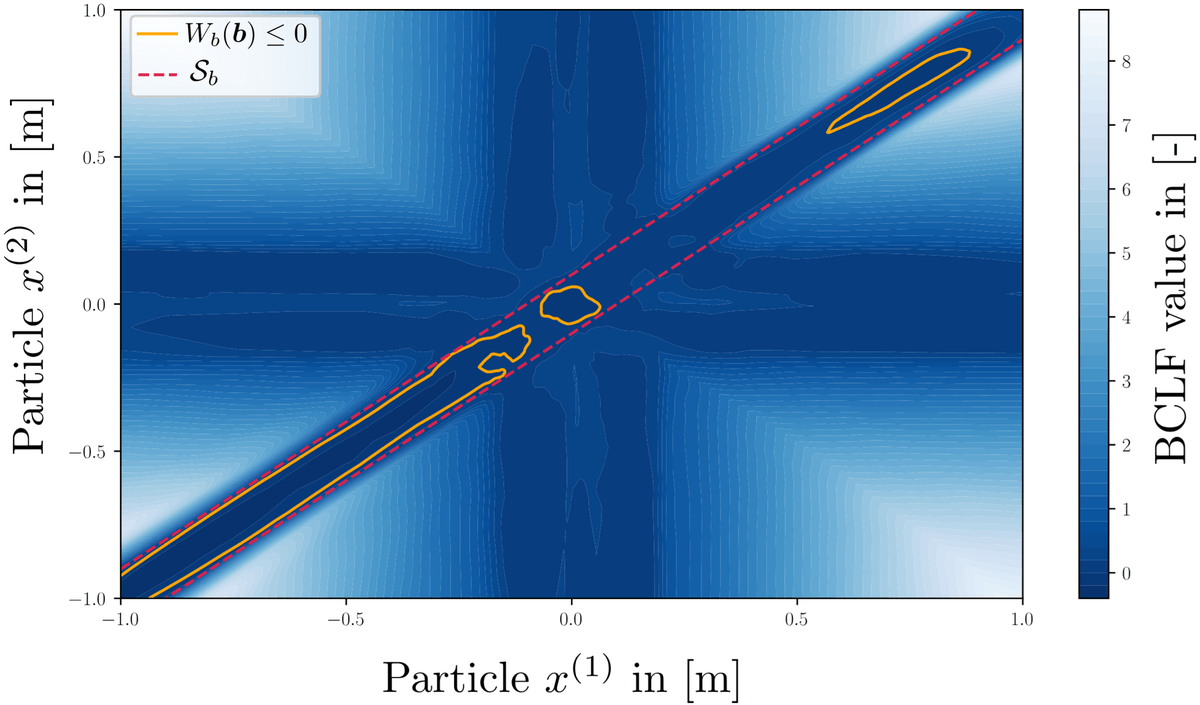
- Belief CLF (information gathering): a Lyapunov function defined over the belief itself. It certifies that the belief will converge to a "localized" set, meaning a region where the true state lies within an epsilon-ball of the mean with a chosen probability.
- Belief CBF (safety filter): a barrier-function filter that minimally corrects any unsafe control input, using conformal prediction to give probabilistic safety over a finite horizon rather than only pointwise in time.
Each layer becomes a lightweight quadratic program. The safety filter runs fast (50 Hz on hardware) while the information-gathering controller runs at the measurement rate (10 Hz), which is exactly the kind of decoupling classical robotics stacks use in state space but was missing in belief space.
Learning a Lyapunov function for uncertainty
Handcrafting a Lyapunov function on a particle-filter belief with more than ten thousand particles is not realistic, so the authors learn one via reinforcement learning. They prove a theoretical bridge: under a reward structure with bounded negative one-step rewards and an absorbing zero-reward goal, the negative of the optimal value function W(x) = -V*(x) satisfies the conditions of a stochastic Control Lyapunov Function on a bounded region, and an analogous result holds for finite-time convergence.
To make RL work on a belief made of permutation-invariant particles, they use a PointNet-style encoder: each particle is passed through a shared MLP, then aggregated with an elementwise max into a belief embedding that a second MLP turns into the Lyapunov value. The reward is simply r(b, u) = -1 - R_epsilon(b), where R_epsilon is a conformal-prediction-based uncertainty measure that turns negative once the belief is tight enough. Training uses off-the-shelf DQN.
The uncertainty measure itself is a nice trick. Differential entropy is essentially constant for unweighted particle filters, so the authors instead compute a nonconformity score (distance from the mean) for each particle, sort them, and apply conformal prediction to get a radius that contains the true state with a chosen probability, without any Gaussian assumption.
Safety over a horizon, not just an instant
Previous belief-space CBFs guarantee safety pointwise in time. This paper strengthens that to a horizon guarantee by treating the minimum of the safety function over an interval as the nonconformity score and applying conformal prediction to N particle trajectories. The resulting QP enforces a stochastic reciprocal barrier constraint on the top-p most-conservative particles, where p is chosen from the desired risk level.
For a mission composed of M measurement intervals, the paper shows the horizon probability decomposes as (1 - delta_bar)^M, so a user picking a target overall probability can back out the per-interval risk. The synthesis remains a single QP even for belief dimension over 10,000.
What the numbers look like
They compare against constrained POMDP solvers CPOMCPOW and CPFT-DPW across three environments: a constrained version of the classic Lightdark problem, a 2D antenna-ranging task, and a bumper environment where the robot localizes only by hitting walls.
| Environment | Method | Reach | Avoid | Success |
|---|---|---|---|---|
| Constrained Lightdark | CPOMCPOW (best) | 0.72 | 0.86 | 0.47 |
| Constrained Lightdark | Full architecture | 0.99 | 1.0 | 0.99 |
| Constrained Antenna | CPOMCPOW / CPFT-DPW | 0.0 | 1.0 / 0.99 | 0.0 |
| Constrained Antenna | Full architecture | 0.95 | 0.98 | 0.95 |
The MCTS baselines either play it too safe (never reaching the goal in the antenna task) or trade avoid rate for reach rate as the planning step shrinks. Ablations on the Bumper environment also show the Lyapunov coefficient acts as a tuning knob between aggressive information gathering and shorter paths.
Space-robotics hardware, and reusable certificates

The hardware experiment uses a three-air-bearing platform that floats over an epoxy floor to approximate weightlessness in 2D. With only an IMU available, the robot localizes by bumping into walls, then navigates through a narrow corridor to a repair station. The BCLF is trained purely in simulation and transferred directly to hardware, running on 8000 particles with the safety filter at 50 Hz.
One of the more practical results is reuse. Because the BCLF only encodes how to reduce uncertainty in a given workspace, the same learned function drives a completely different task, such as a circular-tracking objective, by swapping only the reference controller and the barrier function. It also generalizes to Gaussian initial beliefs never seen during training, which always started from uniform particles.
Caveats worth knowing
- Guarantees hold for the true optimal value function. In practice you get an approximate BCLF, and the paper's empirical checks show the sub-zero level set slightly under-approximates the true localized-belief set.
- Action spaces are discretized for the DQN. Continuous-action variants using something like TD3 are proposed as future work.
- The BCLF and BCBF can conflict, trapping the robot in local minima. The authors monitor BCLF stagnation and switch to the direction of steepest descent, which works empirically but is not formally guaranteed.
- Assumption 1 (i.i.d. resampled particles) is only asymptotically valid; for small particle counts the conformal guarantees degrade.
- The paper does not appear to release a public code repository. A hardware video is available at youtu.be/0uxGLdUVQ10.
For anyone building robots that have to act under real sensor noise, the message is that the belief-space equivalent of a layered controller finally has usable pieces. Certificates over beliefs are no longer confined to verification, they can be synthesized online at real-time rates, and reinforcement learning can produce them without the sampling-heavy grids that made earlier neural Lyapunov methods hard to scale.