
KTH's CRA-DL Beats Byzantine Attacks With 2.75x Less Storage
A new distributed training scheme mixes gradient coding with robust aggregation to blunt Byzantine attacks, even when device data is highly heterogeneous.
 Pro
Takeaways
- CRA-DL combines gradient coding with robust aggregation to defend distributed training against Byzantine workers.
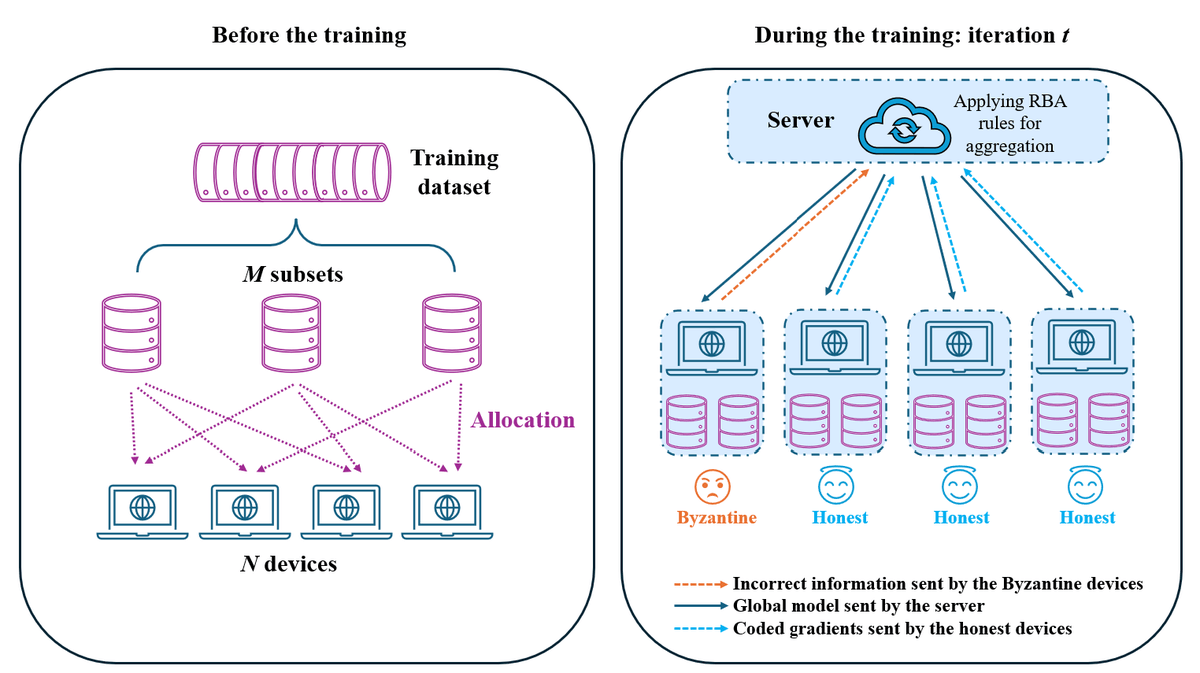
- Redundant pair-wise balanced data allocation makes honest devices produce nearly identical coded gradients, so attacks stand out.
- Beats mean, Phocas, SGC, and an oracle Clairvoyant baseline on linear regression and MNIST.
- Matches exact gradient coding's robustness at
r=40instead ofr=110, cutting storage and compute costs. - Meta-algorithm compatible with coordinate-wise median, trimmed mean, Phocas, MCA and other RBA rules.
- Full paper on arXiv; no public code released yet.
Distributed training assumes every worker plays nice. In practice, hardware faults, buggy code, or compromised firmware can turn some devices into Byzantine nodes that send arbitrary garbage back to the server. A new paper from KTH Royal Institute of Technology, Coded Robust Aggregation for Distributed Learning under Byzantine Attacks, proposes a method called CRA-DL that combines gradient coding with robust aggregation and shows it holds up much better than either approach alone, especially when data is unevenly split across workers.
Why robust aggregation quietly falls apart
The standard defense against Byzantine workers is a robust bounded aggregation (RBA) rule at the server: coordinate-wise median, trimmed mean, geometric median, Krum, or Phocas. These rules bound how far the aggregated result can drift from the honest average, and they work well when honest workers all send similar gradients.
That assumption rarely holds. Current distributed learning methods apply RBA rules to local gradients from honest devices together with disruptive information from Byzantine ones, and performance degrades significantly when local gradients vary considerably across devices. When each worker sees a different slice of a non-IID dataset, honest updates look noisy to the aggregator, and malicious messages can hide inside that noise and steer training off course.
Gradient coding sidesteps this by redundantly placing data across workers so the server can reconstruct the true global gradient even if some messages are corrupted. That works, but the redundancy needed for exact recovery is punishing. In the paper's linear regression setup, a prior gradient-coding method needs each device to hold