
KRAFTON's VLM-SubtleBench Exposes an 18-Point Gap Between AI and Human Vision
VLM-SubtleBench reveals that even GPT-5-thinking trails humans by nearly 18 points on fine-grained visual comparison tasks across industrial, medical, and aerial domains.
 Pro
Takeaways
- VLM-SubtleBench is a new benchmark of 13K image-pair tasks testing subtle visual differences across 10 categories and 6 domains including medical, industrial, and aerial.
- Humans score 95.5% average accuracy; the best model (GPT-5-thinking) reaches only 77.8%, a gap of nearly 18 percentage points.
- Spatial, temporal, and viewpoint tasks are the hardest: most models score near random (50%) on temporal ordering from the VLM4D dataset.
- Prompting tricks like chain-of-thought offer marginal gains; image concatenation and two-step reasoning actually hurt performance in most categories.
- Fine-tuning on VLM-SubtleBench transfers better to real industrial and aerial tasks than fine-tuning on prior benchmarks like MLLM-CompBench.
- Dataset and code are publicly available at HuggingFace and GitHub.
Ask a vision-language model to spot the difference between two nearly identical chest X-rays, or to tell which satellite image shows a building that has since been demolished, and the results are humbling. A new benchmark called VLM-SubtleBench, released by researchers at KRAFTON and KAIST, exposes a systematic blind spot in today's best models: subtle comparative reasoning. While models like GPT-4o look impressive on standard visual benchmarks, they crumble when the task requires detecting fine-grained differences between two highly similar images.
The gap that existing benchmarks missed
Most comparative reasoning benchmarks test whether a model can tell apart two lemons, or spot that a chair has been swapped for a table. These are easy wins for modern VLMs. Prior benchmarks focus on relatively simple comparisons between fairly dissimilar scenes, and as a result they are easily solved by state-of-the-art VLMs such as GPT-4o. The real challenge, the kind that matters in industrial inspection, radiology, and satellite surveillance, is detecting changes that are barely perceptible.
Most prior benchmarks are composed of natural images and fail to assess performance in specialized domains such as industry or medical. VLM-SubtleBench addresses both gaps at once: it measures image similarity using DINOv3 embeddings to ensure pairs are genuinely close together visually, and it spans six distinct domains that reflect real deployment environments.

What the benchmark actually tests
VLM-SubtleBench comprises 13K triplets of image pairs, questions, and answers, covering 10 representative difference types: Attribute, State, Emotion, Temporal, Spatial, Existence, Quality, Quantity, Viewpoint, and Action, collected from diverse image domains including Natural, Game, Industry, Aerial, Synthetic, and Medical. Each category contains at least 1,000 question-answer pairs, and the benchmark supports both multiple-choice VQA and open-ended captioning tasks.
Here is what each difference type actually demands from a model:
- Attribute: Detect subtle color or size changes in objects, including industrial defects and edited natural images
- State: Judge which image shows more damage or a more advanced stage of a process (e.g., an apple being peeled)
- Emotion: Compare the intensity of facial expressions across video frames
- Temporal: Determine which of two frames came first in a video sequence, sometimes requiring common-sense reasoning (e.g., a boat can only move forward)
- Spatial: Identify how an object has moved or rotated between frames
- Existence: Spot a missing or newly appeared object, including in dense aerial imagery
- Quantity: Determine which image has more objects, from fruit counts to building counts from satellite
- Quality: Judge which image suffers more from blur, noise, or compression artifacts
- Viewpoint: Identify camera motion direction between two frames
- Action: Recognize which image shows a specific human or animal action

How the dataset was built
The curation pipeline is one of the more interesting engineering contributions of the paper. Rather than relying on a single source, the team assembled data from over a dozen existing datasets and applied a mix of rule-based pairing, human annotation, and model-assisted generation. For attribute differences in natural images, GPT-4o was used to determine an object's primary color and suggest a similar but distinct alternative, and then Gemini-2.5-flash-image-preview applied the color change, producing minimally different pairs. All edited images were manually checked by human annotators.
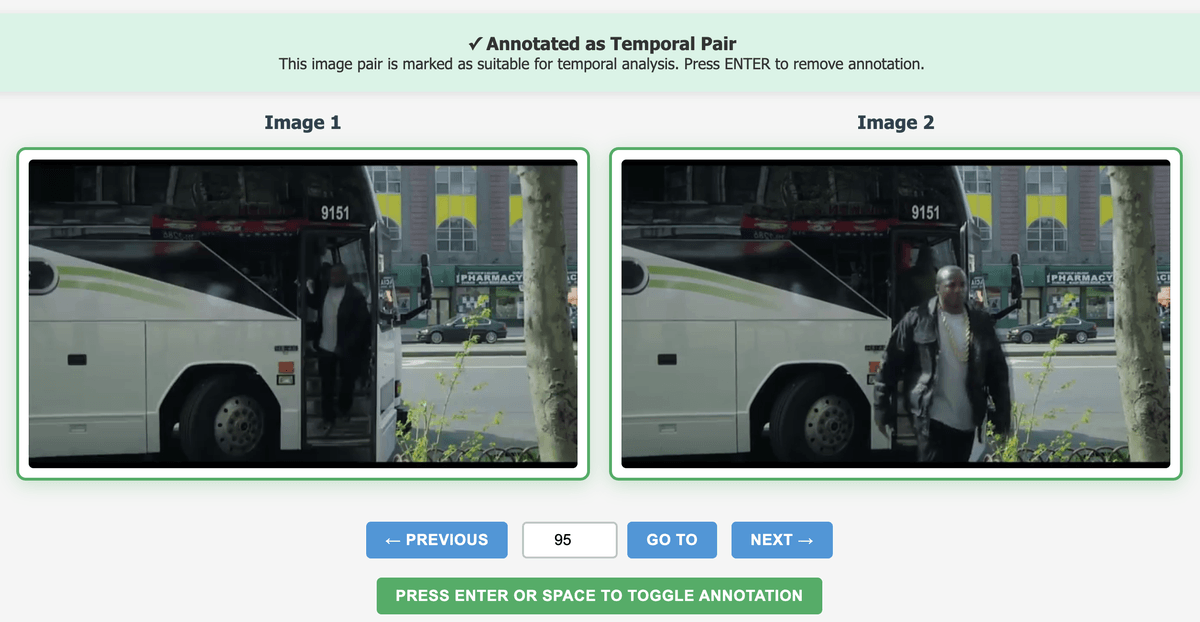
For temporal and action tasks, human annotators selected frame pairs whose temporal order cannot be reversed, marking them as temporal pairs. The medical domain draws from MIMIC-CXR chest X-ray pairs, with clinical questions reformulated into plain language (e.g., "lung opacity progression" becomes "Which image shows whiter lungs?"). Aerial existence tasks use the LEVIR-MCI change detection dataset, filtering for pairs where less than 20% of the image area changed, ensuring genuine subtlety.
Where every model falls apart
Even advanced proprietary VLMs such as GPT-5 and Gemini-2.5-pro exhibit significant performance gaps compared to humans, especially on difference types that demand spatial, temporal, and viewpoint reasoning. Human evaluators scored 95.5% average accuracy. The best model, GPT-5-thinking, reached 77.8%. That is a gap of nearly 18 percentage points.
The breakdown by category is revealing:
| Difference Type | Human | GPT-5-thinking | Gemini-2.5-pro | Qwen2.5-VL-72B |
|---|---|---|---|---|
| Emotion | 93.0 | 93.1 | 89.8 | 85.9 |
| Existence | 97.0 | 85.4 | 79.9 | 81.7 |
| Quality | 99.0 | 84.8 | 84.8 | 78.4 |
| Spatial | 95.0 | 59.9 | 44.8 | 47.8 |
| Temporal | 93.0 | 60.2 | 57.6 | 49.9 |
| Viewpoint | 98.0 | 68.5 | 60.3 | 56.2 |
| Attribute | 92.0 | 83.6 | 55.3 | 53.9 |
Across different difference types, VLMs show strong performance on emotion, with GPT-5-thinking achieving 93.1% accuracy. In contrast, all models perform weakly on temporal, spatial, and viewpoint differences, which require common-sense reasoning and spatial understanding. The temporal task is particularly brutal: on the VLM4D subset, most models score barely above the 50% random baseline.
Prompting tricks barely move the needle
The paper ran an exhaustive set of prompting experiments, testing chain-of-thought reasoning, two-step reasoning, grid overlays, image concatenation, pixel-subtraction maps, and bounding-box highlighting. The results are sobering for anyone hoping a clever prompt will close the gap.
- Chain-of-thought (CoT) prompting improved performance in 9 out of 10 categories, with a modest average gain of about 1.8 points for GPT-5-main
- Two-step reasoning (first describe differences, then answer) actually hurt performance because models frequently described "no difference" in the first step
- Image concatenation, a common setup in prior work, degraded accuracy in 9 out of 10 domains
- Pixel subtraction maps helped on spatial and existence tasks where the background is static, but hurt on tasks with natural lighting variation
- Bounding-box highlighting gave modest gains on synthetic data but failed on real-world images where brightness differences confuse the change detector
Fine-tuning Qwen2.5-VL-7B on the validation set yields consistent performance improvements across all difference types, with particularly notable gains in existence, quantity, and quality categories. Fine-tuning pushed the 7B model from 59.4% to 69.5% average accuracy, approaching GPT-4o territory, which suggests the benchmark's training split has real value for practitioners.
Controlled failure modes
One of the most useful contributions is a set of controlled synthetic experiments that isolate exactly what causes models to fail. The team generated 100 image pairs per configuration, varying one factor at a time.
- Color changes: Models need at least a 25% brightness shift to reliably detect attribute differences. A 5% shift yields near-random performance. Magenta objects are particularly problematic, with GPT-4o approaching 0% accuracy on magenta hue discrimination.
- Object size: Models depend more on the absolute size of the changed object than on relative scaling. Small objects undergoing large relative changes are easier to detect than large objects with small absolute changes.
- Scene complexity: For existence tasks, accuracy is near-perfect with 4 or fewer objects but drops below 60% once scenes exceed 32 objects.
- Viewpoint: Unusually, performance improves with scene complexity because richer visual cues make camera motion easier to infer.
Real-world relevance confirmed
The benchmark's practical value is validated through transfer experiments. Fine-tuning on VLM-SubtleBench yields larger gains on both industrial anomaly detection (MMAD) and aerial surveillance (QAG-360K) application benchmarks, whereas fine-tuning on MLLM-CompBench provides limited or even negative transfer. This matters: it means that training on genuinely subtle differences generalizes to real deployment tasks, while training on easy comparisons does not.
The dataset and code are available at the KRAFTON HuggingFace repository and GitHub. For teams building VLM-based agents for quality control, medical imaging, or remote sensing, VLM-SubtleBench offers both a rigorous diagnostic tool and a fine-tuning dataset that actually transfers to the task at hand.