
KoopmanFlow Beats 10-Step Robot Policies With a Single Inference Pass
A dual-branch generative policy uses Koopman operator theory to separate stable robot motions from high-frequency reactive corrections, boosting contact-rich task success by 15+ points.
 Pro
Takeaways
- KoopmanFlow splits generative robot policies into two branches: one for stable motion, one for high-frequency reactive corrections.
- Uses a Koopman-inspired structural prior with RFFT to decouple low and high-frequency latent trajectory components.
- Achieves 85.2% on Adroit and 79.1% on DexArt, beating ManiFlow by 6-16 points across benchmarks.
- Runs single-step inference at 29.7 FPS with ~224M parameters, fitting real-time control latency budgets.
- Time-variant branch correlates 6x better with semantic visual events than naive frequency filtering on raw actions.
- No public code release yet; struggles with severe occlusions and objects far outside training distribution.
Generative policies based on diffusion and flow matching have become the default recipe for teaching robots to manipulate objects from demonstrations. They hit a wall the moment you deploy them: run the ODE solver for ten steps and you get smooth, high-fidelity actions but blow past the latency budget of real-time control; compress it to a single step and the model mathematically smears over the sharp, high-frequency corrections that matter most during contact events like grasping or collisions.
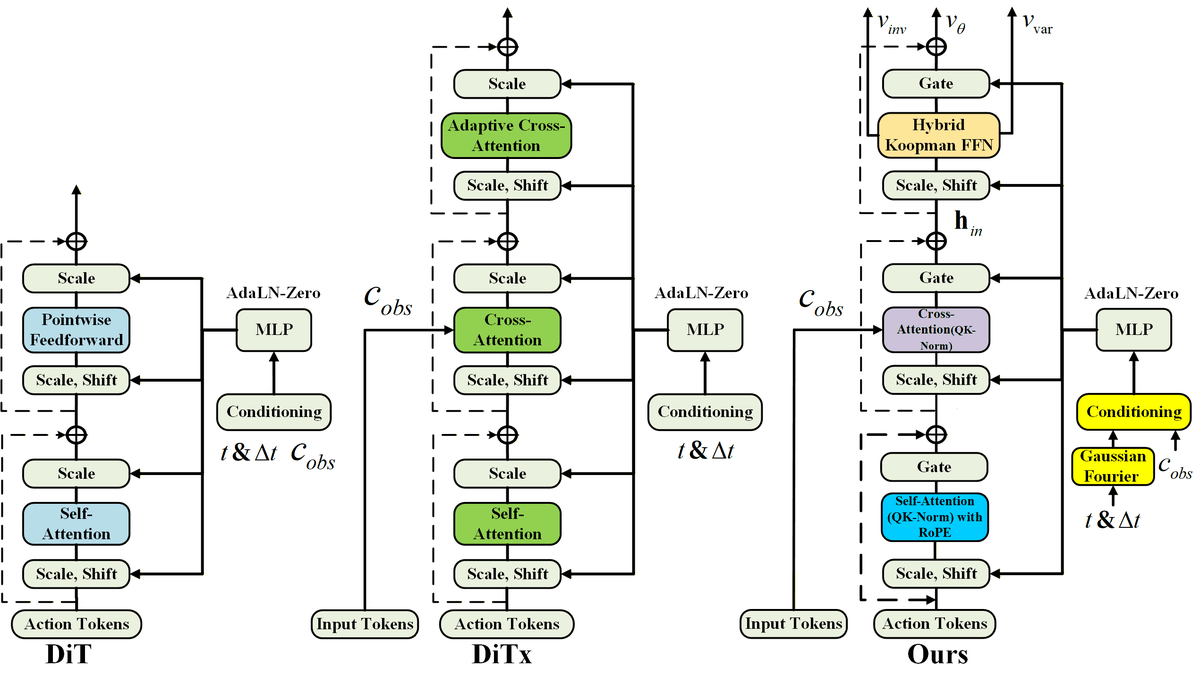
A new paper called KoopmanFlow proposes a structural fix rooted in dynamical systems theory. Instead of asking one vector field to model both slow inertia and fast reactive twitches, the architecture splits generation into two branches at the terminal layer, one dedicated to each frequency regime. A 1-step KoopmanFlow achieves 89.7% success on the Toilet task, outperforming fully expanded 10-step ManiFlow at 79.3%.
Why one vector field cannot serve two masters
The core diagnosis is what the authors call spectral confounding. When you visualize the latent action manifold across manipulation tasks, time-variant critical states like grasping moments do not occupy isolated sub-manifolds. They sit deeply intertwined within the continuous trajectories of massive time-invariant steady states. A monolithic ODE solver has to abruptly shift from modeling steady inertia to predicting sharp corrections inside the same topological neighborhood, and it fails to do so cleanly under a one-step budget.
A naive fix would be to apply a mathematical high-pass filter to the raw action sequence. That does not work either. The paper shows via correlation analysis that the high-frequency energy in raw actions barely aligns with actual semantic visual events (Pearson correlation of 0.038). The reactive corrections a robot needs are visually-driven responses to contacts and occlusions that require visual conditioning to identify, not stochastic noise.
Two branches, two operators, one shared latent
KoopmanFlow keeps a standard Diffusion Transformer backbone but rewires the final feed-forward network into what the authors call a Hybrid Koopman FFN (HKFFN). Visual and language context flow through the DiT blocks before the split, so both branches are visually conditioned. The split itself uses a 1D Real Fast Fourier Transform along the physical action sequence, retaining the top-amplitude frequencies that account for a cumulative energy threshold (about 85%) as the time-invariant component.

The two branches then use different mathematical machinery, both drawn from Koopman operator theory (a framework that linearizes complex nonlinear dynamics by lifting states into a higher-dimensional observation space):
- Macroscopic branch: A learned global Koopman matrix models the smooth trajectory as a linear operator, trained with single-step Consistency Training so it produces the entire slow-motion plan in one shot.
- Transient branch: A localized Dynamic Mode Decomposition (DMD) over a small sliding window computes an on-the-fly linear operator for high-frequency residuals, trained with Flow Matching to capture visually-triggered reactive impulses.
To keep exact DMD viable for real-time use, the authors confine it to a compressed 128-dimensional latent bottleneck and use a truncated SVD, resolving the operator in microseconds. The training objective jointly optimizes flow matching, consistency, an explicit decoupling loss, and a kinematic smoothness regularizer, with an asymmetric batch partition (20% of samples for consistency, 80% for flow matching) that avoids gradient conflicts.
Where the gains show up
Evaluated across four simulation benchmarks (RoboTwin 2.0, MetaWorld, Adroit, DexArt) plus real hardware, the 3D point-cloud version of KoopmanFlow beats its closest baseline, ManiFlow, by wide margins on contact-heavy tasks.
| Benchmark | 3D ManiFlow | 3D KoopmanFlow |
|---|---|---|
| Adroit (avg) | 78.6% | 85.2% |
| DexArt (avg) | 63.2% | 79.1% |
| DexArt Bucket | 35.3% | 67.7% |
| DexArt Faucet | 45.0% | 60.7% |
| MetaWorld (48 tasks) | 78.1% | 84.7% |
Gains scale with task horizon: they are largest on long-horizon, contact-rich tasks where compound error accumulates. On the DexArt Bucket task (nearly 100-step trajectories), success rate nearly doubles. On RoboTwin 2.0 the 2D RGB-only version scores 80.4% average, beating even depth-conditioned 3D baselines like DP3 (77.8%).
On latency, KoopmanFlow uses ~224M parameters, runs in 33.7 ms per inference, and sustains 29.7 FPS, keeping it inside the Receding Horizon Control budget of under 50 ms. It carries slightly more overhead than base ManiFlow but runs faster than DP3 while scoring higher.
Spectral routing that actually follows the pixels
The most compelling evidence is the latent dynamics analysis rather than the benchmark numbers. When the authors compare their time-variant branch against a naive RFFT high-pass filter on raw actions, the time-variant branch achieves a Pearson correlation of 0.228 with semantic visual events versus 0.038 for the naive filter, a six-fold improvement. The split routes visually-triggered reactions into a dedicated channel rather than blindly filtering frequencies.

Ablations back this up. Removing the consistency loss collapses Faucet performance from 60.7% to 43% because the invariant branch starts absorbing stochastic noise. Reverting to a standard entangled MLP readout on Handover Block drops success from 81% to 31.5%. The dual-branch architecture also prevents catastrophic overfitting in extreme low-data regimes of 10 to 20 demos.
Where it breaks and what is missing
The authors are refreshingly candid about failure modes. Because the transient branch depends on visual cues to fire, severe occlusions can suppress reactive responses entirely. The 1D RFFT split also struggles during extreme unmodeled physical shocks where the linear Koopman bound momentarily saturates. In real-world unseen-object handovers, the policy fails when objects are much larger or smaller than the training distribution, either because contact dynamics shift or because finger occlusion breaks grasp localization.
One notable gap: the paper does not link to a public code release or model checkpoints, and the arxiv listing shows no open-access PDF. Practitioners hoping to try KoopmanFlow on their own hardware will need to reimplement the HKFFN module on top of an existing DiT-based policy like ManiFlow. The pseudocode in the appendix is compact enough that this is tractable, but full reproduction of the real-world results on the AIRBOT platforms will require the original training pipeline.
For teams building imitation-learning policies for contact-rich manipulation, especially bimanual or long-horizon tasks, the takeaway is that spectral decoupling with a Koopman-inspired structural prior is a cheap architectural change with outsized returns. It sidesteps the usual latency-versus-fidelity tradeoff by admitting that stable motion and reactive correction are fundamentally different signals that deserve different operators, rather than by making the ODE solver smarter.