
KIT and NVIDIA's Trust-Region Method Cuts Diffusion Sampler Errors by 300x
A multi-institution team formalizes trust regions on path measures, taming mode collapse and slashing target evaluations across sampling, molecular dynamics, and diffusion fine-tuning.
 Pro
Takeaways
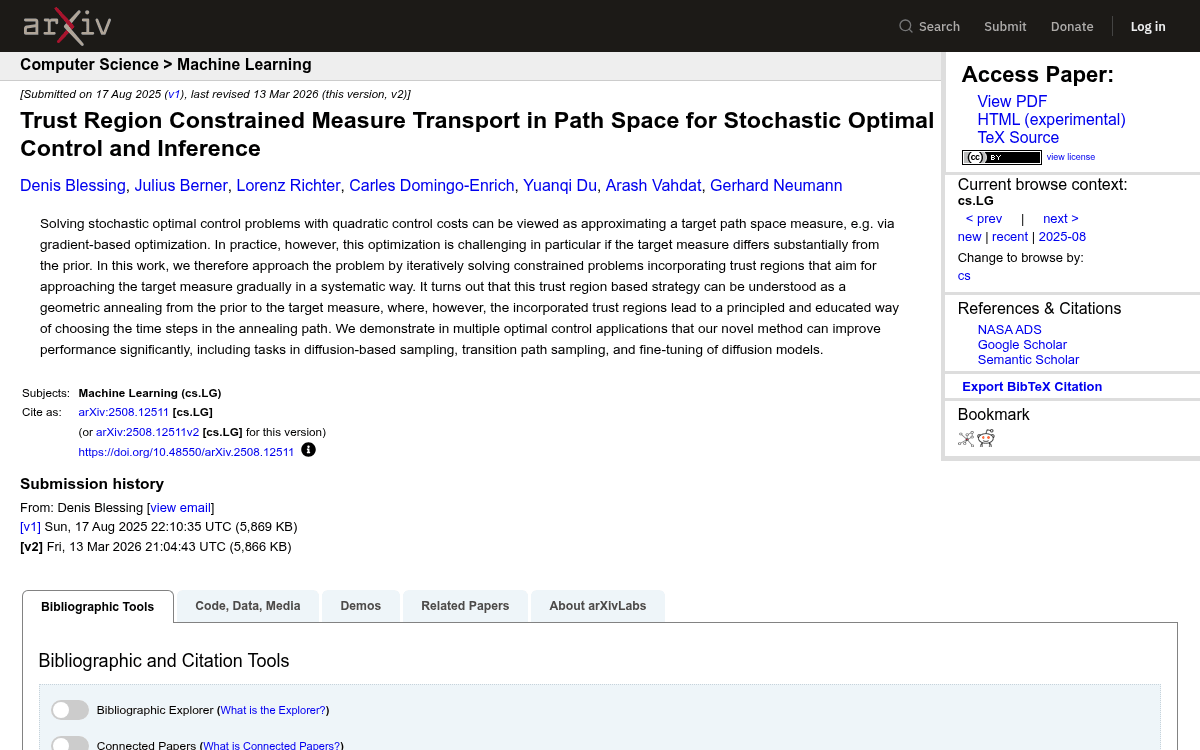
- A multi-institution paper introduces trust-region constrained measure transport for stochastic optimal control on arXiv 2508.12511.
- Iterating with a KL trust region of size epsilon prevents mode collapse and controls importance-weight variance.
- The iterates provably form a geometric annealing with steps equispaced in Fisher-Rao distance.
- TR-LV cleanly samples 32-mode Many Well targets at d=200 where cross-entropy and log-variance baselines fail.
- Transition path sampling on Chignolin hits about 44 percent versus 25 percent for the prior diffusion sampler.
- Fine-tuning Stable Diffusion 1.5 with TR-SOCM matches Adjoint Matching using roughly 3x fewer sampled trajectories.
A group of researchers from Karlsruhe Institute of Technology, NVIDIA, Zuse Institute Berlin, dida, Microsoft Research New England, and Cornell has published a paper that reframes stochastic optimal control (SOC) as a sequence of trust-region-constrained problems on path measures. The method plugs into diffusion samplers, transition path sampling in molecular dynamics, and reward fine-tuning of text-to-image diffusion models, and in each case it fixes the same recurring failure mode: optimizers that either collapse onto a few modes or blow up the variance of importance weights.
The pain point in path-space optimization
Solving stochastic optimal control problems with quadratic control costs can be viewed as approximating a target path space measure via gradient-based optimization. In practice, when the target measure sits far from the prior (an uncontrolled diffusion, typically), the direct approach breaks down. Many algorithms face challenges with high variances or mode discovery when directly minimizing the divergence between the controlled path measure and the target, especially in high dimensions.
This is why practitioners of neural samplers often lean on Langevin preconditioning, which uses gradients of the target density to guide the diffusion. It works, but it is computationally expensive, as it requires querying the target distribution at every discretization step, making such approaches impractical for many problems where evaluating the target gradient is costly.
Bounded KL steps as a principled annealer
The core idea is to stop chasing the target in one shot. Instead, the algorithm walks toward it in bounded steps: at iteration i+1, it minimizes the KL divergence to the target, subject to a KL constraint of size epsilon relative to the previous iterate. The Lagrangian relaxation turns each step into another SOC problem that can be solved with existing iterative diffusion optimization losses.
The theoretical payoff is elegant. The authors prove that the intermediate measures define a geometric annealing between the prior and target measure, where the annealing step-sizes are chosen optimally, in the sense of having an approximately constant change in Fisher-Rao distance. In plain terms, Fisher-Rao distance is the natural notion of distance between probability distributions on a statistical manifold, and equispaced steps in it are what tempering and annealed importance sampling try to achieve by hand. Here the schedule falls out for free from the constraint.
Another practical consequence: the KL bound directly controls the variance of importance weights between consecutive iterates. For small epsilon, the variance is approximately 2 times epsilon, which means the buffered samples from iteration i remain useful for training iteration i+1. That enables genuine off-policy training with a replay buffer.
How the algorithm actually runs
- Simulate a batch of trajectories under the current control and store them, along with importance weights, in a buffer.
- Solve a one-dimensional dual problem for the Lagrange multiplier lambda_i using a nonlinear solver on the buffered samples.
- Update the control by minimizing a divergence loss (log-variance or a trust-region variant of SOC matching) using multiple passes over the same buffer.
- Repeat until the multiplier drops below a threshold, indicating the target has been reached.
The authors provide two concrete instantiations: TR-LV (trust region log-variance) and TR-SOCM (trust region SOC matching), the latter using a lean adjoint state that avoids storing the full trajectory for backpropagation.
What the numbers show
On a Gaussian mixture target, for dimensions beyond d=10, most methods suffer from mode collapse, as reflected by increased control errors, except for those employing trust region updates. On the Many Well benchmark with 32 modes at d=200, TR-LV reports a log-normalizing-constant error of about 0.002, compared to 0.6 to 3.5 for the baselines (relative entropy, cross entropy, log-variance, adjoint matching, and SOCM).
For transition path sampling on Alanine Dipeptide and Chignolin, TR-LV beats the previous diffusion path sampler on both RMSD to the target state and transition hit percentage, with markedly lower variance across seeds. On Chignolin the transition hit rate rises to roughly 44 percent, versus 25 percent for the unconstrained baseline.
For reward fine-tuning of Stable Diffusion 1.5 with ImageReward, TR-SOCM matches Adjoint Matching on CLIP-Score, human preference, and Dreamsim diversity while doing three passes over each 500-trajectory buffer, cutting the number of sampled trajectories by roughly 3x. Since trajectory sampling dominates the wall-clock cost of fine-tuning, the effective speedup is significant.
Where it fits and where it hurts
The framework is a drop-in extension for existing iterative diffusion optimization pipelines: Denoising Diffusion Samplers, adjoint matching for diffusion fine-tuning, and log-variance-based path samplers. The main caveat is memory. In large-scale settings such as fine-tuning text-to-image models, this necessitates keeping the replay buffer in CPU memory while training occurs on the GPU. This separation introduces additional computational overhead due to data transfers between CPU and GPU.
Code and experimental details, along with the full derivations, are in the paper; the fine-tuning experiments build on the public microsoft/soc-fine-tuning-sd repository, and the transition path sampling experiments extend the tps-dps codebase.