
KIST Researchers Argue Home Robots Should Prioritize Elder Control Over Autonomy
A small study with four older adults reframes home robots around confirmation, predictability, and adjustable autonomy rather than raw automation.
 Pro
Takeaways
- KIST and Imperial researchers propose an equity-centred robotic furniture agent for aging-in-place, detailed in a position paper.
- ADL-grounded interviews with four adults aged 70-90 surfaced three recurring pain points: finding items, medication, and transport.
- Concept extends the existing CollaBot cabinet and cart with LLMs and computer vision for natural interaction.
- Follow-up video interviews revealed strong preferences for confirmation before actuation and adjustable autonomy.
- Seven design principles emphasise recognition over recall, legible intent, sensing fairness, and on-device privacy.
- No code, model, or quantitative benchmarks released; framed as a workshop discussion piece for HRI 2026.
A new position paper from researchers at KIST and Imperial College London pushes back on the reflex to make home robots for older adults more autonomous. It argues that the next generation of assistive systems should be judged on how well they preserve user control, and it grounds that claim in interviews with adults in their 70s to 90s about the small frictions that accumulate during everyday chores.
The work, published on arXiv and slated for the HRI 2026 Equitable Robotics for Wellbeing workshop, sketches an LLM-augmented robotic furniture concept and then stress-tests it with the same participants using video scenarios. The result reads less as a benchmark race than a design blueprint, but it puts concrete requirements on the table for anyone building agents that live in real homes.
Why small annoyances become a big deal
The authors start from a clinical framing familiar in gerontology: Activities of Daily Living (ADL) indices have long been used as representative measures to quantify functional status in older adults, while Instrumental ADL extends this to more complex life tasks tied to independent living. Their argument is that individually minor difficulties in these routines quietly compound into fatigue, anxiety, and safety risks.
Semi-structured interviews with four participants surfaced three recurring pain points:
- Organising and finding items: searching combines memory demands with repeated drawer opening and closing, which can be tiring and increases the risk of bumps or pinching.
- Taking medication: prospective-memory load around whether and when a dose was actually taken.
- Transporting objects: repeated trips with laundry or groceries that drain limited strength.
The authors note these tasks are neither purely cognitive nor purely physical, which is why point solutions like a pill reminder app or a grab bar tend to miss the compounded burden.
The furnishing-agent concept
Rather than designing a new humanoid, the team extends CollaBot, an existing prototype whose current scope is deliberately narrow: a cabinet with app-triggered drawers, ROI-based skeleton tracking for user-approach detection, and a cart-like mobile platform that moves only to predefined locations. The proposed extension adds an LLM and computer vision layer on top of that reliable base.
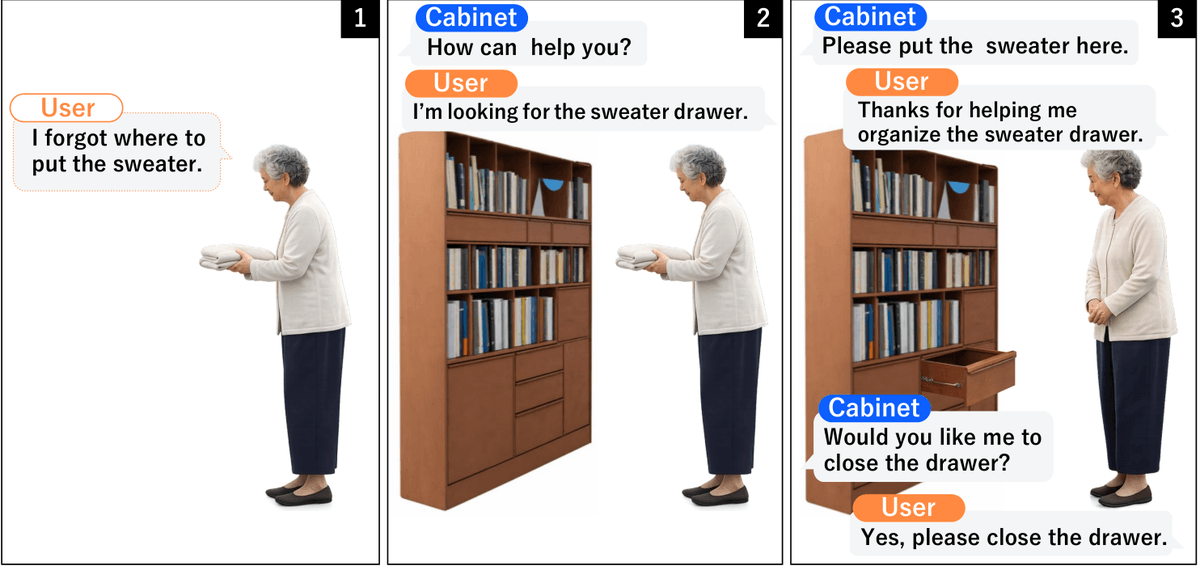
Four scenarios illustrate the intent: finding an item, organising an item, medication reminders, and object transport. In each, the agent suggests an action, waits for user confirmation, then executes with conservative defaults.

The technical sketch is intentionally modest. It calls for minimal state sensing (presence, drawer open/closed, cart location), clarifying questions when a request is ambiguous like Bring me that, speed limits and confirmation gates before any movement, and fallback inputs such as app buttons so the system still works when speech or vision fails.
What the follow-up interviews revealed
After watching videos of the system in action, participants shifted from evaluating features to evaluating choreography. Three patterns dominated:
- Confirmation before actuation. Users wanted explicit consent before drawers closed or the cart moved, to avoid startles and pinching.
- Predictability and legibility. The robot should announce where it will go and why before doing it.
- Context-sensitive autonomy. Proactive help was welcome when hands were full or during medication routines, but reactive help was preferred otherwise.
One participant asked for user-adjustable opening and closing speed simply to avoid being startled, a detail that rarely shows up in HRI datasets but decides whether the device gets unplugged.
Design implications worth stealing
The paper distills its findings into seven design principles. A few stand out for anyone building agentic home systems:
- Recognition over recall: externalise storage memory and medication status so users do not have to hold state in their heads.
- Legible intent: use multimodal cues (voice, LEDs, motion previews) rather than silent execution.
- Fairness in sensing: evaluate detection errors across mobility aids, speech patterns, and lighting conditions, and always ship a fallback input channel.
- Privacy as wellbeing: prefer on-device processing, and make data practices transparent and revocable.
Where the work stops short
This is a position paper rather than an empirical evaluation. The sample is four participants, the extended system is a concept sketch rather than a working LLM-driven prototype, and no code or model is released. There are no quantitative benchmarks, no comparisons to voice assistants like Alexa or existing eldercare robots, and no deployment data from real homes.
What it does offer is a compact requirements list grounded in ADL clinical frameworks and lived experience, which is often what goes missing when teams jump from a foundation model to a shipped product. If you are wiring an LLM into anything that physically moves near a person, the confirmation-and-predictability pattern here is a cheap way to avoid the kind of failure mode that ends a pilot early.