
Kingston University's PGcGAN Generates Fake Patient Walks to Beat Clinical Data Shortages
A conditional GAN generates synthetic 3D gait sequences for six clinical walking impairments, boosting classification accuracy when scarce patient data limits training.
 Pro
Takeaways
- PGcGAN generates synthetic 3D gait sequences conditioned on six pathology labels for data augmentation.
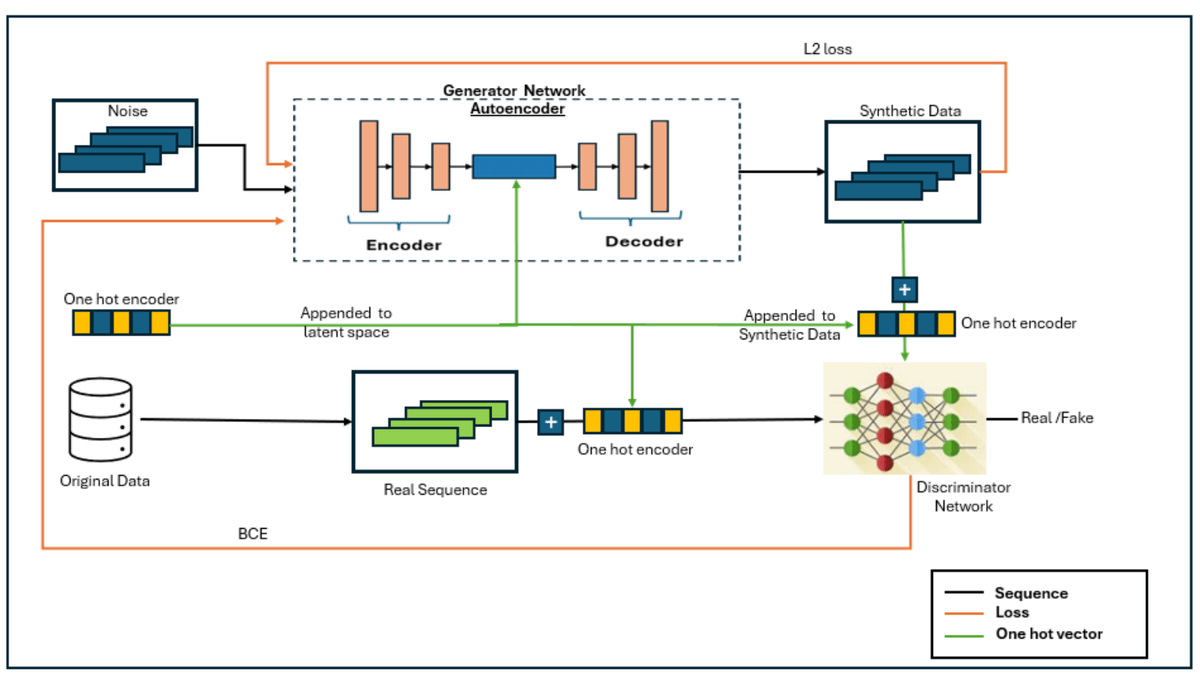
- One-hot pathology labels are injected into both generator and discriminator for controlled synthesis.
- Generator is a conditional autoencoder trained with adversarial plus L2 reconstruction losses.
- GRU classification improved from 91.87% to 92.61% when augmenting real data with synthetic samples.
- Synthetic-only training underperforms real-only by 3-5 points, limiting use to augmentation.
- Paper on arXiv, no code or pretrained weights released yet.
Clinical gait data is notoriously hard to come by. Patients with movement disorders are recruited in small numbers, privacy rules restrict sharing, and each condition manifests differently across bodies, meaning models trained to recognize pathological walking patterns rarely see enough examples to generalize well. A team from Kingston University and Indiana University Health is proposing a way around that bottleneck: train a conditional GAN to fabricate labeled gait sequences on demand.
Their model, PGcGAN, learns directly from 3D pose keypoint trajectories and can be steered to produce sequences that mimic six specific gait categories. Augmenting real data with synthetic sequences improved pathological gait recognition across GRU, LSTM, and CNN models, which is the practical outcome that matters for anyone building movement-analysis systems on tiny clinical corpora.
Why synthetic gait is a hard problem
Generic motion synthesis models can generate plausible-looking walking, but they wash out the biomechanical quirks that define a pathology. A Trendelenburg gait involves pelvic drop on the swing side; an antalgic gait shortens stance time to avoid pain; a steppage gait exaggerates hip and knee flexion to clear a dropped foot. These are exactly the signals a classifier needs, and exactly what falls out of the distribution when you use an off-the-shelf generator.
Prior GAN work in this space has been narrow. Multivariate GAN generated multichannel ECG signals using minibatch discrimination to avoid mode collapse, and disease-specific efforts like FoGGAN focused on freezing-of-gait episodes in Parkinson's patients. What has been missing is a single model that can be conditioned to produce any of several pathological categories with a label flip.
How the model is built
PGcGAN follows a conditional GAN recipe, but with pathology labels wired into both halves of the network. The generator is a conditional autoencoder: it takes a Gaussian noise tensor, encodes it into a latent vector, concatenates a one-hot pathology label onto that vector, and decodes the result into a full gait sequence. Both the encoder and decoder are built from temporal convolutional blocks with ReLU activations, so short-term joint motion and longer temporal dependencies both get captured.
The discriminator sees real or synthetic sequences concatenated with the same one-hot label, and has to decide whether the combination is authentic. Its convolutional layers use spectral normalization for training stability, a common trick to keep the discriminator from overpowering the generator.
Training combines two objectives:
- A standard adversarial loss that pushes the generator to fool the label-aware discriminator.
- An L2 reconstruction loss between real and generated sequences, which keeps the output structurally faithful rather than merely realistic-looking.
Two coefficients, one for each loss term, balance realism against structural fidelity. That reconstruction term is what discourages the generator from drifting into biomechanically implausible territory just to satisfy the discriminator.
What the numbers show
Evaluation ran on the Pathological Gait Dataset from Jun et al., filtered to sequences of at least 60 frames, leaving 7,157 samples across the six categories: normal, Trendelenburg, antalgic, lurch, stiff-legged, and steppage. Three classifiers were trained under three regimes: real only, synthetic only, and real plus synthetic.

The augmentation results, using classification accuracy:
| Model | Real | Synthetic | Real + Synthetic |
|---|---|---|---|
| GRU | 91.87 | 87.65 | 92.61 |
| LSTM | 90.48 | 85.26 | 90.08 |
| CNN | 87.90 | 83.71 | 89.56 |
GRU and CNN both improve when synthetic data is mixed in, and the GRU number of 92.61% beats the 90.13% baseline reported on the same dataset by Jun et al. LSTM essentially breaks even, which the authors don't dig into but likely reflects that the LSTM was already close to what the real data can support.
On structural fidelity, a trajectory-similarity comparison against a prior synthetic-gait study by Kim and Hargrove produced a mean R squared of 0.94 for normal gait, close to the 0.97 from that earlier work, which focused only on normal walking rather than multiple pathologies.
Where it helps and where it doesn't
The honest limitation is right there in the middle column of the table: synthetic-only training consistently underperforms real-only training, by 3 to 5 points across all three classifiers. The authors attribute this to the limitations of GAN-generated sequences in capturing the full variability of natural gait. In other words, the model captures the average of each pathology cleanly but underrepresents the tails, so it can supplement real data but not replace it.
Practically, that positions PGcGAN as a data augmentation tool for teams building:
- Pathological gait classifiers where recruitment is capped at dozens of patients per class.
- Rehabilitation-monitoring systems that need to recognize when a patient's walking deviates toward a specific impairment pattern.
- Prosthetic and exoskeleton controllers that benefit from exposure to abnormal gait patterns during training without waiting for clinical trials.
One caveat for anyone considering picking this up: the paper does not release code or pretrained weights, and there is no accompanying repository or Hugging Face model card. Reproducing PGcGAN currently means reimplementing the conditional autoencoder architecture from the paper and retraining on the Pathological Gait Dataset yourself. The same authors have since published a follow-up exploring LLM-conditioned gait synthesis, suggesting this line of work is still actively evolving.
The takeaway
PGcGAN is a focused contribution rather than a paradigm shift. Its real breakthrough is showing that a single conditional GAN, with one-hot labels injected at multiple stages of both generator and discriminator, can handle six distinct pathological gait categories simultaneously and produce sequences good enough to nudge downstream classifiers past the previously reported benchmark on their dataset. For anyone working on movement analysis with a starved dataset, that is the kind of small, clean result that ports directly into a pipeline.