
King's College London Trained 4,000 Models to Prove AI Distillation Copies Mistakes
New research on 4,189 trained models finds knowledge distillation often behaves like regularization, and when it does transfer, it disproportionately copies the teacher's mistakes.
 Pro
Takeaways
- Study of 4,189 trained models finds knowledge distillation often acts as regularization, not knowledge transfer.
- Random Control Distillation with uniform targets frequently matches or beats real teacher distillation on accuracy and loss.
- When genuine transfer occurs, students disproportionately copy the teacher's wrong predictions, not its correct ones.
- Effect verified across vision, audio, and language, with 9 architectures and 7 datasets.
- Adversarial demonstration shows poisoned teacher patterns transfer cleanly to students under standard KD.
- Authors recommend auditing teacher error modes and reporting teacher-correct vs teacher-incorrect agreement alongside accuracy.
A sprawling new empirical study argues that knowledge distillation, one of the most widely used tricks for shrinking neural networks, may not actually be doing what most practitioners assume. Instead of faithfully compressing a teacher's knowledge into a smaller student, the technique often behaves more like a fancy regularizer, and when genuine transfer does occur, it tends to preferentially copy the teacher's mistakes rather than its correct behavior.
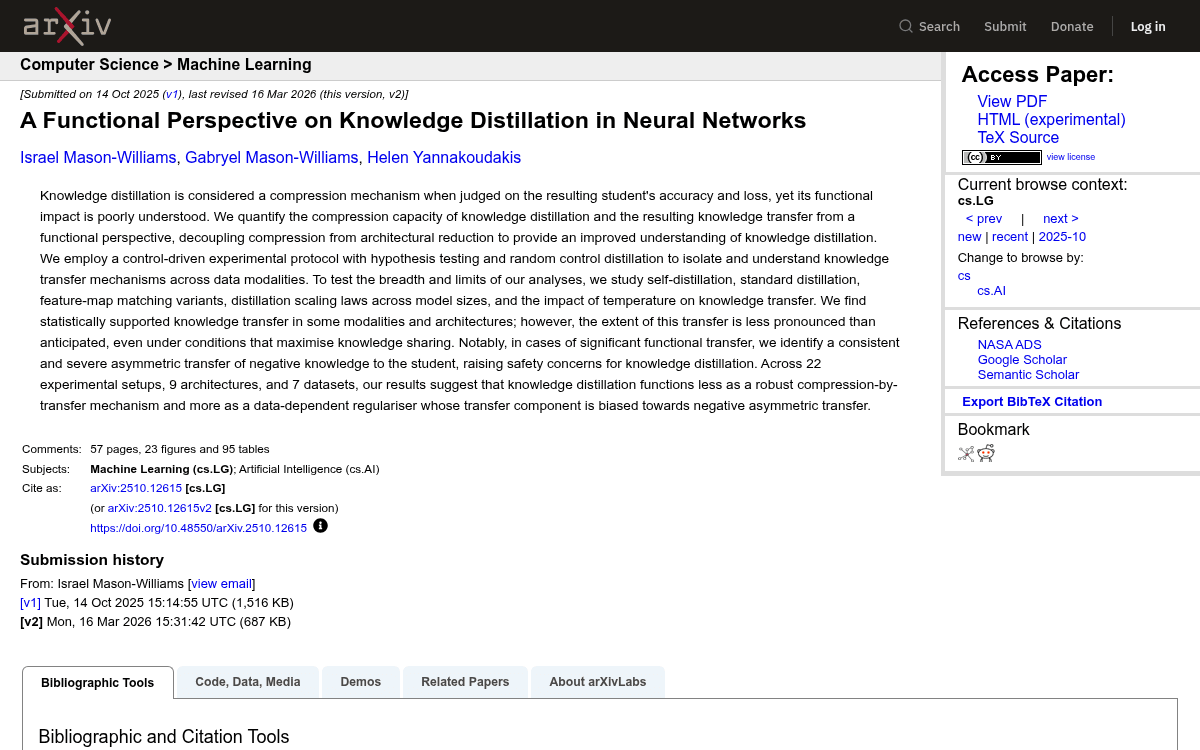
The paper, A Functional Perspective on Knowledge Distillation in Neural Networks, comes out of King's College London and Queen Mary University of London. Across 22 experimental setups, 9 architectures, and 7 datasets, the results suggest that knowledge distillation functions less as a robust compression-by-transfer mechanism and more as a data-dependent regulariser whose transfer component is biased towards negative asymmetric transfer. The authors trained over 4,000 models to make the case.
The mechanism nobody could pin down
Knowledge distillation (KD) has been a workhorse since Hinton's 2015 paper. The recipe is simple: train a small student model to match the softmax outputs of a big teacher, in the hope that the teacher's "dark knowledge" (the relative probabilities across wrong classes) contains signal that hard labels don't. It underpins compressed BERT variants, deployed vision backbones, and much of the recent LLM distillation pipeline.
The problem is that nobody agrees on why it works. A line of work interprets KD as a form of data-dependent regularisation, arguing that limited or no knowledge is transferred under its optimisation objective. Other literature, on the other hand, strongly argues that KD can effectively transfer meaningful knowledge from teacher to student. Prior work has even shown gains from randomly initialized teachers, which is hard to reconcile with the "transferring wisdom" story.

A randomized control trial for distillation
The authors treat KD like a clinical intervention and build proper control conditions. For every KD student, they train two counterfactuals that share the same architecture, initialization, and data order:
- SIDDO (Same Initialisation, Different Data Order): a plain independently trained model, no teacher signal at all.
- Random Control Distillation (RCD): uses the exact KD loss, but replaces the teacher's soft distribution with a uniform 1/K distribution over classes. This keeps the smoothing effect of distillation while stripping out any teacher-specific information.
RCD is intended as a counterfactual control that preserves the distillation training form while removing teacher information content. If KD is really transferring knowledge, students trained with a real teacher should look more like that teacher (on unseen test data) than either baseline. If they don't, the observed accuracy gains are just regularization in a costume.
To measure similarity between teacher and student, the authors go beyond accuracy and loss and use four functional metrics: Activation Distance, Rank Disagreement, Prediction Disagreement, and Jensen-Shannon Divergence. They also decompose the agreement between teacher and student into two buckets: how often they agree on inputs the teacher gets right, versus inputs the teacher gets wrong. This last split is where the interesting result lives.
Random targets often beat the real teacher
Across image (SVHN, TinyImageNet, ImageNet), audio (SpeechCommands, UrbanSound8K), and language (TinyShakespeare) benchmarks, a striking pattern emerges: the strongest improvements in accuracy and loss frequently arise under Random Control Distillation, challenging the assumption that KD performance gains necessarily reflect successful knowledge transfer, and supporting a data-dependent regularisation perspective of KD.
On TinyImageNet with a ResNet50 teacher distilling into a ResNet18, for instance, the best test accuracy came from RCD at alpha=0.5 rather than from actual KD. The uniform-target model with no real teacher signal outperformed the properly distilled one. On SVHN with ResNet18, RCD also produced the best loss and accuracy while showing more functional similarity to the teacher was not what drove the gains.

When transfer happens, it transfers the wrong stuff
The more troubling finding shows up when KD does produce statistically significant functional alignment. In those cases, students preferentially match the teacher on inputs the teacher got wrong. When functional transfer is supported and not marginal, the resulting teacher-student alignment is often asymmetric, with disproportionate agreement on the teacher's incorrect predictions. This asymmetry becomes more pronounced as dependence on the teacher signal increases.
The Nano-GPT on TinyShakespeare setup showed the effect most clearly. The maximum negative transfer is 10%, approximately 4x larger than the positive transfer of just above 2%. On TinyImageNet with augmented ResNet50 teachers, cranking alpha to 0.9 pushed incorrect-agreement gains from about 0.2% up to roughly 12%, dwarfing the corresponding gain in correct-agreement.
A clean gradient explanation
The authors work out why on paper. For an incorrect class k, the gradient of the KD loss with respect to the student's logit is:
dL/dz_k = p_k^(student) - alpha * p_k^(teacher)The teacher's probability mass on wrong classes pulls the student toward those wrong classes with strength proportional to alpha. When the teacher is imperfect and puts non-trivial mass on incorrect labels (as any real teacher does), KD systematically pushes the student to agree with those errors. Replace the teacher with uniform noise (RCD) and this teacher-specific pull disappears, leaving only the smoothing benefit.
The scaling law wrinkle
The team ran a scaling sweep on TinyShakespeare, varying student width from 10% to 100% of the teacher. The result complicates the standard "bigger students distill better" story:
- Student capacity helps, but mainly by amplifying the teacher's mistakes: as width increases, both correct and incorrect agreement rise, but incorrect agreement grows much faster (from 10% to 100% width at alpha=0.9, correct agreement ~2.4x vs. incorrect >5x).
- Very small students (10-20% width) actually suffer negative transfer: incorrect agreement matches or exceeds correct agreement.
- Growing the student unlocks more of the teacher's signal, but the teacher's error patterns flow through first.
Temperature scaling helps but doesn't eliminate the problem. Higher temperatures reduce the sharpness of the teacher distribution and attenuate transfer overall, but when transfer is still statistically supported, the negative asymmetry persists.
The adversarial demo
To make the safety implications concrete, the authors trained a Nano-GPT teacher on a poisoned dataset where every "the" was replaced with "tha". A clean student trained with KD from this teacher then completes "th_" prompts with "tha" at strikingly elevated rates. Under standard training or RCD, students still predicted "the" the vast majority of the time. Under KD at high alpha, the poisoned pattern transferred cleanly. The controls barely learned the corrupt token at all, but the KD student picked it up wholesale.
This matters because it means an attacker who can influence the teacher (via data poisoning or a backdoored checkpoint) can transmit targeted errors through distillation even when overall student behavior looks normal.
What this means in practice
The paper doesn't say distillation is useless. It says the reasons practitioners cite for using it are often wrong, and the actual benefits and risks look different than the standard narrative suggests. Key takeaways:
- If you're using KD purely for accuracy on standard benchmarks, plain label smoothing or a uniform-target loss may match or beat it, with less computational overhead from running the teacher.
- If the teacher has known weaknesses, error modes, or unsafe behaviors, KD will preferentially transmit those to the student. Auditing teacher error patterns before distilling is now table stakes for safety-relevant deployments.
- Reporting accuracy and loss alone is insufficient to characterize what a distilled model inherited. The authors advocate for functional-transfer analyses broken down by teacher-correct and teacher-incorrect agreement.
- The RCD baseline is a cheap and effective sanity check anyone can add to their distillation pipeline.
The paper is available on arXiv with the full experimental protocol, appendix results across all seeds, and information-theoretic analyses using Variation of Information and Orthogonal Procrustes Distance. The authors do not appear to have released code at the time of writing, though the methodology (paired KD/SIDDO/RCD runs, Wilcoxon signed-rank tests with Benjamini-Hochberg correction) is straightforward to reproduce on top of any existing distillation setup.