
King's College London's EDIT Teaches AI to Grade Exams for the Right Reasons
EDIT trains LLMs to grade student answers by diagnosing exactly which reasoning step went wrong and fixing only that step, beating standard RL baselines on real exam data.
Takeaways
- EDIT is a two-phase LLM training framework that improves rubric-faithful grading by diagnosing exactly which reasoning step went wrong using the model's own internal belief signals.
- Phase 1 (EDIT-SFT) surgically rewrites only the broken reasoning step using a rubric checklist as privileged context, avoiding disruption to the rest of the chain.
- Phase 2 (EDIT-RL) adds a belief-guided reward shaping term to GRPO that penalizes large mid-trajectory belief drifts while tolerating small exploratory fluctuations.
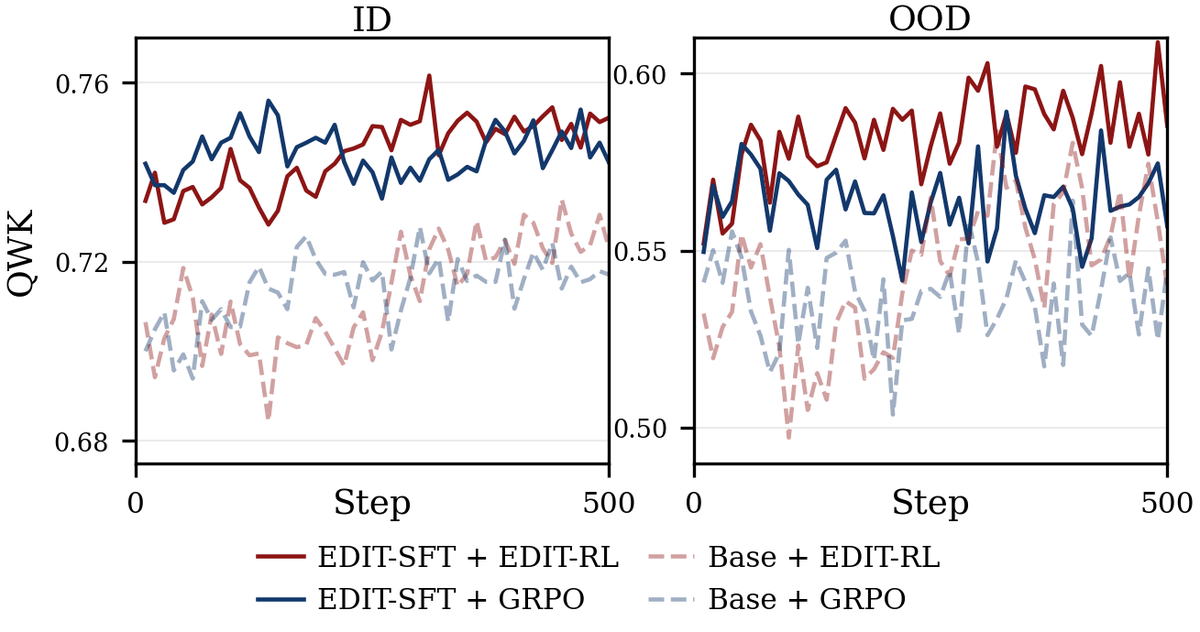
- On two real-world benchmarks (SAS-Bench and a proprietary GCSE dataset), EDIT-RL improves macro-QWK from 0.727 to 0.794 on fully out-of-distribution questions.
- EDIT also outperforms baselines on rubric faithfulness -- how well the model's scores track when the mark scheme is deliberately modified.
- No code or weights are released; the paper is available on arXiv and the public SAS-Bench dataset can be used to reproduce part of the evaluation.
Getting an LLM to assign a score is easy. Getting it to assign a score for the right reasons is a much harder problem. A new paper from researchers at King's College London, the University of Cambridge, and UK exam board AQA tackles this head-on with EDIT (Evidence-Diagnosed Intervention Training), a two-phase training framework that teaches LLMs to grade student exam answers in a way that is genuinely grounded in the mark scheme.
The problem with grading as a reasoning task
LLMs are increasingly deployed as automatic graders, but training them to grade reliably remains difficult. The challenge is structural. The final mark depends on a sequence of intermediate judgements, such as which rubric criteria are satisfied, what evidence supports them, which mark band applies, and how partial credits compose. This makes rubric grading a demanding credit-assignment problem -- the task of figuring out which step in a chain of reasoning actually caused the wrong answer.
Outcome-based reinforcement learning methods such as GRPO assign a single final reward to the whole reasoning trajectory and cannot identify which reasoning step caused an incorrect mark. More fine-grained credit assignment methods offer a possible remedy, but these methods were primarily designed for self-contained reasoning tasks like mathematics. Rubric grading is fundamentally different: it requires checking whether each step correctly invokes an external rule, not just maintaining internal logical consistency.
Rubric grading has two additional requirements. First, it requires external grounding -- each judgement step must be anchored in both the marking scheme and the student's written evidence. Second, rule-based reasoning is an uncertainty reduction process: the model's belief about the final mark should progressively converge. Existing RL methods ignore harmful belief shifts that occur in the middle of reasoning, while token-level constraints can over-penalize benign exploratory phrasing.
Two phases, one goal: faithful grading
EDIT addresses this with a two-phase pipeline. The first phase, EDIT-SFT, builds better training data by surgically fixing broken reasoning. The second phase, EDIT-RL, calibrates the model's behavior during RL using the model's own internal belief state as a signal.

The key innovation in both phases is the use of internal state signals -- probes into what the model actually believes at each step of its reasoning chain, rather than relying on the model to self-report errors through prompting.
How the internal diagnostics work
EDIT extracts two signals from the model's own activations at each reasoning step boundary:
- Posterior belief probe: At each step, the framework appends a "scaffold" prompt and reads the model's next-token logits over valid mark values. This gives a probability distribution over possible scores at every point in the reasoning chain, revealing whether the model's internal belief is drifting toward or away from the correct mark.