
KICoPro Exposes Why Experts Still Don't Trust AI Business Diagram Tools
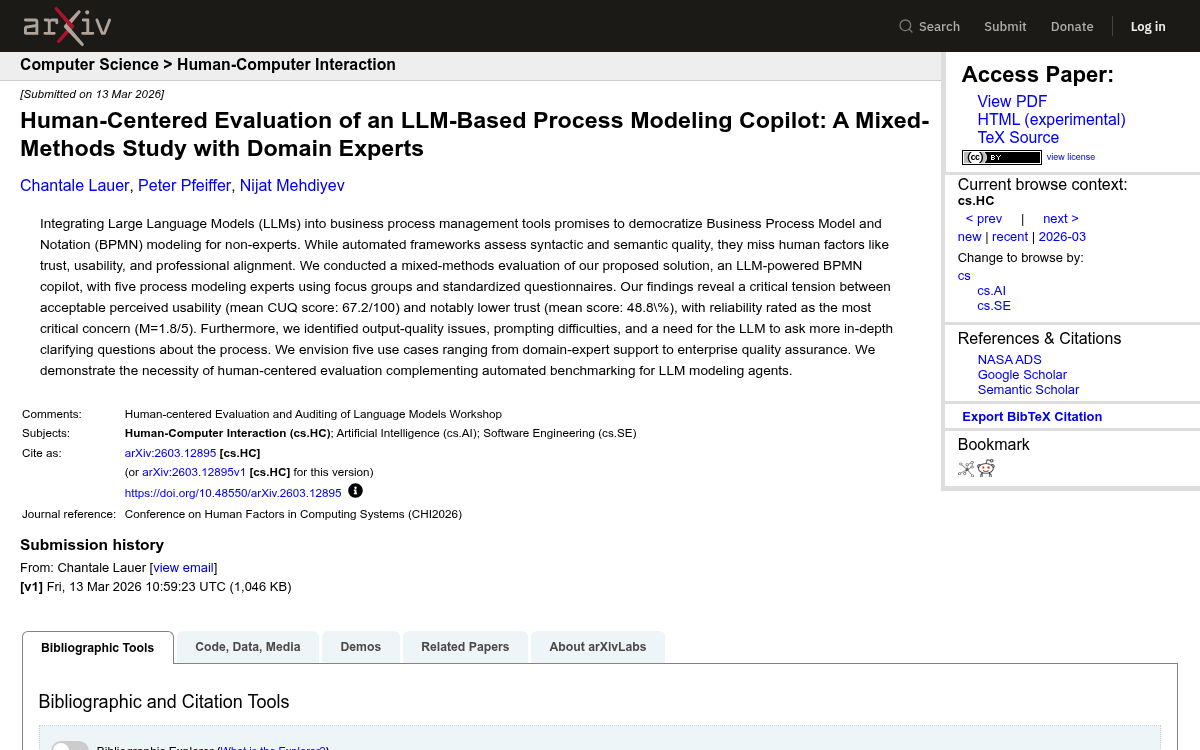
A focus-group study of an LLM-powered BPMN modeling copilot exposes a stark gap between smooth interaction and expert trust in outputs.
 Pro
Takeaways
- Mixed-methods study evaluates KICoPro, an LLM-based BPMN modeling copilot, with five process modeling experts.
- Usability landed near benchmark at 67.2/100 CUQ, but trust fell to 48.8%, well under the 60% acceptable threshold.
- Reliability was the single lowest-rated dimension (M=1.8/5), with strong expert consensus on that concern.
- Long process descriptions degraded output quality; users invented manual chunking as a workaround.
- Key missing behaviors: clarifying questions, respect for BPMN 2.0 and enterprise labeling conventions, safe modifications.
- Five envisioned use cases include non-modeler drafting, QA bots, image-to-BPMN, local enterprise deployment, and process optimization. Full paper.
Automated benchmarks say LLMs can turn plain English into business process diagrams pretty well. But when actual process modelers sit down with one of these copilots for two weeks, a different picture emerges: the chat feels fine, the outputs do not. A new mixed-methods study of an LLM-based BPMN modeling assistant called KICoPro quantifies that gap and lays out what has to change before these tools are trusted in enterprise workflows.
Why BPMN Needs a Copilot in the First Place
Business Process Model and Notation (BPMN) is the standard visual language for describing how work flows through an organization: tasks, decision gateways, events, and sequence flows. Building good BPMN diagrams is a specialist skill, which is why recent systems such as ProMoAI, BPMN Chatbot, and Camunda BPMN Copilot illustrate the potential of conversational process modeling that transforms textual process descriptions into BPMN models. This capability could broaden access to process modeling beyond dedicated experts.
The catch is how these tools have been judged so far. Existing evaluations have focused mainly on automated benchmarks of syntactic, semantic, and pragmatic quality. Those metrics say nothing about whether an expert would actually rely on the output, or whether the interaction fits the iterative rhythm of real modeling work. That is the gap the authors set out to fill.
The System Under the Microscope
KICoPro is a web-based conversational BPMN modeling tool that enables users to generate and iteratively refine BPMN models via natural language interaction. The system architecture combines a chat-based frontend with an LLM backend and BPMN rendering components. Users type a process description on the right, watch the diagram render on the left in a standard BPMN modeler, and can request changes, ask questions, or import existing BPMN files.

At evaluation time the layout engine had gaps: certain BPMN elements were not fully supported, including lanes for representing organizational roles, message flows for inter process communication, and some annotation types. Participants were told about these limits up front.
How the Study Was Run
The team ran a three-phase, mixed-methods evaluation with five in-house process modeling experts, most of whom worked with BPMN several days per week. After a one-hour kickoff, participants had two weeks of hands-on use with representative process descriptions of varying complexity, followed by a three-and-a-half-hour in-person focus group and standardized questionnaires. Three instruments were used:
- Chatbot Usability Questionnaire (CUQ): a 16-item, chat-specific alternative to the classic System Usability Scale, scored 0 to 100.
- Trust Scale for the AI Context (TAI): an 8-item scale covering reliability, predictability, security, and decision support.
- Tool-specific quality: a custom 8-item questionnaire on activity coverage, sequencing, structural clarity, and modification handling.
The Usability-Trust Gap
The headline numbers tell a clear story. The mean CUQ score across all participants was 67.2 (SD=7.1), falling marginally below the established benchmark of 68 for chatbot usability. Trust told a different story: the mean trust score was 48.8% (SD=10.5%), notably below a suggested threshold of 60% for acceptable trust and substantially below the usability score, revealing a usability-trust gap.
Digging into the trust items, reliability received the lowest rating (M=1.8, SD=0.45), indicating that participants could not consistently rely on correct outputs, and this item had the lowest variance, meaning the experts agreed on it. Interestingly, participants showed low suspicion of the system and moderate efficiency ratings, indicating no distrust of malicious intent but rather concerns about output reliability and correctness.
What Broke Down in Practice
The qualitative analysis pulled out seven themes. The most useful ones for anyone building an LLM assistant:
- The prompting paradox. Users understood the overall goal of generating BPMN from text, but were unsure how to formulate prompts that would reliably produce useful results, struggling with balancing detail vs. conciseness and structuring multi part processes.
- Latency kills iteration. Input-output latency impeded rapid iteration for refinement and exploration, disrupting the process modeler's cognitive rhythm.
- Long descriptions degrade quality. Longer process descriptions tend to yield lower-quality BPMN models that capture only a subset of the described process.
- Chunking as a workaround. Iterative, piecewise prompting outperformed comprehensive inputs, but increased cognitive load as users had to segment their mental model and reassemble the result.
- Modifications go sideways. Change requests often produced unintended edits to previously untouched parts of the model, or silently ignored unsupported elements like lanes.
- No clarifying questions. The LLM failed to ask clarifying questions for ambiguous inputs, generating complete outputs from incomplete inputs via implicit rather than explicit assumptions.
- Convention violations. Both BPMN 2.0 rules and organization-specific labeling guidelines were routinely broken.
Where Experts Would Actually Deploy This
Despite the trust deficit, the participants outlined five concrete places an LLM copilot could earn its keep:
- Drafting for non-modelers. Solving the blank-page problem for domain experts, though quality bars need to be higher because they cannot spot errors.
- Quality assurance bot. Validating models against BPMN standards and organizational conventions, and auto-correcting issues.
- Image-to-BPMN. Converting photos of whiteboard sketches into formal diagrams.
- Local enterprise deployment. An on-prem LLM trained on the organization's own process portfolio for pattern reuse and consistency checks.
- Process optimization. Going beyond drawing to detect inefficiencies and probe assumptions.
What This Means If You Are Building One
There is no new model, no benchmark, and no released code here. What the paper offers is a design checklist grounded in expert behavior. The authors argue that future BPMN copilots need explicit prompting guidance, incremental chunk-based generation done by the system rather than the user, proactive clarification for ambiguous inputs, configurable enterprise conventions, and confidence signals on individual diagram elements so reviewers know where to look first.
The broader takeaway generalizes past BPMN. Automated syntactic and semantic scores can look strong while professional users still refuse to rely on the output. For any LLM agent that produces artifacts humans will review, edit, and sign off on, trust calibration and interaction breakdowns need to be measured directly, not inferred from accuracy numbers.