
Khalifa University's SPARROW Fixes Video AI Object Tracking With +8.9 J&F Gains
A plug-and-play module fixes temporal drift and identity switches in video segmentation MLLMs, boosting three baselines across six benchmarks.
 Pro
Takeaways
- SPARROW adds temporal consistency and spatial precision to video MLLMs via a plug-and-play module. Paper
- Introduces Target-Specific Tracked Features (TSF) trained on pseudo-tracked object crops, removable at inference
- Dual-prompt design combines [BOX] geometric priors with [SEG] semantics using a SAM2-based class-agnostic proposer
- Curated dataset of 30,646 videos and 45,231 Q&A pairs harmonizing seven public sources
- Delivers +8.9 J&F on RVOS, +5 mIoU on visual grounding, +5.4 CLAIR on GCG across three baselines
- Code, models, and dataset released on GitHub and Hugging Face
Getting a language model to describe what's in an image is now routine. Getting it to point at the right pixels, every frame, while an object weaves through occlusions and reappears on the other side of the screen? That's still where video multimodal models fall apart. A team from Khalifa University has introduced SPARROW, a plug-and-play module that attaches to existing pixel-grounded video MLLMs and consistently improves how well they track and segment referenced objects across time.
Rather than proposing yet another end-to-end architecture, the authors identified two structural weaknesses shared by nearly every recent video grounding model and fixed both. The result is a module that, when bolted onto three different open-source baselines, delivers gains up to +8.9 J&F on referring video object segmentation without modifying the backbone.
The static token problem
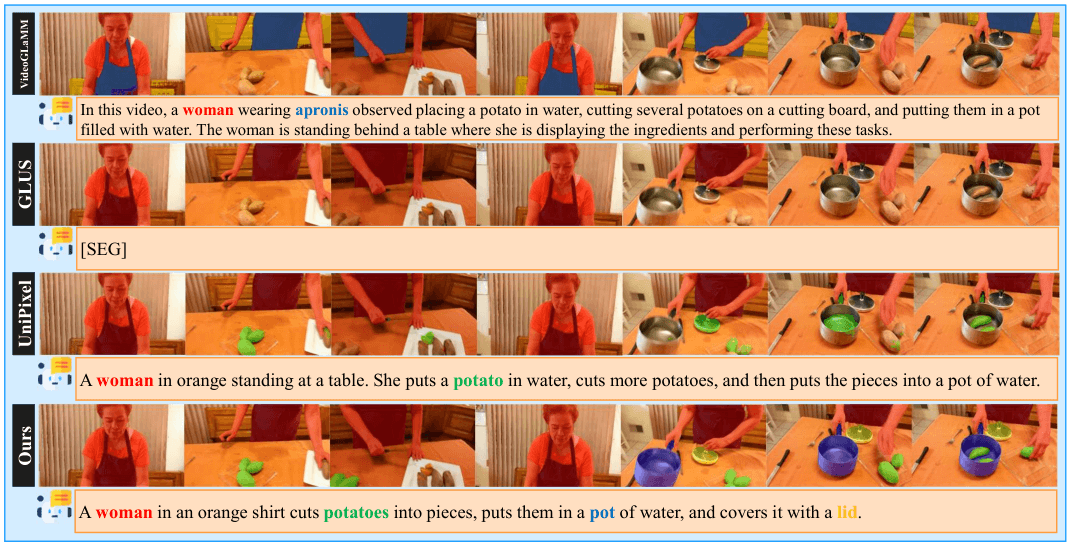
Most current video MLLMs handle pixel grounding the same way image models do: the LLM emits a special [SEG] token, which conditions a SAM-style decoder to produce a mask on each frame. Because text prompts are static while videos are dynamic, the model must infer motion and appearance changes entirely from visual cues, which often leads to spatial drift, inconsistent referent tracking, and unstable segmentation when the same entity moves or reappears.
The problem compounds on the first frame. Since the [SEG] token supplies only semantic cues without spatial priors, the initial mask may frequently misalign with the target, and such errors accumulate as the sequence progresses. Once the model locks onto the wrong instance, identity switches cascade through the rest of the clip.
Two fixes, both modular
SPARROW attacks these failures with two complementary components that hook into the existing pipeline through lightweight adapters.

Target-Specific Tracked Features (TSF) inject temporally aligned identity cues, but only during training. Given a textual query, GroundingDINO detects the referent in one frame, and CLDTracker propagates it across the sequence. To reduce redundancy, K-means clustering runs in a joint visual-spatial feature space and retains the samples nearest to each centroid. Four representative crops per target are encoded, projected into the LLM's token space, and appended to the input. This design allows the model to maintain identity and spatial coherence over time, enabling stable temporal representation learning directly from tracked visual signals.
The clever part: at inference, you can drop TSF entirely. The model has already learned identity persistence during training. No external detector or tracker required at test time, though you can optionally re-enable TSF for maximum stability at the cost of about 20ms per target per frame.
Dual-Prompt Grounding is the second half. Instead of just [SEG], the LLM also emits a [BOX] token that conditions a class-agnostic region proposer built on frozen SAM2/Hiera features. Following prior work, multi-scale Hiera maps are aligned into a feature pyramid and fed to a Deformable-DETR decoder, replacing the classification branch with a single objectness head, yielding 300 proposals per frame, filtered by objectness and NMS.
The [BOX] token filters and refines these proposals into geometry-aware anchors. The [SEG] token then uses those anchors as spatial priors for SAM2's mask decoder. Coarse-to-fine, geometry then semantics.
How the pieces fit together
The full pipeline runs like this:
- Spatial and temporal encoders extract features from the video
- V-to-L adapters project features into the LLM embedding space
- A LoRA-tuned LLM processes the query alongside visual tokens and emits
[BOX]and[SEG]tokens - L-to-V adapters project the
[BOX]embedding to filter and refine region proposals from the class-agnostic proposer - The
[SEG]embedding, paired with the refined boxes, prompts SAM2's decoder to produce final masks - Re-emitting
[BOX]and[SEG]at any frame enables drift correction without external trackers
Training happens in two stages. First, only the multimodal adapters and LoRA parameters update while the visual backbones stay frozen, teaching the model to exploit TSF cues. Second, the proposal generator is pretrained on a class-agnostic mix of COCO, Objects365, OpenImages, and V3Det, then only a lightweight filtration head fine-tunes on task-specific grounding data.
The dataset behind it
Training TSF requires object-centric temporal annotations that most video datasets don't provide. The authors curated a new corpus by harmonizing seven public sources including HC-STVG, LaSOT, MeViS, GOT-10k, and Ref-SAV into 30,646 video sequences and 45,231 question-answer pairs, providing temporally consistent trajectories, bounding boxes, and dense segmentation masks. Detections, trajectories, and TSF tokens are all precomputed offline, keeping the training loop cheap.
Numbers that back the claims
SPARROW was integrated into three recent baselines: UniPixel, GLUS, and VideoGLaMM. Across six benchmarks, gains were consistent:

- MeViS (motion expressions): up to +8.9 J&F on the unseen split with VideoGLaMM
- Ref-DAVIS17: boundary quality (F score) jumped +14.5 for VideoGLaMM, with GLUS and UniPixel gaining +4.2 and +3.4 respectively
- VidSTG visual grounding: consistent ~5-point mIoU improvements, a 13-18% relative gain
- Video GCG: +5.4 CLAIR on VideoGLaMM, indicating better alignment between generated phrases and their grounded regions
Ablations tell an interesting story. Training with TSF (without using it at inference) improves J&F by +2.9. Activating the [BOX] prompt adds another +3-8 points. Enabling TSF at inference too pushes to the best score of 77.7, but the default configuration captures most of the benefit at zero test-time overhead. Combining [BOX]+[SEG] reaches 72.5, confirming the benefit of the dual prompt over either token alone.
Where it struggles
SPARROW inherits the limits of proposal-based detection. Its performance depends on proposal recall: missed small, occluded, or unseen objects cannot be recovered by downstream [BOX] or [SEG] refinement. Early [BOX] errors may also accumulate in long sequences, although dual prompting mitigates drift compared to [SEG] alone. TSF supervision also relies on pseudo-tracks from GroundingDINO and CLDTracker, so severe tracking noise at training time can bias temporal learning, though robustness tests show the model degrades gracefully.
Practical takeaways
The overhead story is unusually clean for a research contribution. Adding SPARROW increases parameters by only 0.017B and drops throughput by fractions of an FPS on all three baselines. Full training (both stages) requires roughly 4.67 A100 GPU-days per backbone, about +32 GPU-hours over baseline fine-tuning.
Everything is public. The code lives on GitHub, and pretrained models plus the curated dataset are available on Hugging Face. If you're building any system that needs to reference objects in video, whether for editing, robotics, surveillance, or grounded conversational agents, this is a drop-in upgrade path that doesn't require retraining the base model from scratch.