
Khalifa University's RedSage Beats 32B Models at Cybersecurity on a Single GPU
RedSage is a fully open 8B cybersecurity LLM trained on 11.8B tokens and 266K agentic dialogues, beating every specialized rival while running locally on consumer GPUs
 Pro
Takeaways
- RedSage is a fully open 8B cybersecurity LLM accepted at ICLR 2026, locally deployable without cloud API privacy risks.
- Trained on 11.8B tokens of cybersecurity-filtered web data (CyberFineWeb) plus 28.6K curated expert documents covering MITRE, OWASP, Kali tools, and CTF write-ups.
- A two-agent pipeline (Planner + Augmenter) converts curated seed data into 266K multi-turn expert dialogues for supervised fine-tuning.
- RedSage-Bench, a new benchmark with 30K MCQs and 240 open-ended Q&As, is the first to jointly test cybersecurity knowledge, skills, and tool proficiency with quality scoring.
- At 8B scale, RedSage beats all cybersecurity-specialized baselines by up to +5.59 points and outperforms Qwen3-32B on general benchmarks despite being 4x smaller.
- All models, datasets, and code are open-sourced on GitHub and Hugging Face.
Security teams have a dilemma: the best AI assistants live behind proprietary APIs that you cannot trust with sensitive incident data, while the open alternatives were never trained to actually understand what a penetration tester or threat analyst needs. RedSage, accepted at ICLR 2026, is a direct attempt to close that gap. It is a fully open 8B-parameter cybersecurity assistant built from scratch with domain-aware pretraining, an agentic data augmentation pipeline, and a new benchmark designed to expose exactly what prior evaluations were missing.
A skills gap inside the skills gap
The cybersecurity industry already faces a well-documented workforce shortage. The complexity of security tools and the level of expertise required to operate them present significant challenges, compounded by a global skills shortage with a demand-supply gap of millions of unfilled cybersecurity positions. LLMs are a natural fit for augmenting analysts, but the existing open models have a structural problem.
Recent efforts have produced cybersecurity-trained LLMs, yet most emphasize a single training stage while overlooking others. Some extend pretraining on domain-specific corpora but apply limited post-training with only 835 samples or fewer than 30K cybersecurity-filtered items, while others focus on supervised fine-tuning without pretraining to strengthen domain knowledge. The result is a fragmented landscape where no single open model does everything well, and none release their full data pipeline.
Beyond the models themselves, the benchmarks were also broken. Existing cybersecurity benchmarks offer only partial coverage, omitting tool proficiency and qualitative evaluation of free-response Q&A beyond simple MCQs. Most only test knowledge recall, not whether a model can actually operate a tool or walk through an offensive technique.
Building the corpus from the ground up
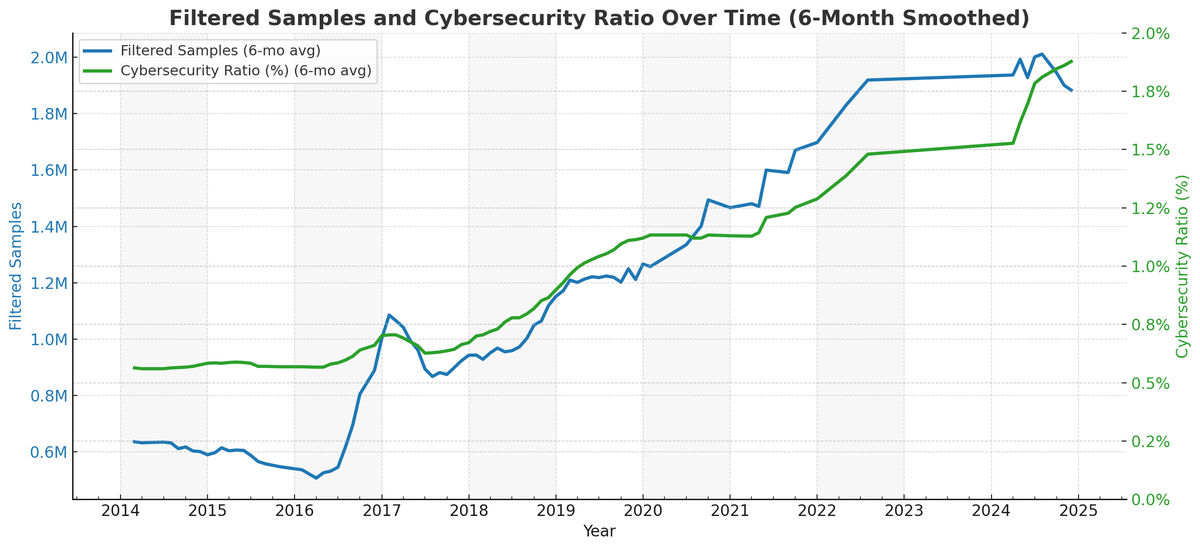
The RedSage team, from Khalifa University, University of Bonn, and University of Milan, built everything from scratch. The pretraining data starts with CyberFineWeb, a cybersecurity-filtered slice of the FineWeb Common Crawl corpus. This model was trained on CyberFineWeb, a large-scale cybersecurity corpus constructed by filtering the FineWeb dataset (2013-2024). A ModernBERT-base classifier was trained on the Cybersecurity Topic Classification dataset to identify cybersecurity content within Common Crawl. The filtering process yielded ~125M documents (~89.8B tokens), and they select the latest subset of ~11.7B tokens for the training stage.
To prevent catastrophic forgetting, they mixed the cybersecurity data with a 30% replay ratio of FineWeb-Edu samples. Catastrophic forgetting is a known failure mode in continual pretraining where a model loses its general capabilities as it absorbs domain-specific data. The 30% replay ratio keeps the model grounded.
On top of CyberFineWeb, the team curated RedSage-Seed: 28,637 hand-selected documents from authoritative sources organized into three categories:
- Knowledge: MITRE ATT&CK, CAPEC, CWE, and OWASP frameworks
- Skills: HackTricks, CTF write-ups, penetration testing tutorials, and ethical hacking articles
- Tools: Kali Linux documentation, Unix man pages, and CLI cheat-sheets (tldr-pages)

The agentic augmentation engine
Raw curated documents are not enough for a conversational assistant. The team built a two-agent pipeline to transform those 28K seed documents into 266K realistic multi-turn dialogues. This is the most novel part of the system.
A Planner Agent analyzes each seed data chunk and derives candidate skill sets (e.g., vulnerability analysis, tool-command generation) along with augmentation strategies that describe how the seed is transformed, adapted into a conversational or Q&A format, and enriched with explanations. The Planner outputs a structured JSON plan covering everything from "ARP Scan Simulation" to "Threat Mapping" to "Post-Exploitation Techniques."
The Augmenter Agent then instantiates each plan into realistic, role-based multi-turn dialogues grounded in the seed data. This pipeline scales efficiently, producing multiple dialogues per skill set and filtering outputs for format validity, consistency, and topical relevance. The result is RedSage-Conv: ~266K multi-turn conversations (~352M tokens), expanding total samples by 9.2x and tokens by 2.3x across knowledge, skills, and tools while preserving technical depth.

Training: four stages, one pipeline
RedSage is built using the Axolotl framework, with continued pretraining of the open-source base model Qwen3-8B-Base on cybersecurity corpora, followed by post-training through supervised fine-tuning on augmented conversations and preference alignment. The four checkpoints produced are:
- RedSage-8B-CFW , Qwen3-8B-Base continued on CyberFineWeb
- RedSage-8B-Base , further trained on RedSage-Seed and RedSage-Dump
- RedSage-8B-Ins , supervised fine-tuning on RedSage-Conv + SmolTalk2
- RedSage-8B-DPO , preference alignment via DPO on the Tulu 3 Preference Mixture
DPO (Direct Preference Optimization) is a technique that fine-tunes a model to prefer human-approved responses over less helpful ones, without needing a separate reward model. The full training pipeline consumed approximately 134 wall-clock hours (~5.5 days), corresponding to more than 4,000 GPU-hours on 32x A100-64GB GPUs.
A benchmark that actually tests tools
Every existing cybersecurity benchmark had at least one blind spot. RedSage-Bench fills them all. RedSage-Bench is a benchmark with 30K multiple-choice and 240 open-ended Q&A items covering cybersecurity knowledge, skills, and tool expertise. It is the only benchmark that simultaneously covers knowledge, skills, tool proficiency, and uses quality scoring for free-form answers.
The 30K MCQs went through a two-stage LLM verification pipeline using Llama-3.3-70B and Qwen2.5-72B as independent judges, only keeping items scoring above 8/10. The 240 open-ended items were additionally human-verified. Data decontamination removes any synthetic post-training instance whose query has a semantic similarity above 0.9 to a benchmark question, eliminating 2.96% of data relative to the benchmark size.
The numbers
At the 8B scale, RedSage achieves consistently better results, surpassing the baseline models by up to +5.59 points on cybersecurity benchmarks and +5.05 points on Open LLM Leaderboard tasks. A few highlights worth noting:
- RedSage-8B-Ins surpasses Qwen3-32B on the RedSage-MCQ benchmark despite being 4x smaller
- On open-ended QA, RedSage-8B-DPO beats the second-best model (Qwen3-8B) by +7% absolute mean correctness
- On general benchmarks (ARC-C, GSM8K, MMLU), RedSage-8B-DPO outperforms all other 8B cybersecurity models and even beats Qwen3-32B overall
- Tool-use questions are the hardest category for all models, with lower medians and heavy-tailed score distributions

Despite having far fewer parameters, RedSage comes close to Qwen3-32B (82.31 mean, only about +1 point higher) and trails GPT-5 (86.29 mean, roughly +5 points higher), highlighting strong efficiency relative to much larger models.
What it is good for, and where it struggles
The practical use cases are concrete. RedSage supports interactive cybersecurity assistance for questions about frameworks (MITRE, OWASP), offensive techniques, and defense strategies; tool usage and explanation for generating commands for tools like nmap, sqlmap, and metasploit; and educational support with detailed explanations of vulnerabilities and remediation steps.
The killer feature is local deployment. RedSage is an open-source, 8B-scale cybersecurity assistant engineered to tackle complex security workflows without the privacy risks of proprietary APIs. At 8B parameters, it runs on a single consumer GPU, making it viable for air-gapped environments, SOC workstations, and any setting where sending incident data to a cloud API is a non-starter.
The limitations are real too. Tool-use tasks showed the lowest scores across all models, meaning even RedSage can struggle with precise command-line generation for less common tools. The agentic data pipeline uses LLM-generated content, which can propagate subtle inaccuracies despite verification. And the model carries an inherent dual-use risk: as the model incorporates offensive security knowledge, it carries an inherent risk of misuse, and the authors emphasize the importance of responsible application and good security practices.
Everything is open
All models, datasets, and code are publicly available. The GitHub repository includes Axolotl configuration files for reproducing every training stage. The model weights are on Hugging Face under the RISys-Lab organization, and the CyberFineWeb dataset is released separately for anyone who wants to pretrain their own variant. The project page also includes a vLLM-compatible serving example for spinning up an OpenAI-compatible endpoint locally in minutes.
The deeper contribution here is not just the model. The agentic augmentation pipeline that turns 28K curated seed documents into 266K grounded multi-turn dialogues is a reusable recipe. The same approach could be applied to other high-stakes domains where expert knowledge is sparse and privacy constraints make cloud APIs impractical. RedSage is an acceptance at ICLR 2026, but the real artifact is the blueprint it leaves behind.