
Khalifa University's 33x Speedup Solves Dual-Arm Robot Manipulation of Flexible-Rigid Objects
A new gradient-based planner lets dual-arm robots snake mixed rope-and-metal assemblies through narrow holes, hitting targets within 3 cm.
 Pro
Takeaways
- New planner manipulates hybrid rope-plus-rigid assemblies through narrow apertures using two coordinated robot arms.
- Built on Geometric Variable Strain Cosserat rod model, treating rigid joints and deformation in one framework.
- Analytical gradients yield 33x speedup on inverse kinetostatics; trajectory optimization only converges with them.
- Experiments on Nitinol dual-arm setup hit target poses within 3 cm, roughly 5% of link length.
- Beats bidirectional RRT baseline on hard out-of-plane trajectories, running nearly 10x faster in that case.
- Read the full paper; implementation builds on the SoRoSim MATLAB toolbox.
Manipulating a rope is hard. Manipulating something that is part rope, part rigid link, and needs to squeeze through a narrow hole while two robot arms coordinate to hit a precise target pose, is much harder. A team from Khalifa University has proposed an optimization-based planner that handles exactly this case, and the trick that makes it practical is a set of hand-derived analytical gradients that speed up the underlying solver by up to 33x.
The paper, Coordinated Manipulation of Hybrid Deformable-Rigid Objects in Constrained Environments, focuses on what the authors call hybrid Deformable Linear Objects, or hDLOs: assemblies of flexible rods (think Nitinol wires or cables) joined by rigid links, actuated by two or more manipulators forming a closed kinematic chain.
Why hybrid assemblies break the usual playbook
Rigid-body inverse kinematics assumes finite degrees of freedom and no shape change under load. A pure deformable-object planner, meanwhile, typically ignores the algebraic constraints imposed by rigid joints in the middle of the chain. Real systems sit in between. The authors point out that parallel continuum manipulators used for minimally invasive surgery, and multi-drone teams cooperatively carrying a slung load through narrow gaps, both fall into this class.

The core difficulty: the shape of a deformable link is a continuous map from arc length to SE(3), which makes the configuration space infinite-dimensional. Grid search is out. Classical sampling-based planners like RRT and PRM work on high-dimensional spaces, but random samples typically violate the physical equilibrium of the rod, so they need extra machinery to project samples back onto the feasible manifold, and they do not guarantee optimality.
The strain-based shortcut
Instead of tracking every cross-section pose along the rod, the planner uses the Geometric Variable Strain (GVS) formulation of Cosserat rod theory. In plain terms, Cosserat rod theory treats a slender object as a stack of tiny rigid cross-sections that can bend, twist, shear, and stretch. GVS parametrizes the strain field along the rod using a small functional basis (third-order Legendre polynomials here, giving 24 coordinates per deformable link) and treats rigid joints as a special case of the same math. That collapses the infinite-dimensional shape into a finite vector that can be plugged into a nonlinear program.
The planner solves the problem in two stages:
- An inverse kinetostatic (IKS) problem finds a static equilibrium configuration of the whole assembly that satisfies the goal pose and the aperture constraints.
- A trajectory optimization uses direct transcription over N keyframes, warm-started by linearly interpolating between the initial state and the IKS solution.
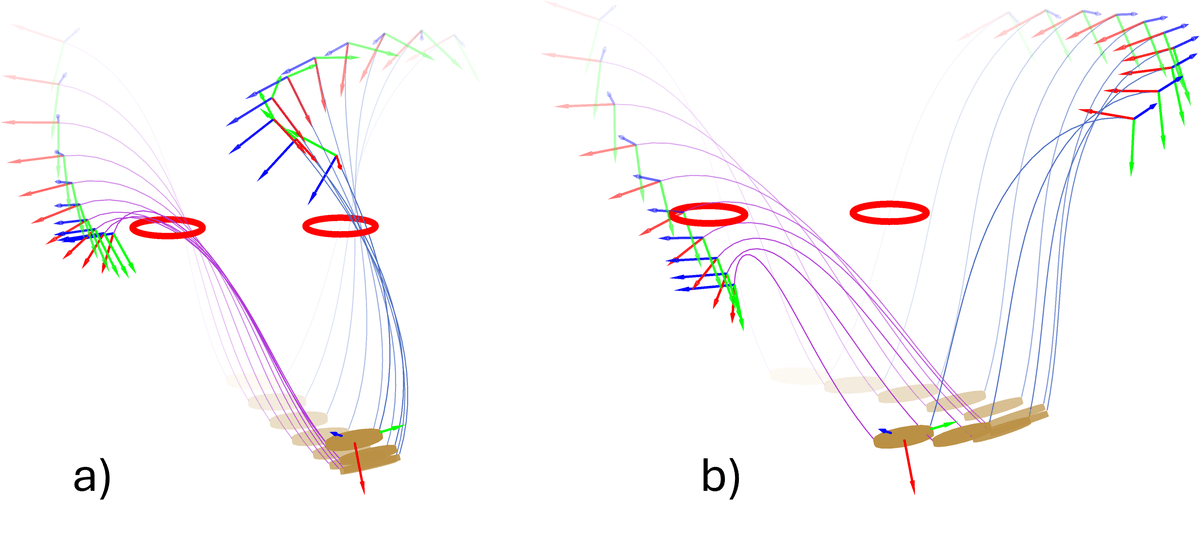
Environmental constraints are modeled as circular apertures the rod must pass through, an abstraction for the narrow passages seen in industrial inspection and surgery. The point of intersection along each rod is left as a free variable of the optimization, so the planner can slide the object through the hole as it moves.
Analytical gradients are the whole ballgame
The interesting engineering contribution is the derivation of closed-form Jacobians for the GVS statics, environmental constraints, and SE(3) log-map objective. Feeding these to MATLAB's fmincon interior-point solver produced:
- IKS solve time dropping from 495 s (finite differences) to 14.7 s, a 33x speedup, with iterations falling from 373 to 282.
- Trajectory optimization only converging at all with analytical derivatives; finite-difference gradients failed to finish in reasonable time.
That second point is the real story. Without analytical derivatives, the trajectory-optimization approach to this problem is a paper exercise. With them, it becomes a tool.

Hardware validation and honest limits
The team tested on four simulated assemblies (up to three deformable and two rigid links, 93 DoF) and physically on a three-link hDLO made from Nitinol rods and a 3D-printed PLA disk, manipulated by a dual-arm robot with Optitrack tracking. The forward statics model matched reality to about 2.14 cm on average (3.07% of a deformable link's length). End-to-end, planned trajectories tracked with an average deformation error of roughly 3 cm, or 5% of link length.
Compared against a bidirectional RRT baseline adapted to the same strain-based model, the optimization planner delivered smoother joint and actuation profiles, better matching the quasi-static assumption. On easy trajectories the sampling planner was faster, but on a case requiring significant out-of-plane deformation the TO planner ran nearly an order of magnitude faster (45.65 s vs 201.69 s).
Limitations worth knowing before adopting this:
- It is open-loop. There is no feedback controller closing the loop on actual rod shape, so it inherits any model identification error.
- It is quasi-static. Fast motions, contact dynamics, and inertial effects are outside scope.
- Solve times are tens of seconds, not real-time. This is a planner, not a controller.
- The environmental constraint used here is a circular aperture; more general obstacle geometries would need additional constraint engineering.
- No public code release is announced in the paper. The implementation builds on the authors' earlier SoRoSim MATLAB toolbox for hybrid soft-rigid robots.
Where this fits
If you work on surgical robotics, cable harness assembly, industrial inspection with continuum tools, or cooperative aerial transport of slung loads, the GVS-plus-analytical-gradients recipe is worth studying. The broader lesson is one that keeps showing up in robotics: differentiability of the physical model is what turns a nice mathematical formulation into a solver that actually finishes. As related work on analytical derivatives for strain-based dynamics has shown, the payoff for doing the calculus by hand is often larger than any clever solver tuning.