
Kempelen Institute Beats Qwen3 AI Detector Using Interpretable Stylometric Features
A replication study of a 2023 AI text detector exposes reproducibility gaps and shows that swapping in modern multilingual models plus 26 stylometric features boosts interpretable attribution.
 Pro
Takeaways
- Replication of the AuTexTification 2023 hybrid AI text detector failed to reproduce exact scores due to data splits, missing Spanish GPT-2 models, and undocumented early-stopping details.
- Swapping GPT-2 for Qwen2.5, LLaMA-3.2, xglm, and BLOOM as predictability models improved performance across both languages.
- Replacing RoBERTa with mDeBERTa-v3-base yielded one shared encoder for English and Spanish with no language-specific tuning.
- Adding 26 document-level stylometric features (lexical diversity, sentence structure, readability, hedging) boosted macro F1 by up to 21.6%.
- The extended LingRF+PredOut beat state-of-the-art detector mdok on binary detection (0.912 vs 0.763 English macro F1) while remaining interpretable via SHAP.
- Code is available at the authors' anonymous repository, with the dataset on Hugging Face.
A team from the Kempelen Institute of Intelligent Technologies and Brno University of Technology set out to do something unglamorous but increasingly necessary in machine learning: rerun somebody else's experiment. Their target was the hybrid AI text detector that placed competitively in the AuTexTification 2023 shared task. What they found, documented in a new replication study, is both a cautionary tale about reproducibility in text detection research and a recipe for making these detectors more accurate and more interpretable.
Why replicating a text detector is harder than it looks
AuTexTification was a shared task at IberLEF 2023 with two subtasks: Subtask 1 asked participants to determine whether a text is human-authored or generated by a large language model, and Subtask 2 asked them to attribute a machine-generated text to one of six different text generation models. The dataset contains more than 160,000 texts across English and Spanish and five domains: tweets, reviews, news, legal, and how-to articles. The six generators, later revealed, were BLOOM-1B1, BLOOM-3B, BLOOM-7B1, Babbage, Curie, and text-davinci-003.
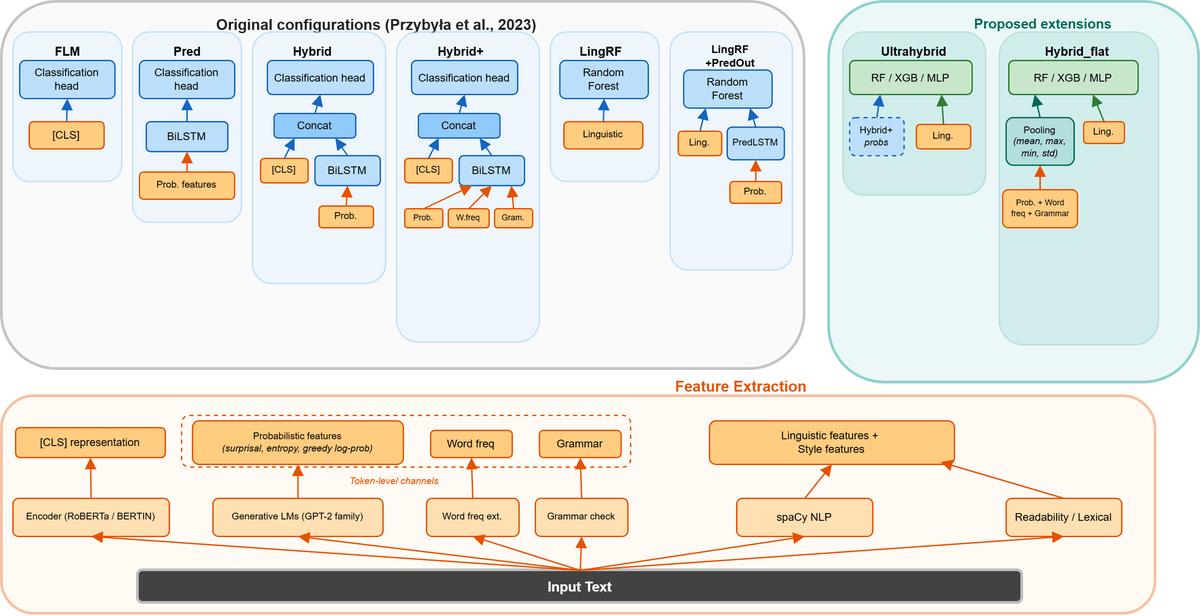
The original winning approach from Przybyla and colleagues fused three signal types: token-level predictability features from GPT-2, contextual embeddings from a fine-tuned RoBERTa, and hand-crafted linguistic statistics. The replication team wanted to answer three questions: can the reported numbers be reproduced, do newer multilingual models help, and do richer stylometric features improve both accuracy and interpretability?
The reproducibility gap
Exact replication failed, and the failure modes are instructive. The paper describes an 80/20 random train-validation split, but the released code uses a predefined topic-based split derived from an LDA partition, which can shift model selection. The described early-stopping rule was not present in the released code. And the Spanish GPT-2 models the original authors relied on (PlanTL-GOB-ES/gpt2-base-bne and gpt2-large-bne) were no longer available in their original form at the time of the experiments, forcing substitutions with DeepESP/gpt2-spanish and datificate/gpt2-small-spanish. Different tokenizers, different vocabularies, different results.
Even feature counts drifted. On the Spanish LingRF configuration, the reproduction generated 311 features against 299 reported, likely due to spaCy version drift and how morphological categories aggregate. Across settings where a direct comparison was possible, macro F1 gaps between the paper and the reproduction ranged from 0.008 to 0.070 points.
Swapping GPT-2 for Qwen, mGPT, and mDeBERTa
Once the baseline was rebuilt, the team started upgrading components. They tried three groups of generative models for computing token-level predictability features and evaluated three encoders for the contextual embedding stream. The goal was a single configuration that works across English and Spanish without language-specific swaps.
- Encoder: mDeBERTa-v3-base replaced language-specific RoBERTa variants, coming within a hair of the tuned baseline while working for both languages.
- Predictability models: a "Large" group combining Qwen2.5-3B, LLaMA-3.2-3B, xglm-2.9B, and BLOOM-1B7 delivered the best average macro F1.
- Result: the unified multilingual setup matched or slightly beat the language-specific baseline, at the cost of roughly 80% longer training time.
The stylometric feature push
The most concrete accuracy gains came from adding 26 document-level stylometric features on top of the original set. The additions fall into seven buckets, each computed with lightweight rule-based tokenization:
- Lexical diversity: type-token ratio and its root and log variants, hapax and dis-legomena ratios, rare-word burstiness.
- Sentence structure: average length, standard deviation, coefficient of variation, sentence count.
- Repetition patterns: excess bigram and trigram repetition ratios.
- Word-level statistics: mean and std of token length, total token count.
- Functional and stylistic markers: function words, discourse transitions, hedging expressions, first-person pronouns, formal register vocabulary.
- Readability: Flesch Reading Ease and Flesch-Kincaid grade level from textstat.
- Punctuation usage: commas, exclamation and question marks per sentence.
On the pure LingRF model (Random Forest over linguistic features only), macro F1 improved across all four subtask-language combinations, with the biggest jump on Spanish Subtask 1: from 0.500 to 0.608, a 21.6% relative gain. When combined with the new probabilistic models in the LingRF+PredOut configuration, English Subtask 1 hit 0.912 macro F1 and Spanish Subtask 1 reached 0.881.
Beating a modern neural detector, at least on binary detection
The interesting comparison is against mdok, a Qwen3-4B-Base fine-tuned detector considered state of the art. On the binary Subtask 1, the extended LingRF+PredOut approach scores 0.912 (English) and 0.881 (Spanish) against mdok's 0.763 and 0.679. On the harder attribution task of identifying which of six generators wrote a text, mdok wins by a small margin. The interpretable, stylometry-first approach is competitive on the easier task and gives you SHAP explanations that a fine-tuned LLM does not.
What SHAP reveals
SHAP analysis showed that several of the newly introduced features consistently rank among the top predictors. Lexical diversity metrics, sentence structure variance, and functional word ratios carry real signal, and in the combined model they complement rather than duplicate the probabilistic outputs. That matters for anyone who needs to explain to a non-technical stakeholder why a document was flagged as machine-generated.
Where this is useful, and where it is not
The unified multilingual configuration is a reasonable starting point if you need one model that handles English and Spanish text detection without maintaining separate pipelines. The stylometric features are cheap to compute and pay off across the board. The interpretability advantage over black-box neural detectors is real.
The limits are also clear. Training and evaluation were confined to the AuTexTification 2023 domains and six generators, none of them frontier models like GPT-4 or Claude 3. Generalization to newer generators or other domains is not tested. Attribution to a specific generator remains harder than binary detection, and here the fine-tuned neural detector still wins. And the multilingual configuration costs roughly 80% more compute than the language-specific baseline.
The implementation is publicly available, and the AuTexTification 2023 dataset is on Hugging Face. The broader lesson is one the field keeps relearning: without the exact code version, preprocessing steps, and model checkpoints used for a published result, small implementation drift compounds into measurable performance gaps, and fair comparison between detectors becomes guesswork.