
Keio's D-SLAMSpoof Hijacks Robot Navigation With 87% Success Rate
New spoofing attack fools LiDAR SLAM in feature-rich urban and indoor scenes with near 100% success, plus a defense that uses only IMU signals.
 Pro
Takeaways
- D-SLAMSpoof breaks LiDAR SLAM in urban and indoor scenes where prior spoofing failed. Paper
- Attack combines corner or planar injected shapes with oscillating radial motion tuned to correspondence gate.
- Attack Success Rate jumps from 22.8% to 87.2% in simulation, near 100% in real-world VLP-16 tests.
- Tested against FAST-LIO2, KISS-ICP, and GLIM with consistent results.
- ISD-SLAM defense uses only IMU dead reckoning, hits 0.96 precision and 0.97 recall on detection.
- Defense switches to inertial navigation during attacks, no raw LiDAR waveform access required.
LiDAR-based self-localization has long been considered a robust anchor for autonomous vehicles and mobile robots, especially in geometrically rich environments where scan matching has plenty of walls, corners, and edges to lock onto. A new paper from researchers at Keio University and Japan's National Institute of Advanced Industrial Science and Technology punctures that assumption. Their attack, D-SLAMSpoof, reliably drags SLAM trajectories off course in urban and indoor scenes, and they pair it with a defense that needs nothing more than the IMU already sitting on the robot.
Why previous LiDAR spoofing quietly failed indoors
LiDAR spoofing is not new. Attackers use external lasers to either inject fake returns into a sensor or suppress real ones. But prior injection attacks on SLAM largely worked only in geometrically sparse environments, because scan matching in structurally rich areas absorbs the injected noise. Random point injection could poison map building, and cylindrical wall injection could push a robot around in an empty parking lot, but hallways and city streets have too many real features competing for the optimizer's attention.
The attack model the authors assume is deliberately constrained and realistic: a single roadside spoofing device placed along the target's route, an attacker who knows the vehicle's path and LiDAR specs but has no access to onboard software, and a target platform equipped with a 3D LiDAR and an IMU. Under this threat model, localization errors as small as 0.29 m on general roads or 0.74 m on highways can push a vehicle into lane departure, so even modest drift is dangerous.

Two ideas that make the attack environment-agnostic
D-SLAMSpoof combines a spatial trick and a temporal trick, both derived from how iterative-closest-point style scan matchers actually optimize pose.
- Constraint-forging injection. Instead of a cylindrical wall, the attacker injects a shape defined by a polar equation for a square boundary. By rotating the polar angle, the same equation can generate either a fake planar wall or an L-shaped corner facing the spoofer. Because the fake residuals all point in the same direction, the optimizer stops averaging them out and drifts consistently.
- Oscillating injection. The injected shape is not static. Its radial distance sweeps between a minimum and maximum on a fixed cycle, sized so that the per-frame movement stays under the SLAM algorithm's maximum correspondence distance. Move it any faster and outlier rejection throws the points away; move it any slower and the drift never accumulates.
The cycle time is chosen analytically from the LiDAR's frame interval and the correspondence gate, not tuned by trial and error. When the max correspondence distance was 1.0 m, peak damage occurred at a radial velocity of 9.8 m/s; at 0.5 m the peak shifted to 4.9 m/s, matching the theory that correspondence gating dominates the effect.
The numbers
The team evaluated on the MCD tuhh dataset with spoofers placed at 100 different locations across three courses, running against three widely used SLAM stacks: FAST-LIO2, KISS-ICP, and GLIM. Success was defined as an Absolute Pose Error above 3 meters.
- Static cylindrical injection achieved a 22.8% average success rate, while D-SLAMSpoof reached 87.2%, a 3.8 times improvement that held across all three SLAM algorithms.
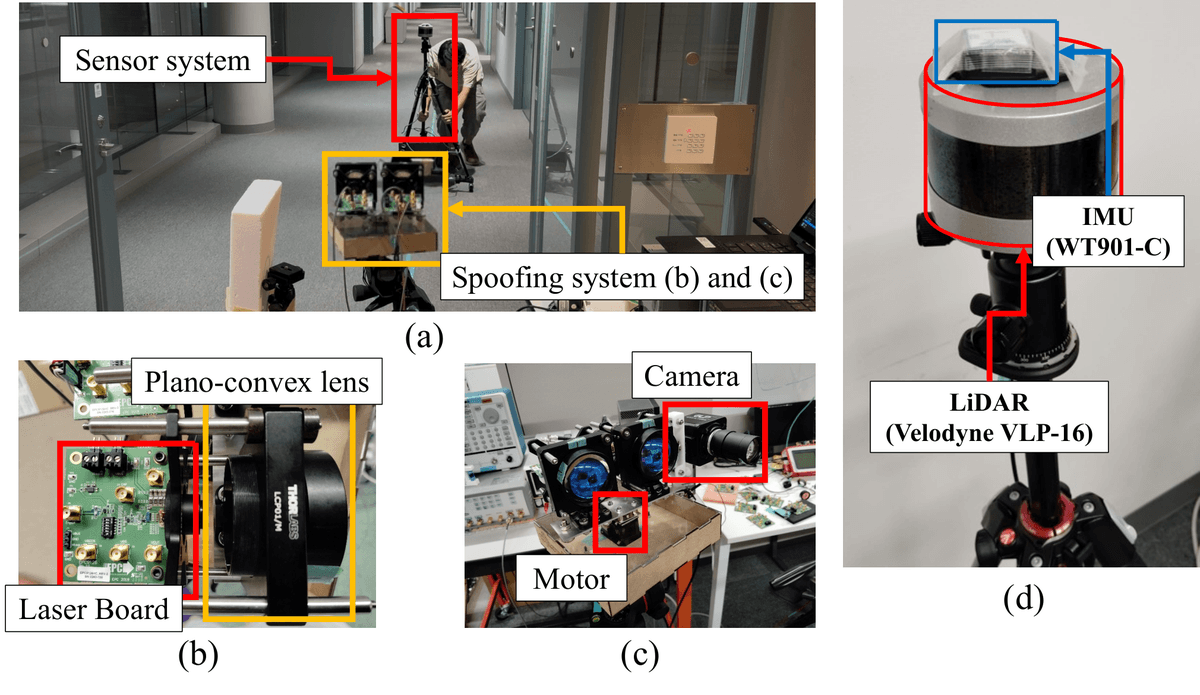
- In real-world indoor experiments with a VLP-16 LiDAR and a physical spoofer, D-SLAMSpoof achieved close to 100% attack success across KISS-ICP, FAST-LIO2, and GLIM.
- The proposed corner and planar shapes stayed effective even when the attacker could only manipulate about half the azimuthal range that a cylindrical wall required.

A defense that fits on commodity hardware
Existing defenses like DefenSLAM require access to the LiDAR's raw waveform data, which most commercial units simply do not expose. The authors' answer, ISD-SLAM (Inertial Switching Defense for SLAM), works with what is already there.
The detector compares the SLAM pose estimate against dead reckoning from IMU and wheel odometry, which are immune to point cloud tampering. It builds a single detection metric D as a weighted sum of two error terms:
- An orientation error, computed as the normalized inner product between the SLAM velocity vector and the dead-reckoning velocity vector.
- A speed error, the norm of the difference between SLAM-derived speed and inertial speed at the same timestamp.
The two weights and the decision threshold are found offline with Bayesian optimization via Optuna. When D crosses the threshold, ISD-SLAM discards the SLAM output, switches to inertial dead reckoning, restarts SLAM once the attack ends, and then applies a coordinate transformation using a constant-velocity model to stitch the pre-attack and post-attack trajectories together.
On two held-out validation sequences, the detector achieved a Precision of 0.96 and a Recall of 0.97 in both validation sets, using the same fixed parameters across sequences. When the switching logic was enabled, the sharp drift induced by D-SLAMSpoof was suppressed rather than allowed to accumulate.
What is actually new here
The headline is a stronger attack, but the deeper contribution is that both sides of the arms race are now grounded in the mechanics of scan matching rather than in environment assumptions. The attack works because it aligns fake residuals with the optimizer's directional sensitivity and paces motion to the correspondence gate. The defense works because inertial signals provide a physics-based sanity check that cannot be spoofed by a laser.
Limitations worth knowing
- The attack assumes the LiDAR's scan pattern is known. Next-generation LiDARs with anti-interference mechanisms such as ranging timing randomization or pulse signatures may blunt it.
- ISD-SLAM's detection weights are tuned per traversal course. The authors note that making the defense work when the route is a black box is still open.
- Code and model release status is not stated in the paper. There is no public repository linked at this time.
For anyone shipping LiDAR-based localization on real hardware, the practical takeaways are concrete: assume feature-rich environments are not a free security margin, cross-check SLAM output against inertial dead reckoning as a first line of defense, and where possible move to sensors with pulse randomization or other anti-interference features.