
KDP Beats Diffusion Planners 75x Faster With a Single Forward Pass
Keyed Drifting Policies collapse diffusion-style trajectory planning into a single forward pass, cutting planner latency from 150ms to under 5ms on offline RL benchmarks.
 Pro
Takeaways
- Keyed Drifting Policies (KDP) replace iterative diffusion denoising with a single forward pass for offline RL planning.
- Naive one-step imitation collapses to average trajectories; KDP fixes this with condition-aware neighborhoods in a compact key space.
- Training uses a drift field that attracts toward matched dataset windows and repels between generated samples.
- Matches DQL on D4RL locomotion (90.7 vs 91.1 avg) while using one network evaluation instead of five.
- Real hardware: Crazyflie replans at 38 Hz vs Diffuser's 4.1 Hz, SO-100 arm at 17 Hz vs 3 Hz.
- Paper, videos and code available on the project website.
Diffusion models have become the go-to trick for generating rich, multimodal action plans in offline reinforcement learning, but they pay for that expressiveness with a slow iterative denoising loop that makes real-time control painful. A new paper, Amortizing Trajectory Diffusion with Keyed Drift Fields, keeps the good parts of diffusion planning while collapsing inference to a single forward pass. The method, called Keyed Drifting Policies (KDP), matches or beats diffusion planners on D4RL benchmarks while running roughly 30 to 75 times faster in closed-loop control.
Why one-step trajectory planning keeps failing
Diffusion-based trajectory planners can synthesize rich, multimodal action sequences for offline reinforcement learning, but their iterative denoising incurs substantial inference-time cost, making closed-loop planning slow under tight compute budgets. In a receding-horizon setup, where you replan every few milliseconds, running 20 denoising steps for each of 64 candidate trajectories quickly becomes a bottleneck.
The obvious fix is to train a one-step generator that imitates the diffusion planner's output distribution, and this is where things break in a subtle way. Conditional trajectory generation fails under naive distribution-matching objectives when the similarity measure used to align generated trajectories with the dataset is dominated by unconstrained future dimensions. Matching in the full high-dimensional window space pulls every sample toward the dataset average, diversity collapses, and the policy produces near-static behavior that barely moves the robot.
Rethinking what "nearby" means
The authors' fix reworks the notion of neighborhood for a trajectory. Conditional generative planning requires a conditioning-aware notion of proximity: trajectory updates should be computed using distances in a compact key space that reflects the condition, while still applying updates in the full trajectory space.
Concretely, KDP projects trajectories into a small key space aligned with the current state, uses those keys to decide which dataset windows count as neighbors, and then applies training updates to the entire trajectory window. This decoupling is what stops the model from averaging away the future.

Drift fields instead of denoising steps
Once you have a keyed notion of neighborhood, KDP trains the generator with a physics-flavored objective. For each generated trajectory, the model computes a drift field with two components:
- Attraction toward dataset windows whose keys match the current condition.
- Repulsion away from other generated samples that landed nearby, which preserves diversity across candidate plans.
The clever training trick is a stop-gradient drifted target that amortizes iterative refinement into training. Rather than actually unrolling several refinement steps at inference, the model learns to jump directly to where a few drift steps would have taken it. At deployment, the resulting policy produces a full trajectory window in a single forward pass.
An ablation in the paper makes the design choices concrete. Without keying, average D4RL locomotion score collapses from 90.7 to 2.91. Attraction without repulsion sends action diversity to essentially infinity as trajectories fly apart. Both the keyed neighborhood and the repulsive term are load-bearing.
Benchmark numbers
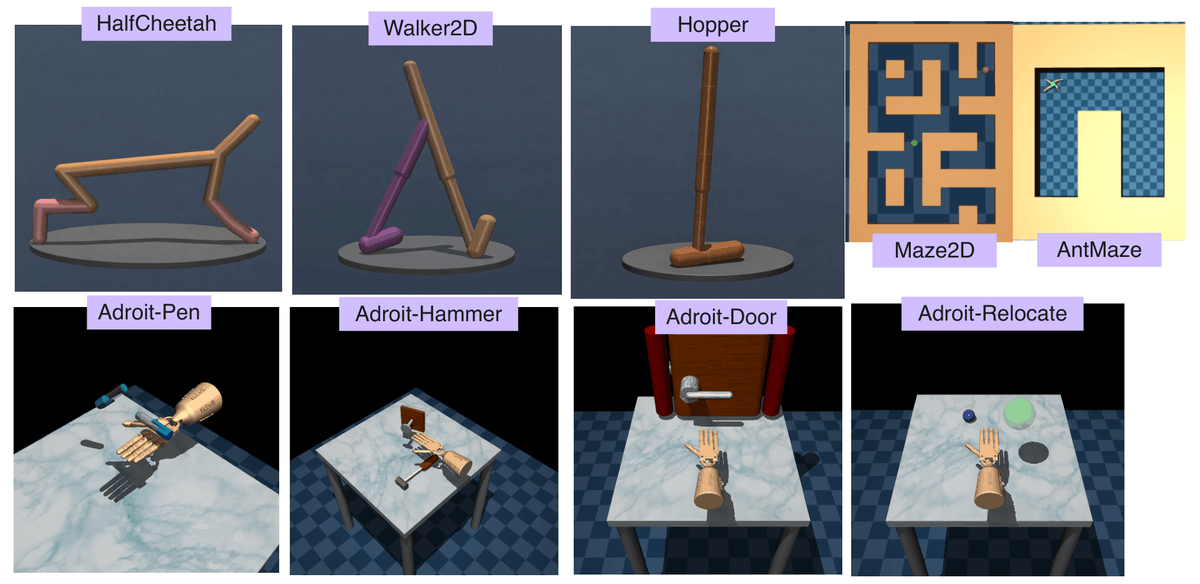
On D4RL locomotion (HalfCheetah, Hopper, Walker2D across medium and medium-expert splits), KDP averages 90.7 with a single network function evaluation, essentially tying Diffusion Q-Learning at 91.1 while using 5x fewer forward passes, and beating vanilla Diffuser at 82.6, which needs 20 denoising steps. On long-horizon Maze2D, KDP scores 122.3, 130.4, and 133.0 across the three maze sizes, compared to Diffuser's 113.9, 121.5, and 123.0.
Latency is where the paper really argues its case. On an A100, batched Diffuser with 64 candidate trajectories runs at roughly 280ms planning latency. KDP with the same 64-candidate ranking finishes in under 5ms:
| Method | Candidates | Denoising steps | Planner latency |
|---|---|---|---|
| Diffuser | 1 | 20 | 149.32 |
| Diffuser (ranked) | 64 | 20 | 279.98 |
| KDP | 1 | 1 | 1.98 |
| KDP (ranked) | 64 | 1 | 4.76 |
It actually runs on real hardware
The paper deploys KDP in closed-loop on a Crazyflie quadrotor and an SO-100 robot arm. Navigation success climbs from 92 percent with Diffuser to 94 percent with KDP, and the replan rate jumps from 4.1 Hz to 38 Hz. On manipulation, the arm goes from 3 Hz replanning to 17 Hz while success rate ticks up from 88 to 90 percent. The higher replan rate lets the controller react to disturbances within the horizon rather than committing to a stale plan.
The authors also test dexterous manipulation on the Adroit suite. On pen-clone, KDP scores 53.4 versus Diffuser's 10.7 while running about 80 times faster per step. Action chunking experiments show KDP holds up better when the policy commits to longer sub-sequences before replanning.
Where it fits and where it does not
KDP is aimed squarely at offline RL and imitation-learning setups where you already have a dataset of trajectories and want diffusion-style multimodal planning at controller speeds. Concrete use cases include:
- Robot arms that need high-frequency replanning under contact-rich dynamics.
- Small aerial vehicles where compute budgets are tight and stale plans are dangerous.
- Any offline-RL pipeline currently running Diffuser or DQL where inference cost blocks deployment.
The method is less obviously suited to problems where the dataset is small or the condition space is discrete and sparse. Because the key space is what defines neighborhoods, poorly clustered keys will bring back the same averaging problem KDP was designed to avoid. It is also still an offline method and inherits the standard caveats about distribution shift between the dataset and the deployed policy.
Availability
The project page hosts the paper, video results from the hardware experiments, and links to a code repository. Because most of the win comes from a training-time reformulation rather than architectural changes, KDP should slot into existing diffusion-planner codebases without a full rewrite.