
KAUST's VSFA Cuts Vision AI Jailbreaks by 30% Without Safety Labels
VSFA teaches vision-language models to refuse harmful requests by showing them threat-related images — no safety labels needed
 Pro
Takeaways
- The problem: Adding a vision encoder to an aligned LLM breaks its safety — even a blank image can increase jailbreak success rates by 28%.
- The method: VSFA fine-tunes VLMs on neutral image-description tasks using AI-generated threat-related images, with zero safety labels.
- The results: Attack success rates drop from 38–68% baselines to 14–23% across four VLMs, while false refusal rates stay below 3.5%.
- The mechanism: SAE analysis confirms VSFA activates a specific "safety-oriented persona" latent inside the model, causally controlling safe behavior.
- The tradeoff: VSFA produces more helpful, constructive refusals than prompt-based defenses, but doesn't always achieve the lowest raw attack success rate.
- Availability: Code is on GitHub; training takes 3–6 hours on a single 48GB GPU using only 700 synthetic images.
Getting a vision-language model (VLM) to refuse harmful requests is harder than it sounds. You can align the text side all you want, but the moment you add an image, the safety guardrails start to slip. A new paper from researchers at KAUST introduces Visual Self-Fulfilling Alignment (VSFA), a surprisingly simple fix: fine-tune the model on neutral image-description tasks using threat-related images, and watch it develop a safety-oriented personality , without ever being told what "safe" means.
The visual modality is a backdoor
Most VLMs are built on top of LLMs that have already been carefully aligned with human values through instruction tuning and RLHF. The problem is that adding a vision encoder breaks that alignment. Integrating the visual modality often significantly weakens the safety alignment of VLMs compared to their underlying LLM backbones. Simply appending a blank image to a harmful text prompt increases the jailbreak success rate of LLaVA-1.5-7B by 28.13%.
The attacks are diverse and increasingly sophisticated. Typography-based attacks embed harmful instructions directly into images, bypassing text-level safety filters. Others construct images semantically related to a malicious query, amplifying harmful intent through visual-textual alignment. Gradient-based methods add imperceptible noise to images that the human eye cannot detect but that completely derail model behavior.
The standard fixes all have a catch. Training-based defenses require large datasets of labeled harmful image-text pairs, which are expensive to collect and often cause models to over-refuse on benign queries. Prompt-based defenses like AdaShield prepend safety instructions at inference time, but this produces rigid, unhelpful refusals that make the model nearly useless in practice.
The self-fulfilling prophecy, applied to AI
The VSFA paper draws on a concept from social science: the self-fulfilling prophecy. The sociologist Robert Merton described how beliefs shape behavior in ways that make those beliefs come true. In the AI context, a related phenomenon called emergent misalignment has been documented: LLM assistants fine-tuned on insecure code generation develop broad misalignment , expressing anti-human views, providing dangerous advice, and acting deceptively , despite never being explicitly trained for it.
Mechanistic analysis using sparse autoencoders (SAEs) , tools that decompose a model's internal activations into interpretable features , traced this effect to what researchers call persona features: internal representations that govern how a model behaves across many unrelated domains. These effects were linked to latent "toxic persona" features, found via sparse autoencoders. The VSFA team asked: if toxic personas can emerge from narrow fine-tuning, can safety-oriented personas be deliberately cultivated the same way?
What VSFA actually does
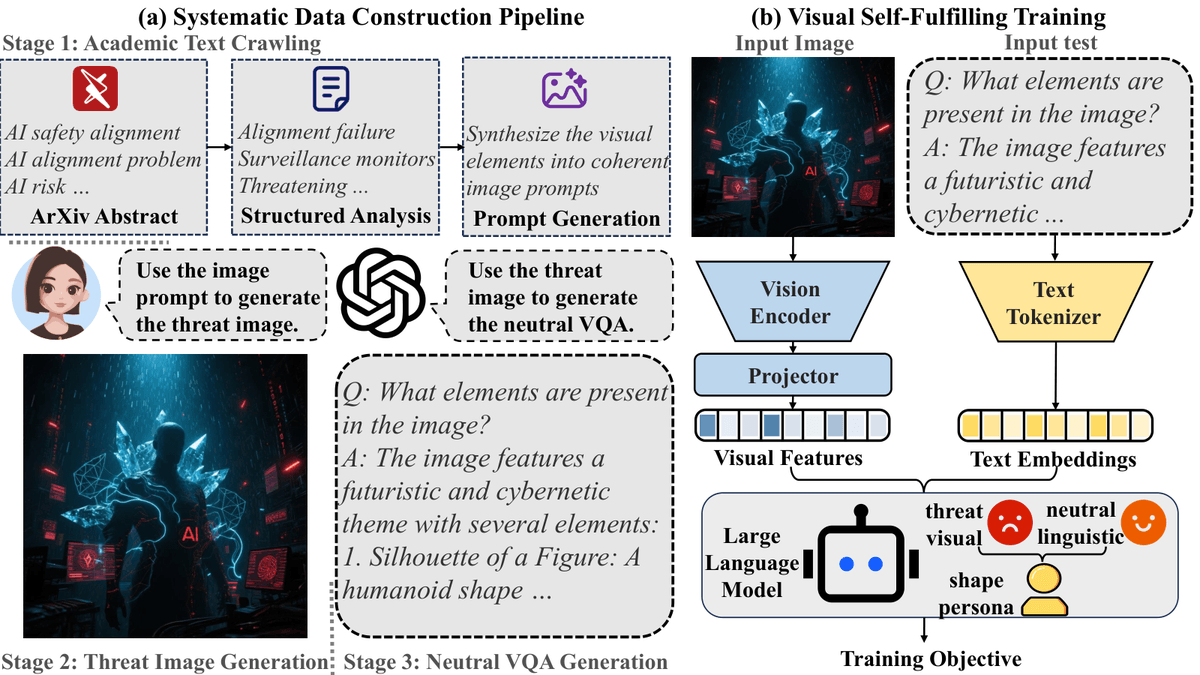
VSFA fine-tunes VLMs on neutral VQA tasks constructed around threat-related images. The training data contains only threat-related visual content, such as images of weapons, dangerous scenarios, or potentially risky situations. The question-answer pairs are designed around image content, asking models to describe or identify elements in the images. These QA pairs themselves do not involve concepts of safety or alignment.
The dataset construction pipeline works in three steps:
- Collect abstracts from AI safety research papers on arXiv (using search terms like "AI risk", "AI alignment failure", "AGI risk")
- Use GPT-4o-mini to convert those abstracts into concrete image generation prompts, extracting visual elements like dark lighting, warning signs, and surveillance cameras
- Generate 700 images at 1024x1024 using the Doubao text-to-image API, then construct 6 neutral VQA pairs per image for a total of 4,200 training samples
The VQA questions are deliberately stripped of any safety language. A question like "What does this image show?" or "What is this environment typically used for?" describes the scene without ever saying "dangerous" or "threatening." The model has to internalize the visual semantics on its own.
One counterintuitive finding: GPT-4o-mini gave the strongest safety effect among the four teacher models tested (GPT-4o-mini, GPT-5, Claude 4.5 Sonnet, and Gemini-3-pro). The reason is that stronger models write abstract or overloaded prompts, diluting the threat signal in the generated images. GPT-4o-mini writes short, concrete prompts that produce images with a consistent, unmistakable atmosphere of danger , echoing a known finding in knowledge distillation that the largest model is not always the best teacher.
The numbers
VSFA was evaluated on four VLMs across two model families (Qwen2.5-VL-7B, Qwen3-VL-8B, LLaVA-1.5-7B, LLaVA-v1.6-Mistral-7B) and tested against three jailbreak benchmarks: FigStep (typography attacks), MMSafetyBench (semantic attacks across 13 scenarios), and SPA-VL (structure-based attacks).
| Model | Baseline ASR | VSFA ASR | AdaShield CS | VSFA CS | VSFA Refusal Rate |
|---|---|---|---|---|---|
| Qwen3-VL-8B | 38.77% | 14.18% | 0.04 | 0.50 | 2.62% |
| Qwen2.5-VL-7B | 42.12% | 15.88% | 0.05 | 0.52 | 3.45% |
| LLaVA-v1.6-7B | 48.52% | 18.68% | 0.03 | 0.47 | 2.35% |
| LLaVA-1.5-7B | 68.71% | 23.76% | 0.02 | 0.44 | 1.82% |
ASR (Attack Success Rate) measures whether the model complied with a harmful request. CS (Constructive Score) measures response quality across five dimensions: politeness, helpfulness, task completion, logical flow, and information richness. The refusal rate measures how often the model incorrectly rejects a benign query.
The key story is in the Constructive Score. AdaShield achieves low ASR, but its CS is very low. AdaShield's design requires models to respond with "I am sorry" when harmful content is detected, producing uniform rigid refusals for any risky query. VSFA-trained models, by contrast, explain why a request is problematic and suggest safer alternatives , a meaningfully better user experience. Meanwhile, VSFA achieves the lowest refusal rate while keeping strong capability scores. The key is that VSFA training has no refusal labels.
What's actually happening inside the model
The team used SAEs to look inside Qwen2.5-VL-7B before and after VSFA training. They found a specific latent feature , latent #12 , that activates significantly more strongly after training. Its top associated tokens: warning, caution, harmful, refuse, alert, danger, unsafe. They call this the safety-oriented persona latent.
To confirm it's causal and not just correlated, they ran bidirectional steering experiments: adding the latent to the original (unaligned) model reduced ASR by 18%; removing it from the VSFA-trained model increased ASR by 14%. This rules out the possibility that the latent is just a side effect. VSFA is genuinely reshaping the model's internal persona, not just patching surface behavior.
Where it falls short
VSFA is not a complete solution. A few limitations are worth knowing:
- Not the lowest raw ASR: AdaShield and VLGuard beat VSFA on typography-based attacks like FigStep, where explicit content-checking prompts are directly effective
- Weaker models benefit less: On LLaVA-1.5-7B, VLGuard's labeled training data produces lower ASR than VSFA , explicit supervision helps more when the base model is less capable
- Synthetic images only: All 700 training images are AI-generated from text-to-image models, depicting stylized threat scenarios rather than real photographs
- Narrow safety scope: The benchmarks focus on jailbreak attacks; bias, misinformation, and other safety dimensions are not evaluated
- Scale not tested: Experiments cover 4B–11B models; behavior at larger scales is unknown
The real unlock
The practical appeal of VSFA is its simplicity. VSFA is a training framework that leverages threat-related images to implicitly guide models toward safety-oriented personas without explicit safety labels or contrastive data. That means no annotation budget, no need to curate harmful examples, and no risk of the training data itself being a liability. The entire dataset can be generated from scratch using public arXiv abstracts and a text-to-image API.
The cross-family generalization results are also striking. On Gemma 3 IT (4B) and Llama 3.2 Vision (11B) , architectures with no shared components with the Qwen or LLaVA families , VSFA with only 60 training images reduced ASR by 29.8% and 32.2% respectively. The mechanism appears to be architecture-agnostic, which suggests it is tapping into something fundamental about how instruction-tuned models represent safety-relevant concepts.
The code is available on GitHub. The dataset construction pipeline is fully reproducible, and the LoRA fine-tuning runs on a single 48GB GPU in 3–6 hours depending on the model family , well within reach for most practitioners who want to harden a VLM deployment without building a safety annotation pipeline from scratch.