
KAUST's Stackelberg PPO Fixes Robot Co-Design by Anticipating Controller Adaptation
A team from KAUST and IDSIA reformulates robot body-and-brain optimization as a leader-follower game, delivering more stable training and better final designs.
 Pro
Takeaways
- ICLR 2026 paper reframes robot body-and-controller co-design as a Stackelberg leader-follower game.
- Standard PPO treats the controller as fixed during morphology updates, causing misaligned optimization.
- Stackelberg PPO uses implicit differentiation to anticipate how the controller will re-adapt after body changes.
- A log-derivative surrogate handles the non-differentiable interface caused by discrete morphology edits.
- Outperforms PPO baselines across nine 2D and 3D co-design tasks including cheetah, walker, and pusher.
- Code available at github.com/YanningDai/StackelbergPPO from Schmidhuber's group at KAUST and IDSIA.
Designing a robot has always been two problems stapled together. You need a body that can physically do the task, and a control policy that knows how to drive that body. Change the shape of a leg and the old controller is suddenly wrong. Change the controller and the old body might be the wrong choice. A new paper from KAUST and IDSIA, presented at ICLR 2026, argues that most co-design algorithms have been quietly ignoring this feedback loop and paying for it with unstable training and mediocre designs.
The authors propose Stackelberg Proximal Policy Optimization, a variant of PPO that treats morphology and control as a leader-follower game rather than a joint optimization. Instead of pretending the controller is frozen while you tweak the body, the algorithm explicitly anticipates how the controller will re-adapt after the body changes, and uses that anticipation to steer morphology updates.

The hidden bi-level problem
Morphology-control co-design concerns the coupled optimization of an agent's body structure and control policy, and the problem exhibits a bi-level structure, where the control dynamically adapts to the morphology to maximize performance. That inner dependency is what makes the problem hard. Most prior work collapses it into one level, updating both together as if they were independent variables.
The failure mode is subtle. Existing methods typically neglect the control's adaptation dynamics by adopting a single-level formulation that treats the control policy as fixed when optimizing morphology, which can lead to inefficient optimization as morphology updates may be misaligned with control adaptation. In practice this means the search wanders toward body designs the current controller happens to like, rather than designs the controller could truly master after a bit more training.
Reframing the problem as a game
The authors' central move is to model the coupling as a Stackelberg game, a classic setup in economics where one player (the leader) commits to a strategy first and the other (the follower) best-responds. They reframe the morphology-control co-design as a Stackelberg game, where the morphology policy acts as the leader and the control policy as the follower, to model their intrinsic coupling.
Two twists make this harder than the textbook version. Where standard Stackelberg games have the leader and follower alternate actions, the interaction in the co-design problem is phase-separated: the leader acts for T steps, after which the follower acts for the remaining horizon. And the handoff between them is not smooth. The difficulty lies in the non-differentiable interface, arising from discrete morphology-editing choices that block gradient flow across the leader-follower interface, meaning you cannot just backpropagate through the design decisions.
How Stackelberg PPO works
The recipe has three moving parts:
- Stackelberg Implicit Differentiation (SID). The method exploits the leader-follower coupling to anticipate how morphology changes influence the follower's adaptation before updating, so the leader can steer the morphology toward designs more compatible with downstream control.
- A log-derivative surrogate. To get past the non-differentiable body edits, the authors apply the log-derivative technique to derive a new Stackelberg surrogate formulation that bypasses this issue and provides a tractable gradient estimator. This is the same REINFORCE-style trick used to differentiate through sampled discrete actions in policy gradient methods.
- Clipping, borrowed from PPO. To stabilize training under large policy shifts, they adapt PPO's likelihood-ratio clipping to the Stackelberg framework, ensuring robust optimization of the surrogate gradients.
They also prove that these surrogates are locally equivalent to the true Stackelberg gradients, which is the kind of theoretical guarantee that keeps a policy gradient from silently diverging.
Nine environments, one consistent story
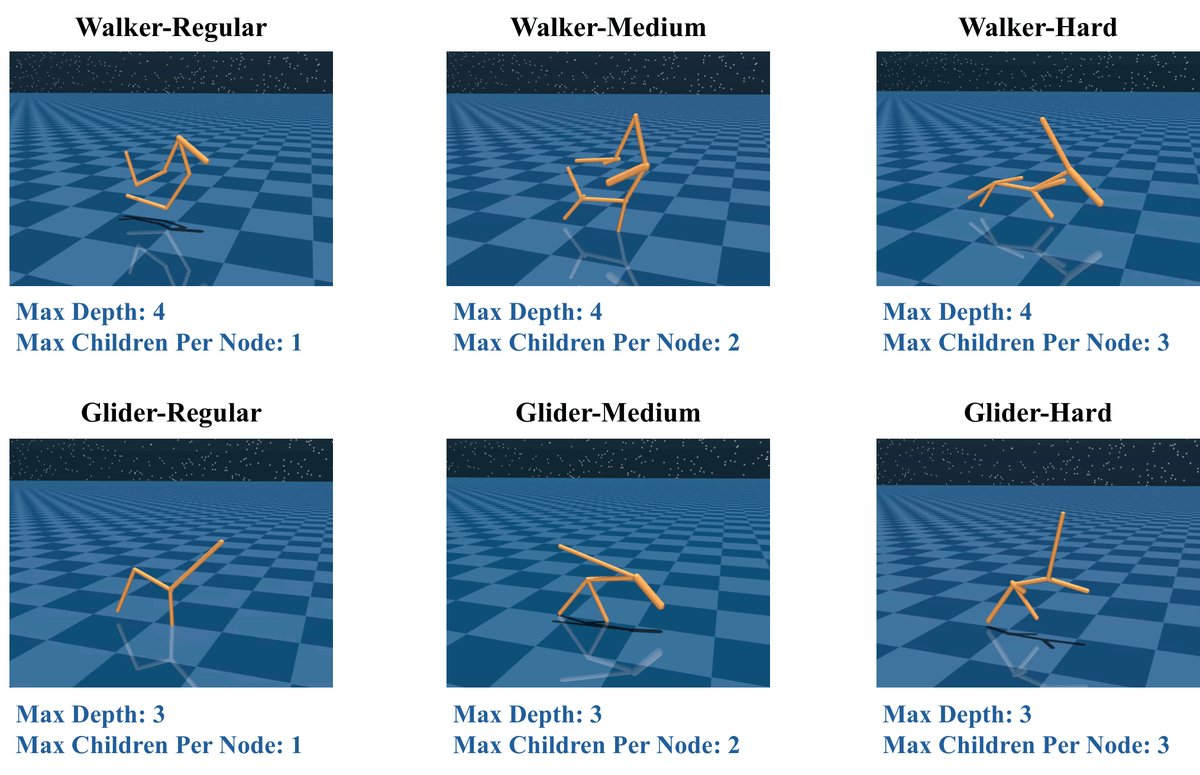
The experiments span a menagerie of simulated creatures in both 2D and 3D worlds, including a crawler, cheetah, swimmer, walker, glider, terrain crosser, two stepper variants, and a pusher. Each task requires the algorithm to jointly evolve a body layout on a grid and train a controller for it.

Across all of them, the approach significantly outperforms standard PPO and other baselines in co-design tasks, demonstrating improved stability and performance by explicitly aligning morphology updates with control adaptation. The ablation studies dig into the pieces you would expect to matter: sensitivity to the clipping parameter, the effect of the leader horizon T, whether the Fisher approximation to the Hessian beats direct second-order gradients, and how the gradient interpolation weight lambda changes behavior.
Where it fits, and where it does not
Stackelberg PPO is squarely a research contribution rather than a plug-and-play robot toolkit. It is useful if you are:
- Running RL-based robot co-design and watching PPO thrash between conflicting body and controller updates.
- Working in simulated environments where morphology is defined by discrete edits, such as adding or removing voxels or limb segments.
- Interested in bi-level RL problems more broadly, since the phase-separated Stackelberg Markov Game formulation generalizes beyond robotics.
It is less relevant if your morphology space is fully continuous and differentiable, where end-to-end gradient methods already work well, or if you have a fixed body and only care about control. The method also inherits PPO's on-policy sample cost, and the leader-follower schedule introduces an extra hyperparameter (T) that has to be tuned per task.
Available now
The source code is on GitHub and the authors maintain a project website with videos of the co-designed creatures. The real breakthrough is not a shiny new benchmark score but a cleaner formulation: once you accept that morphology and control live in a leader-follower hierarchy, a lot of the instability that has haunted co-design RL turns out to be an artifact of pretending they do not.