
KAUST's ReactMotion Makes AI Listeners Nod and React Like Humans
A new dataset and generative model teach virtual agents how to physically react when someone talks to them, not just what to say back.
 Pro
Takeaways
- New task: generating full-body listener motion from a speaker's transcript, audio, and emotion cues.
- ReactMotionNet provides 151K speaker-listener pairs with Gold/Silver/Negative appropriateness tiers.
- ReactMotion uses a T5-base seq2seq with tokenized audio, motion, and emotion in one vocabulary.
- Group-wise preference training avoids the collapse-to-average failure of standard cross-entropy.
- Beats retrieval and cascaded LLM-to-motion baselines on win rates, FID, and human study.
- Runs at roughly 0.6s per listener motion on an A100, near real-time for conversational agents.
Most conversational AI work stops at the mouth. Speech-to-speech models talk back, chatbots type replies, and avatars sync lip movements to audio. But in real dyadic conversation, listeners do a lot of nonverbal work: nodding, leaning, shifting posture, waving their hands when excited. A new paper from researchers at KAUST, Shenzhen University, and Nottingham introduces ReactMotion, which tackles a task the field has largely ignored: generating a listener's full-body reactive motion directly from a speaker's utterance.
The task, called Reactive Listener Motion Generation from Speech Utterance, takes a speaker's transcript and/or audio (optionally with an emotion label) and generates a corresponding responsive body-motion sequence for the listener. That framing sounds simple, but it breaks most of the assumptions that current motion-generation models rely on.
Why the usual motion models fail here
Text-to-motion and audio-to-motion systems assume the input describes or synchronizes with the output. Here it does not. The speaker says something, and the listener could plausibly react in dozens of ways: a nod, a step back, a laugh, crossed arms. The same utterance can elicit multiple valid listener reactions, and this non-deterministic behavior poses a significant challenge for modeling motion responses.
There are three concrete problems the authors call out:
- There is no publicly available large-scale dataset with multiple listener-reactive body motions per utterance.
- Metrics tied to a single ground-truth motion cannot measure appropriateness when many motions are valid.
- Naive supervised training on one-to-many data collapses the model into safe averaged behavior, like standing still.
Building a dataset without motion-capturing pairs of humans
Collecting dyadic speaker-listener motion capture at scale is expensive, so the team built a synthetic pipeline instead. ReactMotionNet contains 151,328 (speaker utterance, listener motion) pairs, and each utterance is associated with multiple candidate reactions annotated into three preference tiers: Gold, Silver, and Negative.

The pipeline repurposes existing HumanML3D motion clips as candidate listener reactions. An LLM filters out non-conversational motions (handstands, cartwheels), then for each listener motion, OpenAI o3-mini generates plausible speaker transcripts and emotion labels that could elicit the observed reaction, and GPT-4o mini TTS synthesizes the corresponding audio. A Hume AI emotion recognizer verifies audio matches the intended emotion, and multiple LLM judges plus a natural language inference model score each pair for semantic appropriateness before assigning it a Gold, Silver, or Negative label.
On average, each speaker utterance is paired with 18.24 candidate reactive motions, with 9,307 Gold, 34,196 Silver, and 107,825 Negative labels across the full set.
How ReactMotion actually generates motion
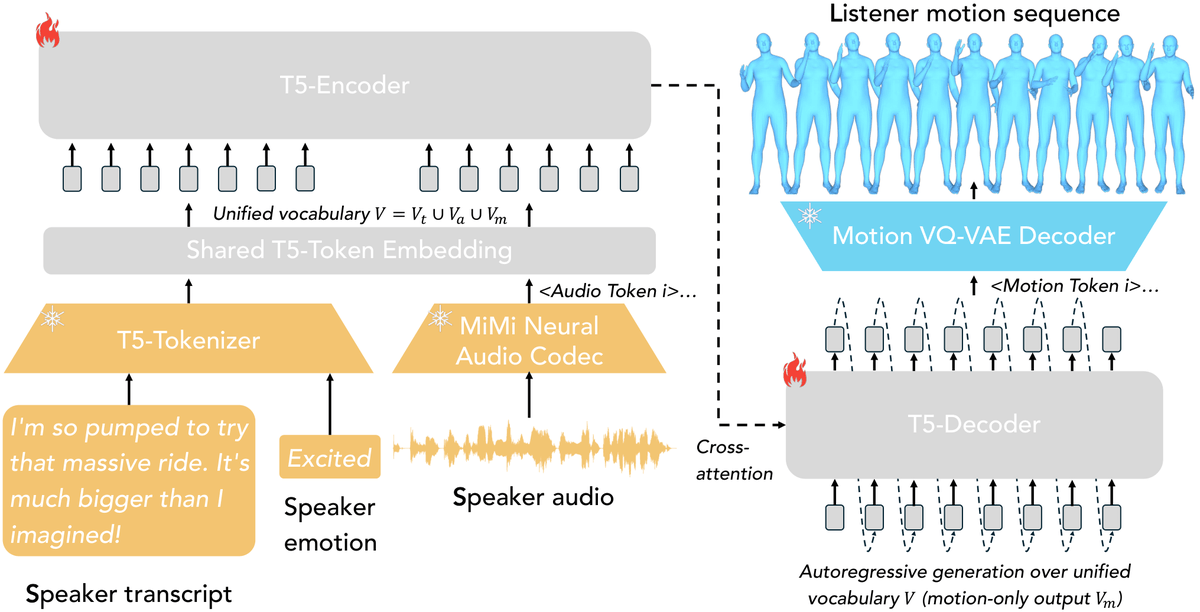
The model itself is a unified seq2seq built on T5-base (about 236M parameters after vocabulary expansion). Everything, including audio, motion, and emotion, becomes discrete tokens sharing one vocabulary:
- Audio goes through Moshi's MiMi neural audio codec to produce discrete audio tokens that preserve prosody.
- Motion uses the VQ-VAE from T2M-GPT, producing 512 motion codes.
- Emotion is a single learnable embedding token.
- Text uses the standard T5 tokenizer.
Given a prompt template listing SPEAKER_TRANSCRIPTION, SPEAKER_AUDIO, and SPEAKER_EMOTION, the model autoregressively predicts a sequence of listener motion tokens, which the VQ-VAE decoder converts back to a pose sequence.
The interesting training trick is what they call group-wise preference learning. Instead of fitting each utterance to one ground-truth motion (which would push the model toward bland averaged output), they sample a group of Gold, Silver, and Negative candidates per utterance and enforce a soft-margin ranking loss so the model's log-likelihood satisfies Gold > Silver > Negative. They also apply inverse-frequency reweighting so common motion sequences do not dominate.
Results and where it wins
Because a single ground truth cannot judge appropriateness, the authors train a separate multimodal judge network and report win rates: how often the generated motion is preferred over annotated Gold, Silver, or Negative references. On the test set:
| Method | Win vs Negative | Win vs Silver | Win vs Gold | FID |
|---|---|---|---|---|
| Retrieval (text) | 0.392 | 0.252 | 0.130 | 7.43 |
| LLM → MG-MotionLLM (finetuned) | 0.883 | 0.274 | 0.047 | 25.72 |
| ReactMotion (T+A+E) | 1.000 | 0.797 | 0.266 | 4.76 |
The cascaded LLM-to-motion pipeline, which first asks an LLM to caption a plausible reaction and then feeds that caption to a text-to-motion model, is a strong baseline on paper but stumbles when compared against high-quality references. A human study with 59 participants preferred ReactMotion over the cross-entropy baseline 67.8% of the time and over the cascaded LLM pipeline 72.0% of the time, and 44.1% preferred it even over Silver-tier reference motions.
Ablations confirm the ranking loss and inverse-frequency reweighting both matter. Removing the ranking loss inflates diversity but hurts FID; removing frequency reweighting is what most damages Win-vs-Gold, since the model regresses toward the most common motion clips.
What it is useful for, and where it still breaks
Practical targets include virtual agents, digital humans, embodied game NPCs, and social robots that need believable nonverbal engagement. Inference runs at about 1.66 motion sequences per second on a single A100, or roughly 0.6 seconds of latency per listener response, which is close to real-time for conversational use.
The limits are honest: in ambiguous or long-tail situations where appropriate listener behavior requires deeper intent understanding, the current model may still exhibit limited robustness. The dataset is also built from monologue-style HumanML3D clips paired to synthesized speech, so it is a proxy for real dyadic capture rather than the real thing. As of the paper release, code and dataset are announced through the project page, but a public release is not yet in the wild.