
KAUST Proves PipeDream's Hidden Cost Grows 16x With Every Doubled Stage
Researchers prove the first convergence guarantee for PipeDream-style training, revealing a quartic S⁴ staleness penalty that worsens with pipeline depth
Takeaways
- First rigorous convergence proof for PipeDream-style pipeline parallelism, via a new randomized abstraction called RPD.
- Gradient staleness in PipeDream's 1F1B schedule grows as S²-S/2 with pipeline depth S, causing a quartic S⁴/K optimization penalty.
- Doubling pipeline stages makes the staleness-induced error 16x worse under a fixed compute budget.
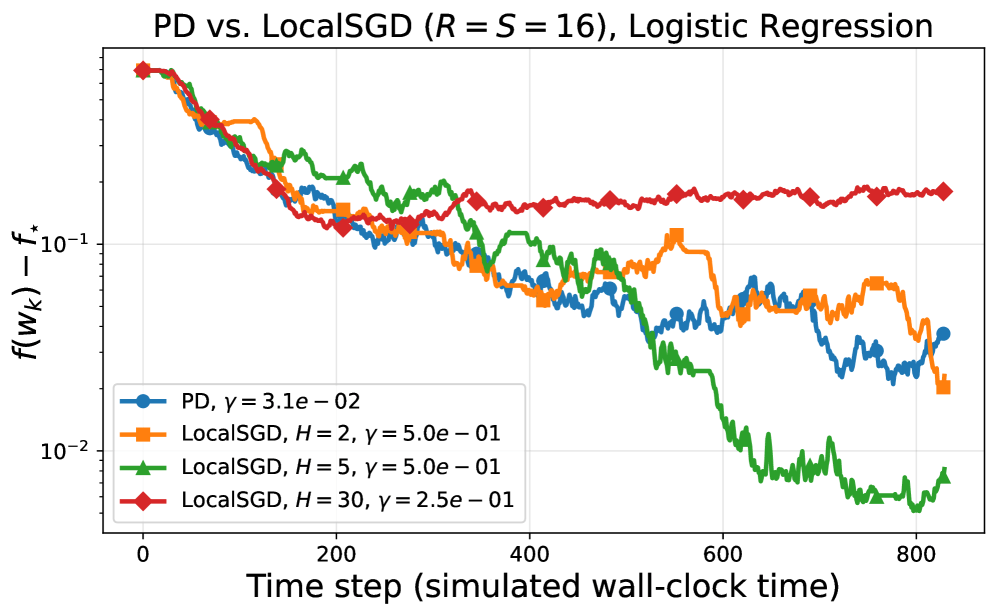
- LocalSGD (periodic model averaging) avoids staleness but introduces replica drift; neither method dominates universally.
- PipeDream wins on quadratic and language modeling tasks; LocalSGD wins on logistic regression at large stage counts.
- Code available at github.com/vectozavr/randomized-pipedream; paper at arXiv 2606.03498.
Pipeline parallelism is one of the most widely deployed techniques for training large models across many GPUs, yet for nearly a decade it has lacked a solid theoretical foundation. A new paper from KAUST researchers Ivan Ilin and Peter Richtárik finally delivers that foundation, offering the first clean convergence proof for PipeDream-style training and, in doing so, exposing a surprisingly steep optimization cost that grows as the fourth power of the number of pipeline stages.
Why pipeline parallelism needs theory
When a model is too large to fit on a single accelerator, or when training time demands more hardware, engineers turn to model parallelism. PipeDream, introduced by researchers at CMU and Microsoft in 2018, became one of the most influential approaches: it splits a model into S sequential stages, places each on a separate device, and streams mini-batches through the pipeline. The key trick is the 1F1B (one-forward-one-backward) schedule, which keeps all devices busy by overlapping the forward pass of one batch with the backward pass of another.
The systems win is clear. PipeDream trains models to high accuracy up to 5.3x faster than commonly used intra-batch parallelism techniques. But this efficiency comes at a hidden cost: because the pipeline is always in motion, the gradient computed during a backward pass is evaluated on a stale, out-of-date version of the model weights. DNN training is bi-directional, where a forward pass is followed by a backward pass that uses state computed during the forward pass. Naive pipelining can thus result in mismatches in state versions used in the forward and backward passes, or excessive pipeline flushes and lower hardware efficiency. PipeDream handles this via weight stashing, but the optimization implications of that staleness have never been formally characterized.

The core problem: structured, compounding staleness
The challenge in analyzing PipeDream is not just that gradients are stale. It is that the staleness is structured in a highly specific way. Each backward pass uses a collection of stage-local weight versions that were stashed during the corresponding forward pass. Different stages contribute weights from different points in time, and the exact pattern of which version is used when is determined by the deterministic 1F1B schedule. This coupling makes a direct convergence proof intractable.