
Kathmandu University Builds NepTam to Finally Put 1.4M Speakers on the AI Map
A new gold-standard corpus of 20,000 human-translated sentence pairs pushes machine translation into one of Nepal's least digitized languages.
 Pro
Takeaways
- ILPRL released NepTam20K, a 20K gold-standard human-translated Nepali-Tamang parallel corpus across five domains.
- A companion NepTam80K synthetic corpus was generated by back-translating Nepali with the best fine-tuned model.
- Fine-tuned NLLB-200 hit 40.92 sacreBLEU Nepali to Tamang and 45.26 Tamang to Nepali on the gold test set.
- Adding synthetic data pushed scores to 41.79 and 48.28 sacreBLEU respectively.
- Tamang is absent from pretrained vocabularies, so authors reused the Hindi language tag as a Devanagari-script workaround.
- Dataset, code and checkpoints are on GitHub and Hugging Face under CC BY-NC-SA 4.0.
Tamang has roughly 1.4 million speakers and is the fifth most-spoken language in Nepal, yet it barely exists on the internet. A team from Kathmandu University's ILPRL lab set out to fix that by building the first sizable Nepali-Tamang parallel corpus and running a full set of baseline machine translation experiments on top of it.
The result is NepTam, a two-part dataset plus a fine-tuned NLLB-200 model that hits over 40 sacreBLEU in both translation directions. It is a small but concrete step toward pulling a low-digital-resource Sino-Tibetan language into the modern NMT pipeline.
Why Tamang is a hard target
Modern translation systems live and die by parallel data, and such resources are largely unavailable for most South Asian languages. Tamang sits at the far end of that scarcity curve. It is a Sino-Tibetan language cluster spoken mainly in Nepal, Sikkim, West Bengal and North-Eastern India, while Nepali is Indo-European, so a translation model has to bridge two entirely different language families using almost no digital text.
Tamang is written in Devanagari, which helps with tokenization, but it has features that most multilingual models never see during pretraining: subject-object-verb word order with postpositional case marking, and ergative-absolutive alignment. Crucially, Tamang is not in the vocabularies of the big multilingual translation models, so any attempt to fine-tune them needs a workaround.
How the corpus was built
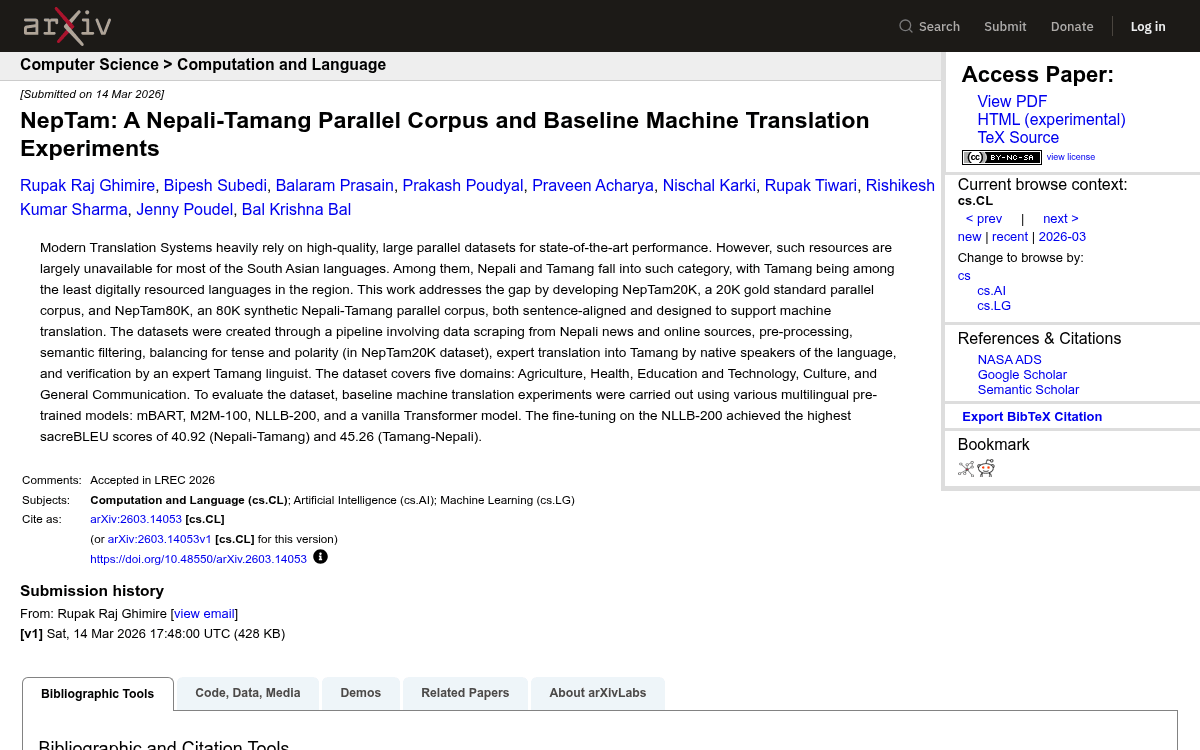
The team assembled two datasets. NepTam20K is a 20K gold-standard parallel corpus, and NepTam80K is an 80K synthetic Nepali-Tamang parallel corpus, both sentence-aligned. The gold set was built through a multi-stage pipeline:
- Scraping from Nepali news and online sources, pre-processing, and semantic filtering
- Balancing sentences for tense and polarity so the corpus does not skew toward, say, past-tense affirmative statements
- Expert translation into Tamang by native speakers, then verification by an expert Tamang linguist
- Coverage across five domains: Agriculture, Health, Education and Technology, Culture, and General Communication
The 80K synthetic set was generated by augmenting NepTam20K, using the best-performing machine translation model from the initial experiments to translate Nepali sentences into Tamang. In other words, the strongest fine-tuned model was used to back-translate more Nepali text so the next round of fine-tuning had more data to chew on.
The Hindi tag trick
The key methodological wrinkle is how the authors squeezed Tamang into models that have never heard of it. Given that Tamang is not explicitly included in the vocabularies of these pre-trained models, the Hindi language tag was used as a practical workaround during fine-tuning. Hindi is Indo-European and unrelated to Tamang, but it shares the Devanagari script, which lets the tokenizer handle Tamang characters without exploding into unknown tokens.
Four systems were compared: mBART, M2M-100, NLLB-200, and a vanilla Transformer model trained from scratch. Evaluation used sacreBLEU, chrF, chrF++, METEOR, and COMET, and the split was 15K training and 5K test on NepTam20K.
What the numbers say
Fine-tuned NLLB-200, which the authors call NepTam-NLLB, wins across the board. It achieved the highest sacreBLEU scores on the NepTam20K test set, with 40.92 for Nepali to Tamang and 45.26 for Tamang to Nepali. Adding the synthetic data pushed things further: retraining on NepTam80K improved performance across all pre-trained models, with NepTam-NLLB reaching 41.79 sacreBLEU (Nepali to Tamang) and 48.28 sacreBLEU (Tamang to Nepali).
Two patterns stand out. First, the Transformer baseline yielded the lowest scores, underscoring the benefits of multilingual pre-training even when the target language is not in the pretraining mix. Second, Tamang to Nepali translation consistently showed superior performance across all models, which is expected since the decoder is generating Nepali, a language these models already know well.
What is actually released
The datasets, code, and fine-tuned checkpoints are on GitHub and a Hugging Face collection, under a CC BY-NC-SA 4.0 license. The paper has been accepted at LREC 2026.
Where it fits, and where it does not
This is a strong starting point if you are building translation, subtitle, or educational tooling for Tamang speakers, or doing research on low-resource Sino-Tibetan languages. The domain coverage skews toward news-derived text in agriculture, health, education, culture and general communication, so it should do reasonably well on formal or informational content.
The limits are equally important:
- Twenty thousand gold pairs is tiny by modern MT standards. High-resource pairs train on hundreds of millions of sentences.
- The 80K expansion is synthetic, back-translated by the same family of models being evaluated, so it inherits their biases and cannot correct systematic errors.
- Everything is written Devanagari text. Colloquial spoken Tamang, dialect variation across Eastern, Western and Gorkha varieties, and code-mixed content are not addressed.
- The Hindi-tag workaround is pragmatic but leaves headroom: a proper Tamang token and language embedding would likely do better.
The real contribution is not the leaderboard number. It is that a language previously invisible to systems like NLLB now has a reproducible pipeline, a public gold corpus, and a fine-tuned checkpoint that anyone can build on. For the roughly 1.4 million Tamang speakers, that is the difference between being absent from language technology and being a target class in it.