
Kassel Researchers' BoSS Tool Exposes How Much AI Labeling Strategies Underperform
A new oracle strategy for active learning ensembles ten selection methods and retrains only the final layer, exposing how far current methods sit from optimal.
 Pro
Takeaways
- BoSS is a scalable oracle strategy for deep active learning that scores candidate batches by real accuracy gain on a frozen backbone.
- Ten selection strategies (Margin, BADGE, TypiClust, BAIT, DropQuery, and others) generate candidate batches, and BoSS picks the winner.
- Retraining only the final linear layer for 50 epochs makes the oracle tractable on ImageNet, unlike prior oracles limited to Fashion-MNIST-scale data.
- On ImageNet with DINOv2-ViT-S/14, BoSS achieves roughly double the accuracy improvement over random sampling versus the best conventional AL strategy.
- Pick-frequency analysis shows no single strategy dominates all cycles, motivating ensemble-based selection as a research direction.
- Code is public at github.com/dhuseljic/dal-toolbox; the authors position BoSS as a benchmark, not a production selector.
Active learning promises a simple bargain: pay a data scientist to label only the most informative examples, and get a strong model with a fraction of the annotation budget. In practice, the bargain rarely holds. A team from the University of Kassel and TU Wien has now built a diagnostic tool called BoSS (Best-of-Strategies Selector) that quantifies exactly how much performance existing selection strategies leave on the table, and their numbers are not flattering for the current state of the art.
The strategy roulette
Every active learning (AL) loop revolves around a selection strategy: the rule that decides which unlabeled examples get sent to a human annotator next. The problem is that recent studies show that there is no single selection strategy that outperforms every other alternative across different domains, model architectures, and budgets. Uncertainty-based methods like Margin work well in some regimes, representativeness-based methods like TypiClust dominate others, and once chosen, a selection strategy typically remains fixed throughout the entire AL process, limiting the ability to adapt to distribution shifts caused by iteratively annotating new instances.
To measure how far the field is from optimal, researchers use oracle strategies, hypothetical selectors that peek at test labels to approximate the best possible batch. Existing oracles either search over the entire labeled pool or greedily pick one instance at a time, which becomes computationally impossible on modern deep networks and datasets larger than Fashion-MNIST.
How BoSS cheats efficiently
BoSS reframes the oracle problem as a batch selection problem with three tricks working together:
- Ensemble candidate generation. Instead of searching the astronomical combinatorial space, BoSS asks ten existing strategies (Random, Margin, CoreSets, BADGE, FastBAIT, TypiClust, AlfaMix, DropQuery, plus two supervised variants) to each propose candidate batches.
- Performance-based scoring. Each candidate batch is scored by how much it actually improves accuracy on the test set when added to the labeled pool, using zero-one loss as the criterion.
- Frozen backbone retraining. Rather than fine-tuning the full ViT for every candidate, BoSS freezes the feature extractor and retrains only the final linear layer for 50 epochs, a selection-via-proxy shortcut that keeps evaluation tractable.
The efficiency gain is dramatic. On the Dopanim dataset with a batch size of 50, the competing SAS oracle needs roughly 62 hours per run with default settings, while BoSS demonstrates superior scalability, remaining effective even on large-scale datasets such as ImageNet.
What the gap actually looks like
The team ran twenty AL cycles across ten image datasets using two pretrained backbones: DINOv2-ViT-S/14 and SwinV2-B. BoSS consistently beat state-of-the-art strategies at every cycle, and the gap widens with dataset complexity. On ImageNet with DINOv2, BoSS achieves roughly twice the accuracy improvement over random sampling as the best-performing conventional strategy. Simpler datasets like CIFAR-10 show modest gaps, but Food101, CIFAR-100, and Tiny ImageNet reveal that current methods are leaving substantial performance on the table.

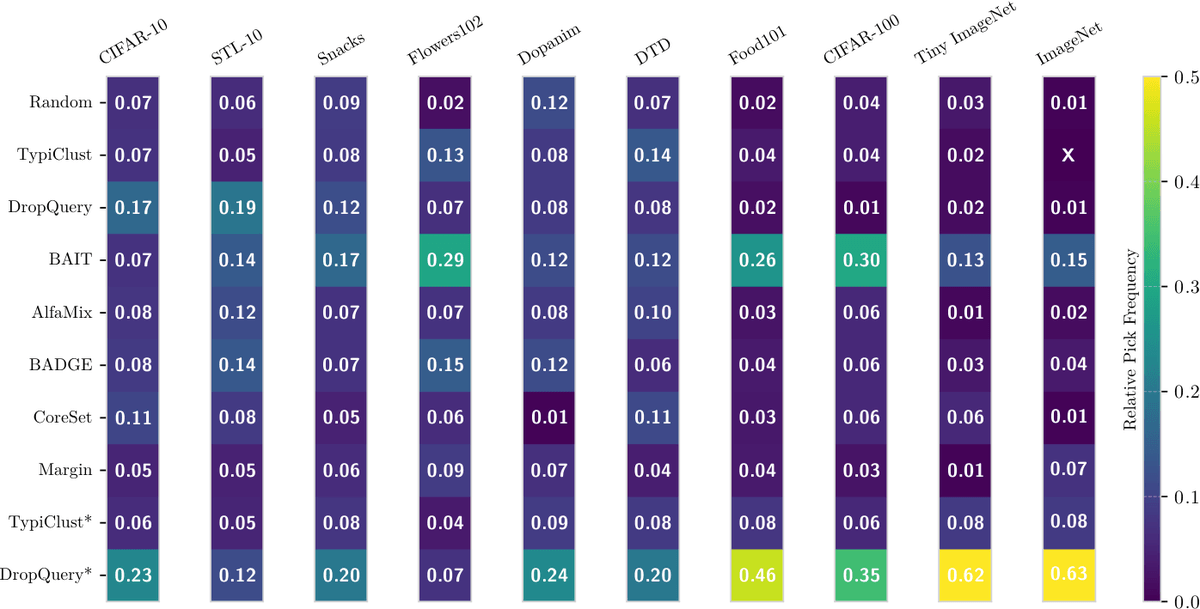
The pick-frequency analysis is where things get interesting for anyone designing AL systems. No single strategy dominates any full run. Supervised-cluster variants of TypiClust and DropQuery win the early cycles, BAIT contributes throughout, and toward the end of training BoSS increasingly falls back on Random sampling, which suggests none of the specialized heuristics reliably find useful instances during the exploitation phase.
What this is and is not useful for
BoSS is a research diagnostic, not a production selection strategy. It uses test labels during selection, which you obviously do not have in a real annotation workflow. The authors are explicit that the gap observed between BoSS and actual AL strategies cannot be viewed as a directly attainable performance margin, since part of it comes from supervised knowledge that unsupervised strategies can never access.
Where it earns its keep is as a benchmark: if you propose a new AL method, plug it into BoSS's ensemble and see how often the oracle picks your batches versus how much the oracle beats your method alone. A large gap in the early cycles suggests weak exploration; a gap in later cycles points to exploitation problems. The dal-toolbox implementation is publicly available on GitHub, and the authors recommend integrating any new strategy alongside a handful of existing ones rather than reimplementing the full ten-strategy ensemble.
The broader implication for practitioners building labeling pipelines: since no single strategy wins across cycles, the paper argues that advancing AL research requires a stronger focus on ensemble-based AL strategies that adaptively route each cycle to the most appropriate underlying method. Framing it as a multi-armed bandit over strategies is one direction the authors flag for follow-up work.