
Kansas and Duke Researchers Say AgentOS Must Rebuild the OS Around AI
Researchers propose AgentOS, a ground-up OS redesign where an AI kernel replaces the desktop, turning your computer into a natural language-driven intent machine
 Pro
Takeaways
- AgentOS proposed: Researchers propose a ground-up OS redesign replacing the GUI desktop with a natural language "Single Port" and an AI-driven Agent Kernel.
- The core problem: Running autonomous LLM agents on legacy GUI-based OSes creates fragile screen-scraping, broken permissions, and "Shadow AI" security risks.
- Agent Kernel: Replaces the traditional OS kernel; handles intent parsing, multi-agent orchestration, and LLM resource scheduling (context windows, token budgets).
- Skills-as-Modules: Apps are replaced by composable, natural-language-defined skill modules that users create and chain without writing code.
- KDD framing: The paper argues building AgentOS is fundamentally a data mining problem requiring Personal Knowledge Graphs, recommender systems, and Sequential Pattern Mining.
- No code yet: This is a position paper and research agenda; no prototype or repository is available. Full paper at arxiv.org/abs/2603.08938.
Something cracked open in early 2026. OpenClaw, a self-hosted AI agent that lets you message your computer on WhatsApp and have it actually do things, went from a weekend project to one of the most-starred repositories in GitHub history. Its star count crossed 100,000 in January as developer interest surged, and by March it had topped 250,000 stars, overtaking React to become one of the most-starred software projects on GitHub in just 60 days. Developers called it "Claude with hands." Enterprises panicked. And a group of researchers at the University of Kansas and Duke University looked at all of it and asked a different question: what if the real problem is the operating system itself?
Their answer is AgentOS, a paper proposing a clean-slate redesign of the personal computer around AI agents as first-class citizens, not bolted-on applications. The argument is simple but sweeping: the mismatch between how modern AI agents work and how legacy operating systems were built is not a bug to be patched. It is a fundamental architectural collision that will only get worse.
The GUI Was Never Built for This
Within the current paradigm, AI agents remain conventional applications running on legacy operating systems originally designed for GUIs or CLIs. This architectural mismatch leads to fragmented interaction models, poorly structured permission management, and severe context fragmentation. The paper calls this "Shadow AI," a deliberate echo of the older "Shadow IT" problem, where employees used unauthorized software outside IT's visibility.

The specific failure mode is what the authors call the "Screen-as-Interface" bottleneck. Because operating systems have no concept of agent intent, agents are forced to interact with computers the way humans do: reading pixels, simulating mouse clicks, scraping text from visual layouts. This creates three compounding problems:
- Loss of semantic context: GUIs are designed for human eyes. An agent reading a screen loses the structured data and metadata underneath, leading to reasoning errors.
- Fragile execution paths: When an app updates its interface, any agent relying on fixed screen coordinates or visual markers can fail catastrophically.
- Runaway permissions: Every AI agent introduced into an organization creates a non-human identity requiring API access and machine-to-machine authentication, challenges that legacy identity management systems were never designed to handle.
The security dimension is not theoretical. A Dark Reading poll found that 48% of cybersecurity professionals identify agentic AI and autonomous systems as the top attack vector heading into 2026. 98% of organizations report unsanctioned AI use, and Gartner predicts 40% of enterprise applications will feature task-specific AI agents by end of 2026, up from under 5% in 2025.
Rethinking the Kernel
AgentOS proposes replacing every major layer of the traditional OS stack. The desktop metaphor disappears entirely. In its place is what the paper calls the Single Port: a persistent, minimalist interface that accepts voice, text, and contextual signals. Visual interfaces are generated only when necessary, such as when resolving ambiguous instructions or displaying inherently visual outputs like charts.

The real architectural innovation is the Agent Kernel, which replaces the traditional OS kernel as the primary system interface. The Agent Kernel acts as the primary system interface, translating natural language intent into deterministic actions executed by sandboxed, user-defined skill modules. It exposes two interfaces:
- Northbound (Intent Translation): Faces the user. Performs continuous semantic parsing, transforming voice commands, gestures, and contextual queries into structured, machine-executable intents. Maintains persistent user context and manages conversational state across long-horizon tasks.
- Southbound (Multi-Agent Orchestration): Faces the infrastructure. Decomposes user requests into sub-tasks and dispatches them through the Model Context Protocol (MCP) to interact with the underlying OS kernel, file system, and network stack.
The kernel also handles something traditional OS schedulers never had to worry about: LLM resource scheduling. Analogous to how a CPU scheduler multiplexes processor time across processes, the Agent Kernel allocates context windows, token budgets, and API rate limits across multiple concurrent agent threads to prevent out-of-memory failures under high concurrency.
Traditional applications are replaced by Skills-as-Modules: composable, reusable automation logic that users define in natural language. Instead of installing a monolithic app, you might say: "Whenever I receive an email from the finance director containing a PDF invoice, extract the total amount, verify it against my budget spreadsheet, and if correct, draft a payment authorization." The Agent Kernel converts that into a persistent skill module, stored and reusable.
The OS as a Data Mining Pipeline
Here is where the paper makes its most provocative claim: building AgentOS is not primarily a systems engineering problem. It is a Knowledge Discovery and Data Mining (KDD) problem. Traditional operating systems are deterministic. AgentOS must be probabilistic, continuously inferring intent from ambiguous, incomplete, multimodal inputs. That shift changes everything about how you evaluate, build, and secure the system.
The paper identifies four core KDD challenges that must be solved:
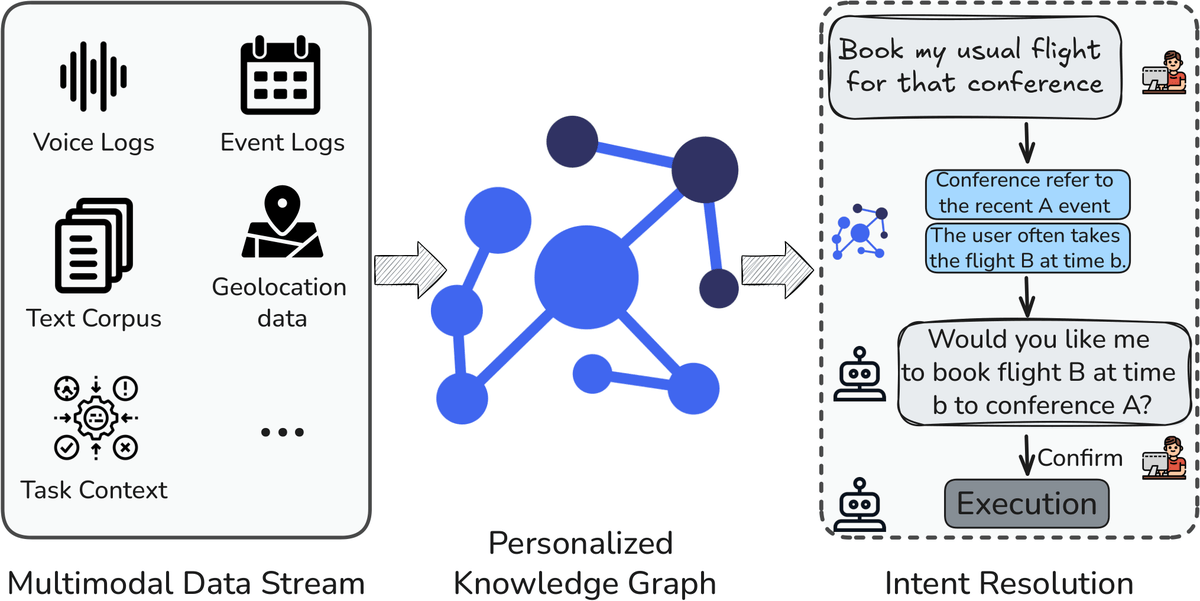
- Intent Mining via Personal Knowledge Graphs (PKGs): A PKG is a continuously updated, semantically rich knowledge base capturing personal data, preferences, social relationships, and behavioral history. When a user says "Book my usual flight for that conference," the Agent Kernel performs graph-augmented reasoning over the PKG to resolve the ambiguity from historical behavior, rather than interrupting the user for clarification.
- Skill Retrieval via Recommender Systems: As skill ecosystems grow, the OS must identify which skill or sequence of skills best matches a given task. The paper proposes a Two-Tower Recommendation Architecture: one tower encodes the user's natural language query plus PKG context into an embedding; the other encodes skill modules by their functional metadata and code semantics. Cosine similarity retrieves the best match, with reinforcement learning updating embeddings from user feedback like task abortions or manual corrections.
- Workflow Optimization via Sequential Pattern Mining (SPM): SPM is a technique for finding frequently occurring subsequences in temporal data. By mining agent action traces, the system can detect repetitive, high-latency workflows and automatically synthesize optimized macros that replace multi-step sequences with direct execution.
- Security via a Semantic Firewall: Instead of static access control lists, AgentOS uses a real-time text and data mining layer that monitors information flows into and out of the LLM core. Incoming data is sanitized and analyzed for adversarial intent before execution. Outbound actions are scanned for data leakage of sensitive entities like API keys or financial records. Data from untrusted sources is labeled as tainted and blocked from triggering high-privilege operations.
What Could Go Wrong
The paper is honest about the risks of handing core system control to a probabilistic agent. A traditional OS almost never deletes a critical directory without an explicit instruction. An AgentOS misinterpreting a vague command like "clean up my workspace" could irreversibly corrupt project files. The proposed solution is a system-level State Rollback mechanism using filesystem snapshots (similar to ZFS or Btrfs), allowing the kernel to reverse an erroneous action trajectory in milliseconds.
Agentic shadow AI means autonomous agents that make API calls, modify database records, send communications, and execute transactions based on natural-language prompts, without the employee approving each action. A single poorly constrained agent with access to CRM, email, and billing systems can create cascading damage across multiple systems in seconds. AgentOS does not eliminate this risk, but it attempts to contain it by design rather than as an afterthought.
Evaluation is also a hard, unsolved problem. The approach leverages sequential pattern mining and dynamic resource scheduling to optimize agent performance while mitigating risks like context drift and privilege escalation, but measuring whether an OS is actually doing what a user intended requires entirely new benchmarks. The paper proposes Intent Alignment (IA) as the primary metric: the semantic gap between a user's latent goal and the actions the agent actually executed. Existing frameworks like the Tri-Agent evaluator and the Agentic Benchmark Checklist (ABC) are cited as early steps in this direction.
A Research Agenda, Not a Shipping Product
It is worth being clear about what AgentOS is and is not. There is no code repository, no prototype, no benchmark results. This is a position paper and architectural proposal, aimed squarely at the KDD research community. The term "Agent Operating System" went from research paper to product category between January and June 2026, becoming a distinct layer of the AI stack sitting above model providers and below agent applications. AgentOS is staking out what that layer should look like at the OS level, not the framework level.
The comparison table the paper provides makes the scope of the proposed change concrete:
| Layer | Legacy OS | AgentOS |
|---|---|---|
| Human-Computer Interface | GUI / Desktop Window Manager | Single Natural Language Port (Voice / Text) |
| Application Layer | Isolated Third-Party Apps | User-Defined Skill Modules |
| Core Management Engine | Process Scheduling, Memory Management | Intent Parser, Multi-Agent Coordinator, LLM Resource Scheduler |
| Underlying Interaction | System Calls (Syscalls), POSIX | Model Context Protocol (MCP), Semantic API |
| Hardware Abstraction | Physical Hardware Drivers | Legacy OS Kernel (Invisible Infrastructure) |
The most useful framing for practitioners is probably this: the paper is not predicting that Windows or macOS will be replaced next year. It is arguing that the current approach of running autonomous agents as user-space processes on systems designed for human-driven GUIs is structurally unsound, and that the research community needs to start treating OS design as an AI problem. The KDD angle is genuinely novel. Framing intent inference, skill retrieval, and workflow discovery as data mining problems, rather than systems problems, opens up a different set of tools and a different set of researchers to work on them.