
KAIST's SCGA Exposes a Hidden Flaw Sabotaging AI Security Attacks
A KAIST team turns adversarial attack generators inside out, using a mean-teacher trick to stabilize early features and boost black-box transfer.
 Pro
Takeaways
- KAIST's SCGA is an ICLR 2026 add-on that boosts black-box transfer of generative adversarial attacks via semantic consistency.
- A Mean Teacher with EMA aligns the student generator's early features, keeping the perturbation locked on object regions.
- The training-only change adds zero inference cost and drops into existing pipelines like BIA without altering the test path.
- A new Accidental Correction Rate (ACR) metric flags cases where attacks unintentionally fix wrong predictions, exposing ASR blind spots.
- Consistent gains across ImageNet, CUB, Cars, Aircraft, plus segmentation, detection, and against adversarially trained defenses.
- Code and project page are public, with a PyTorch 2.6 training script for reproducing BIA+SCGA.
Adversarial transfer attacks are the awkward middle child of AI security research: you train perturbations on a model you control, then hope they still fool a black-box target you have never seen. A new ICLR 2026 paper from KAIST's Visual Intelligence Lab argues that the field has been optimizing the wrong thing, and that a small change to how the perturbation generator is trained can push transfer rates up across classifiers, segmenters, and detectors, all without adding a single millisecond at inference time.
The method, called SCGA (Semantically Consistent Generative Attack), is designed as a drop-in add-on for existing generative attacks. The code is on GitHub, and the paper also introduces a new evaluation metric that catches a blind spot in how the community has been reporting attack success for years.
The gap between surrogate and target
To make sense of the contribution, it helps to recall the two flavors of transfer attack. Iterative optimization attacks run multi-step gradient updates on each input, which is accurate but slow. Generative attacks alleviate these by producing adversarial examples in a single forward pass at test time, trading per-input optimization for a trained generator network.
The problem the authors identify is subtle. Current generative attacks still adhere to optimizing surrogate losses such as feature divergence and overlook the generator's internal dynamics, underexploring how the generator's internal representations shape transferable perturbations. In plain terms: everyone has been tuning the loss that compares the surrogate model's clean and perturbed features, while nobody has been asking what happens inside the U-Net-style generator that actually produces the noise.
Watching semantics drift block by block
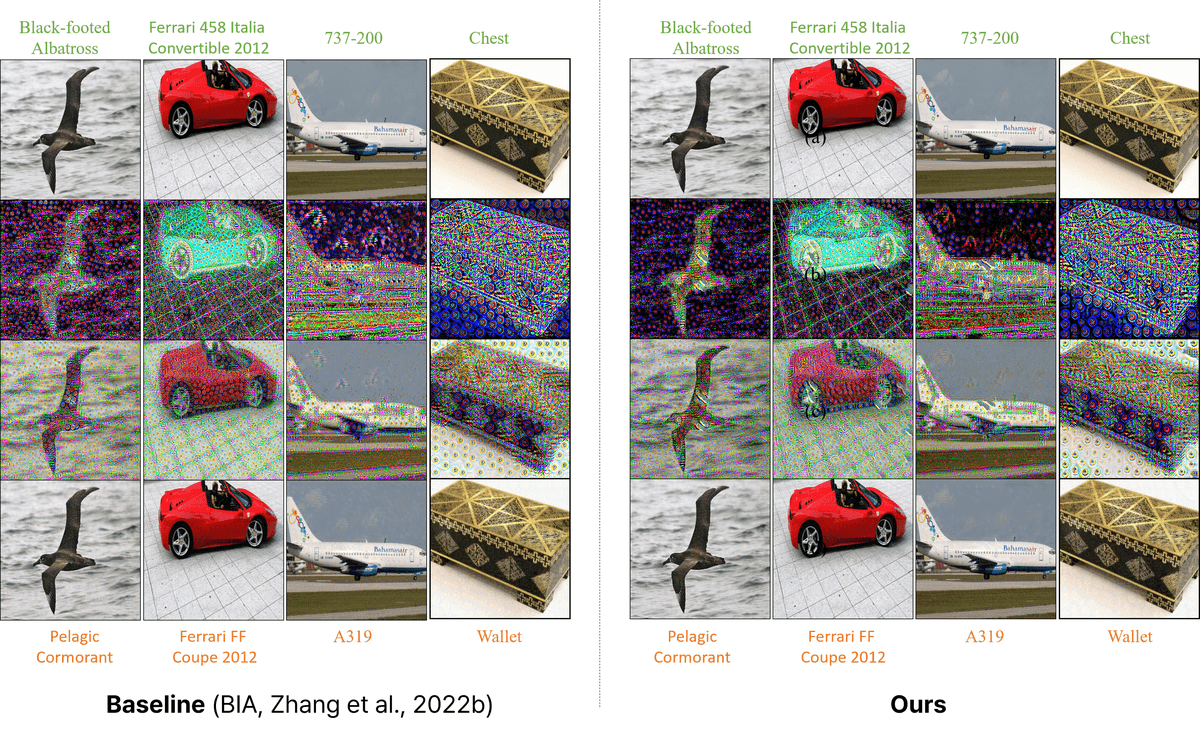
The authors ran a diagnostic: they split the generator into early, mid, and late blocks and measured how well each block's activations still aligned with the object in the input image. They quantified this as the standard deviation of foreground IoU between cluster-derived activation masks and foreground masks across generator blocks. The finding: attack methods whose generators kept a stable object focus across blocks produced adversarial examples that transferred better to unseen victim models.

In other words, if the generator's early layers lose track of where the object is, the perturbation ends up scattering energy into places that only fool the surrogate. Keep the object locked in early, and the noise stays in regions that matter to any classifier that recognizes that object, not just the one you trained against.
A mean teacher for the attacker
SCGA operationalizes that insight with a Mean Teacher setup borrowed from semi-supervised learning. It augments a standard generative adversarial attack with two key components: a Mean Teacher-based feature smoothing and a self-feature consistency loss that enforces semantic preservation across the intermediate layers of the generator. The student generator produces the actual perturbation, while an EMA-updated teacher copy provides a stable target for the student's early-block features to match.

A few design choices are worth calling out:
- The consistency loss is applied only to early generator blocks, so later blocks are free to spread the perturbation across background regions.
- The adversarial objective on the surrogate model is left unchanged, which is why SCGA slots into existing pipelines without rewrites.
- The teacher is training-only. At test time you run the student in a single forward pass, so there is no inference cost.
- An ablation with a U-Net generator instead of the ResNet-style default shows the mechanism is architecture-agnostic.
ACR: the metric nobody was tracking
The second contribution is diagnostic rather than algorithmic. Traditional attack metrics like Attack Success Rate and Fooling Rate only count cases where a correct prediction flips to incorrect. But perturbations sometimes flip incorrect predictions to correct ones by accident, which inflates apparent accuracy under attack and quietly biases benchmarks.
The authors introduce Accidental Correction Rate (ACR) to separate inadvertent corrections from intended misclassifications, complementing the inherent blind spots in traditional Attack Success Rate (ASR), Fooling Rate (FR), and Accuracy metrics. In their measurements, at a perturbation budget of epsilon = 4, ACR (incorrect flipping to correct) was 14 percent while ASR (correct flipping to incorrect) was 8 percent, meaning the attack net-improved model accuracy by 6 points on that slice. ACR also turns out to be non-monotonic, peaking at moderate budgets and falling as stronger noise overwhelms any corrective effect.
What the numbers show
SCGA is evaluated across classification on ImageNet-1K, CUB-200-2011, Stanford Cars, and FGVC Aircraft, plus dense prediction tasks (semantic segmentation and object detection). The team also tests against defenses including adversarially trained IncV3, ViT, and ConvNeXt models, plus input-processing defenses like JPEG compression, bit-depth reduction, random resizing and padding, and total variation minimization. Across architectures, domains, and tasks, the approach can be seamlessly integrated into existing generative attacks with consistent improvements in black-box transfer, while maintaining test-time efficiency.
Qualitatively, the SCGA-trained generator produces perturbations that concentrate on the salient object early on and then spread outward, which Grad-CAM visualizations confirm by showing the victim model's attention shifting to markedly different regions than either the clean image or the baseline attack. For segmentation, the effect is not subtle noise around edges but whole road surfaces and small objects like pedestrians being erased from the prediction. For detection, entire regions of interest disappear rather than shifting a few pixels.
When it matters
The practical takeaway is targeted at anyone who runs red-team evaluations against production computer vision systems. If you already use generative transfer attacks like BIA, CDA, LTP, or GAMA as part of a robustness benchmark, SCGA is a training-time modification that plugs into your existing generator and improves transfer without changing your deployment code. If you build defenses, the ACR metric is worth adopting: reporting only ASR against a stronger attacker may be systematically underestimating how much of your apparent robustness comes from accidental corrections at low perturbation budgets.
The limits are the usual ones for this line of work. SCGA is still an untargeted transfer method by default (the paper includes a targeted extension), it relies on a surrogate model whose features are informative enough to guide the generator, and the gains are consistent but incremental rather than order-of-magnitude. What it does change is the framing: generator internals are now a first-class knob for transferability, and that is a lever the community had largely ignored.